Cantares 7
King James Version + Apocrypha · Toca un versículo para ver sus referencias cruzadas.
Admiration by the Bridegroom
1How beautiful are thy feet with shoes, O prince’s daughter! the joints of thy thighs are like jewels, the work of the hands of a cunning workman. 2Thy navel is like a round goblet, which wanteth not liquor: thy belly is like an heap of wheat set about with lilies. 3Thy two breasts are like two young roes that are twins. 4Thy neck is as a tower of ivory; thine eyes like the fishpools in Heshbon, by the gate of Bath-rabbim: thy nose is as the tower of Lebanon which looketh toward Damascus. 5Thine head upon thee is like Carmel, and the hair of thine head like purple; the king is held in the galleries. 6How fair and how pleasant art thou, O love, for delights! 7This thy stature is like to a palm tree, and thy breasts to clusters of grapes. 8I said, I will go up to the palm tree, I will take hold of the boughs thereof: now also thy breasts shall be as clusters of the vine, and the smell of thy nose like apples; 9And the roof of thy mouth like the best wine for my beloved, that goeth down sweetly, causing the lips of those that are asleep to speak.
The Bride
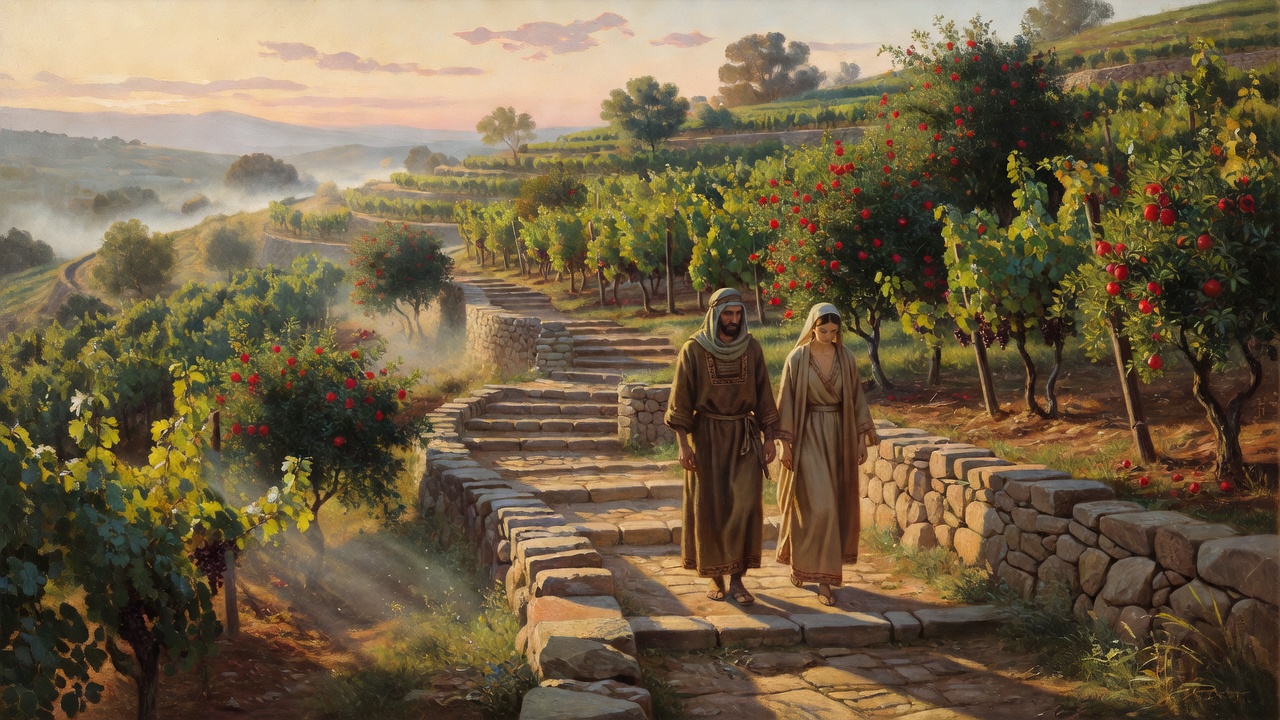
10¶ I am my beloved’s, and his desire is toward me. 11Come, my beloved, let us go forth into the field; let us lodge in the villages. 12Let us get up early to the vineyards; let us see if the vine flourish, whether the tender grape appear, and the pomegranates bud forth: there will I give thee my loves. 13The mandrakes give a smell, and at our gates are all manner of pleasant fruits, new and old, which I have laid up for thee, O my beloved.
¿Sabías que…?
Poesía de Amor y Paisaje
- El poema describe la belleza de la mujer utilizando destacados puntos geográficos de la región. Sus ojos son comparados con los estanques de Hesbón, cerca de la puerta de Bat-rabim al este del Jordán, mientras que su perfil se asemeja a una torre majestuosa en la cordillera del Líbano que mira hacia Damasco.Fuentes: el propio texto bíblico · Heshbon · Bath-rabbim · Lebanon
- El capítulo concluye con una invitación al campo durante el despertar de la primavera. Los amantes salen a observar los brotes de las vides, la floración de los granados y el aroma de las mandrágoras, reflejando la estrecha relación en la poesía hebrea antigua entre la intimidad romántica y la naturaleza.Fuentes: el propio texto bíblico
Notas escritas con ayuda de IA a partir de fuentes abiertas (Theographic Bible Metadata, CC BY-SA 4.0; Easton’s Bible Dictionary, dominio público) y revisadas antes de publicarse.
Lugares de este capítulo
- Bath-rabbim · Hoy: in Tell Hesban · 31.801, 35.809 · versículo 4
- Damascus · 33.511, 36.306 · versículo 4
- Lebanon · 33.540, 35.584 · versículo 4
- Mount Carmel · 32.672, 35.023 · versículo 5
Solo aparecen lugares identificados con alta confianza (90 % o más según las fuentes académicas reunidas por OpenBible). Mapa de la época: DARE (Digital Atlas of the Roman Empire), CC BY 4.0; mapa actual: © colaboradores de OpenStreetMap; lugares: OpenBible.info (CC BY 4.0).
Créditos y licencia de esta traducción
King James Version + Apocrypha
The King James Version or Authorized Version of the Holy Bible, using the standardized text of 1769, with Apocrypha/Deuterocanon
Public Domain
Language: English
Dialect: archaic British
Letters patent issued by King James with no expiration date means that to print this translation in the United Kingdom or import printed copies into the UK, you need permission. Currently, the Cambridge University Press, the Oxford University Press, and Collins have the exclusive right to print this Bible translation in the UK. This royal decree has no effect outside of the UK, where this work is firmly in the Public Domain. Please see http://www.cambridge.org/about-us/who-we-are/queens-printers-patent and https://en.wikipedia.org/wiki/King_James_Version#Copyright_status for more information.
This free text of the King James Version of the Holy Bible is brought to you courtesy of the Crosswire Bible Society and eBible.org .
2026-09-26
Títulos de sección adaptados de la Berean Standard Bible (dominio público); no forman parte del texto bíblico de esta traducción.
Fuente: http://ebible.org/eng-kjv/ · eBible.org