Cantares 6
American Standard Version (1901) · Toca un versículo para ver sus referencias cruzadas.
Together in the Garden
The Friends
1Whither is thy beloved gone,
O thou fairest among women?
Whither hath thy beloved turned him,
That we may seek him with thee?
The Bride
2My beloved is gone down to his garden,
To the beds of spices,
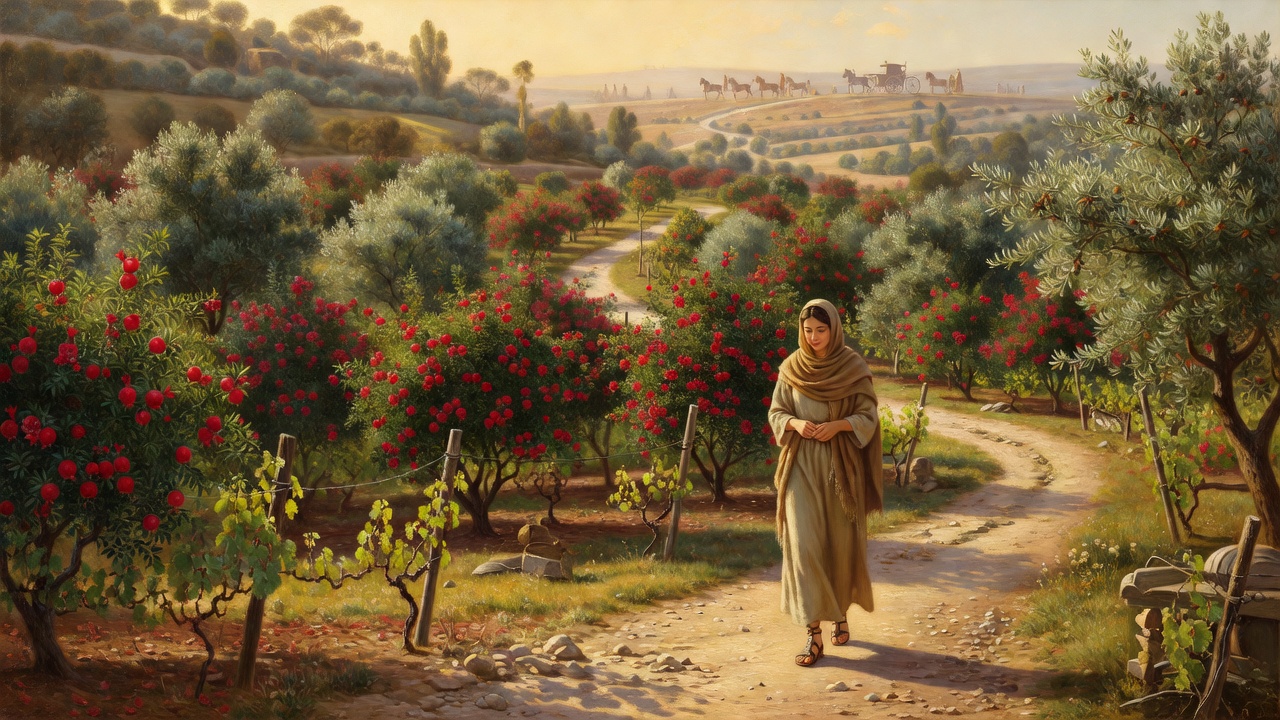
To feed in the gardens, and to gather lilies.
3I am my beloved’s, and my beloved is mine:
He feedeth his flock among the lilies.
The Bridegroom
4Thou art fair, O my love, as Tirzah,
Comely as Jerusalem,
Terrible as an army with banners.
5Turn away thine eyes from me,
For they have overcome me.
Thy hair is as a flock of goats,
That lie along the side of Gilead.
6Thy teeth are like a flock of ewes,
Which are come up from the washing;
Whereof every one hath twins,
And none is bereaved among them.
7Thy temples are like a piece of a pomegranate
Behind thy veil.
8There are threescore queens, and fourscore concubines,
And virgins without number.
9My dove, my undefiled, is but one;
She is the only one of her mother;
She is the choice one of her that bare her.
The daughters saw her, and called her blessed;
Yea, the queens and the concubines, and they praised her.
The Friends
10Who is she that looketh forth as the morning,
Fair as the moon,
Clear as the sun,
Terrible as an army with banners?
The Bridegroom
11I went down into the garden of nuts,
To see the green plants of the valley,
To see whether the vine budded,
And the pomegranates were in flower.
12Before I was aware, my soul set me
Among the chariots of my princely people.
The Friends
13Return, return, O Shulammite;
Return, return, that we may look upon thee.
Why will ye look upon the Shulammite,
As upon the dance of Mahanaim?
¿Sabías que…?
Belleza y Esplendor Real
- El poema elogia la belleza de la mujer comparándola con Tirsa y Jerusalén, dos destacados centros reales. Tirsa fue una antigua ciudad cananea célebre por su encanto que más tarde sirvió como una de las primeras capitales del reino del norte de Israel, mientras que Jerusalén se alzaba como la capital montañosa de Judá.Fuentes: Tirzah · Jerusalem · el propio texto bíblico
- La descripción del cabello que desciende como un rebaño de cabras de Galaad evoca el territorio montañoso al este del río Jordán, donde los rebaños pastaban por laderas escarpadas.Fuentes: Gilead · el propio texto bíblico
Notas escritas con ayuda de IA a partir de fuentes abiertas (Theographic Bible Metadata, CC BY-SA 4.0; Easton’s Bible Dictionary, dominio público) y revisadas antes de publicarse.
Lugares de este capítulo
Solo aparecen lugares identificados con alta confianza (90 % o más según las fuentes académicas reunidas por OpenBible). Mapa de la época: DARE (Digital Atlas of the Roman Empire), CC BY 4.0; mapa actual: © colaboradores de OpenStreetMap; lugares: OpenBible.info (CC BY 4.0).
Créditos y licencia de esta traducción
American Standard Version (1901)
The American Standard Version of the Holy Bible, first published in 1901.
Public Domain
Language: English
Dialect: Archaic American
This public domain Bible translation is brought to you courtesy of eBible.org.
If you would like to make a donation to help keep free Bible access like this going, please visit https://eBible.org/give.php .
2026-10-02
Títulos de sección adaptados de la Berean Standard Bible (dominio público); no forman parte del texto bíblico de esta traducción.
Fuente: http://ebible.org/eng-asv/ · eBible.org