Cantares 2
American Standard Version (1901) · Toca un versículo para ver sus referencias cruzadas.
The Bride’s Admiration
The Bride
1I am a rose of Sharon,
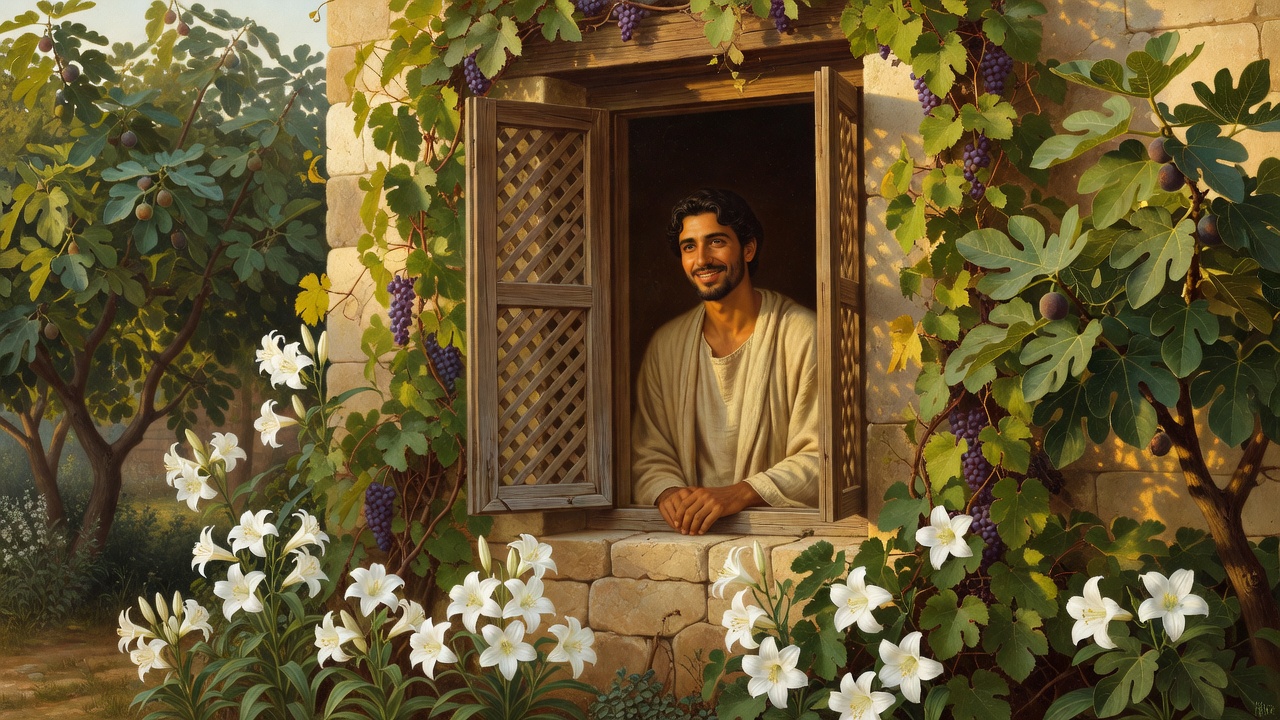
A lily of the valleys.
The Bridegroom
2As a lily among thorns,
So is my love among the daughters.
The Bride
3As the apple-tree among the trees of the wood,
So is my beloved among the sons.
I sat down under his shadow with great delight,
And his fruit was sweet to my taste.
4He brought me to the banqueting-house,
And his banner over me was love.
5Stay ye me with raisins, refresh me with apples;
For I am sick from love.
6His left hand is under my head,
And his right hand doth embrace me.
7I adjure you, O daughters of Jerusalem,
By the roes, or by the hinds of the field,
That ye stir not up, nor awake my love,
Until he please.
8The voice of my beloved! behold, he cometh,
Leaping upon the mountains,
Skipping upon the hills.
9My beloved is like a roe or a young hart:
Behold, he standeth behind our wall;
He looketh in at the windows;
He glanceth through the lattice.
10My beloved spake, and said unto me,
Rise up, my love, my fair one, and come away.
11For, lo, the winter is past;
The rain is over and gone;
12The flowers appear on the earth;
The time of the singing of birds is come,
And the voice of the turtle-dove is heard in our land;
13The fig-tree ripeneth her green figs,
And the vines are in blossom;
They give forth their fragrance.
Arise, my love, my fair one, and come away.
The Bridegroom
14O my dove, that art in the clefts of the rock,
In the covert of the steep place,
Let me see thy countenance,
Let me hear thy voice;
For sweet is thy voice, and thy countenance is comely.
The Friends
15Take us the foxes, the little foxes,
That spoil the vineyards;
For our vineyards are in blossom.
The Bride
16My beloved is mine, and I am his:
He feedeth his flock among the lilies.
17Until the day be cool, and the shadows flee away,
Turn, my beloved, and be thou like a roe or a young hart
Upon the mountains of Bether.
¿Sabías que…?
La Primavera y el Despertar del Amor
- Sarón era una fértil llanura costera que se extendía entre el mar Mediterráneo y las colinas al oeste de Jerusalén, célebre por su belleza y vegetación, lo que dio origen a metáforas como la rosa de Sarón.Fuentes: Saron · el propio texto bíblico
- El poema describe la llegada de la primavera mediante señales campestres, tales como el cese de las lluvias invernales, el arrullo de las tórtolas, los higos que maduran y las viñas en flor que debían cuidarse de los zorros.Fuentes: el propio texto bíblico
- La mujer apela repetidamente a las hijas de Jerusalén, formulando sus advertencias sobre el amor a través de figuras de la fauna silvestre, como gacelas y ciervas del campo.Fuentes: Jerusalem · el propio texto bíblico
Notas escritas con ayuda de IA a partir de fuentes abiertas (Theographic Bible Metadata, CC BY-SA 4.0; Easton’s Bible Dictionary, dominio público) y revisadas antes de publicarse.
Lugares de este capítulo
Solo aparecen lugares identificados con alta confianza (90 % o más según las fuentes académicas reunidas por OpenBible). Mapa de la época: DARE (Digital Atlas of the Roman Empire), CC BY 4.0; mapa actual: © colaboradores de OpenStreetMap; lugares: OpenBible.info (CC BY 4.0).
Créditos y licencia de esta traducción
American Standard Version (1901)
The American Standard Version of the Holy Bible, first published in 1901.
Public Domain
Language: English
Dialect: Archaic American
This public domain Bible translation is brought to you courtesy of eBible.org.
If you would like to make a donation to help keep free Bible access like this going, please visit https://eBible.org/give.php .
2026-10-02
Títulos de sección adaptados de la Berean Standard Bible (dominio público); no forman parte del texto bíblico de esta traducción.
Fuente: http://ebible.org/eng-asv/ · eBible.org