Lamentaciones 4
American Standard Version (1901) · Toca un versículo para ver sus referencias cruzadas.
The Distress of Zion
1How is the gold become dim! how is the most pure gold changed!
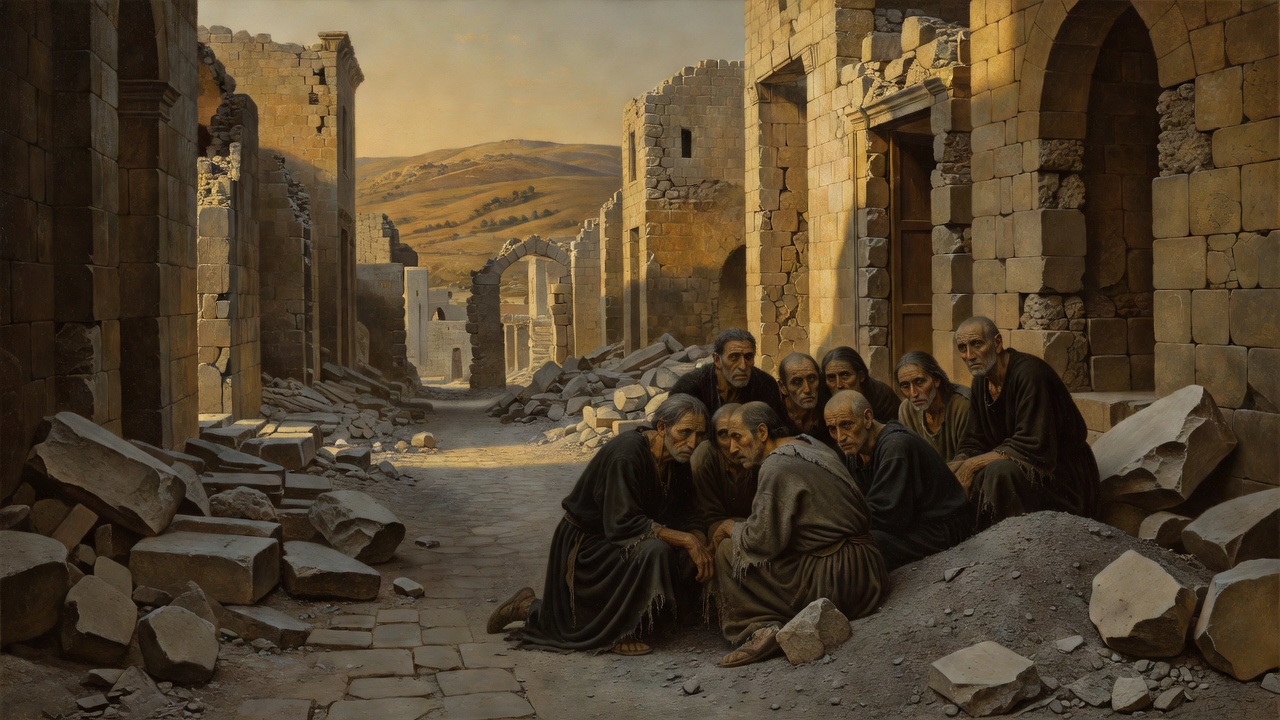
The stones of the sanctuary are poured out at the head of every street.
2The precious sons of Zion, comparable to fine gold,
How are they esteemed as earthen pitchers, the work of the hands of the potter!
3Even the jackals draw out the breast, they give suck to their young ones:
The daughter of my people is become cruel, like the ostriches in the wilderness.
4The tongue of the sucking child cleaveth to the roof of his mouth for thirst:
The young children ask bread, and no man breaketh it unto them.
5They that did feed delicately are desolate in the streets:
They that were brought up in scarlet embrace dunghills.
6For the iniquity of the daughter of my people is greater than the sin of Sodom,
That was overthrown as in a moment, and no hands were laid upon her.
7Her nobles were purer than snow, they were whiter than milk;
They were more ruddy in body than rubies, their polishing was as of sapphire.
8Their visage is blacker than a coal; they are not known in the streets:
Their skin cleaveth to their bones; it is withered, it is become like a stick.
9They that are slain with the sword are better than they that are slain with hunger;
For these pine away, stricken through, for want of the fruits of the field.
10The hands of the pitiful women have boiled their own children;
They were their food in the destruction of the daughter of my people.
11Jehovah hath accomplished his wrath, he hath poured out his fierce anger;
And he hath kindled a fire in Zion, which hath devoured the foundations thereof.
12The kings of the earth believed not, neither all the inhabitants of the world,
That the adversary and the enemy would enter into the gates of Jerusalem.
13It is because of the sins of her prophets, and the iniquities of her priests,
That have shed the blood of the just in the midst of her.
14They wander as blind men in the streets, they are polluted with blood,
So that men cannot touch their garments.
15Depart ye, they cried unto them, Unclean! depart, depart, touch not!
When they fled away and wandered, men said among the nations, They shall no more sojourn here.
16The anger of Jehovah hath scattered them; he will no more regard them:
They respected not the persons of the priests, they favored not the elders.
17Our eyes do yet fail in looking for our vain help:
In our watching we have watched for a nation that could not save.
18They hunt our steps, so that we cannot go in our streets:
Our end is near, our days are fulfilled; for our end is come.
19Our pursuers were swifter than the eagles of the heavens:
They chased us upon the mountains, they laid wait for us in the wilderness.
20The breath of our nostrils, the anointed of Jehovah, was taken in their pits;
Of whom we said, Under his shadow we shall live among the nations.
21Rejoice and be glad, O daughter of Edom, that dwellest in the land of Uz:
The cup shall pass through unto thee also; thou shalt be drunken, and shalt make thyself naked.
22The punishment of thine iniquity is accomplished, O daughter of Zion; he will no more carry thee away into captivity:
He will visit thine iniquity, O daughter of Edom; he will uncover thy sins.
¿Sabías que…?
La Agonía de la Ciudad Caída
- El poeta considera que el prolongado sufrimiento de Jerusalén fue peor que el destino de Sodoma. Mientras que Sodoma fue destruida en un instante por fuego divino, los habitantes de Jerusalén soportaron el tormento lento y desgarrador del asedio y la hambruna.Fuentes: el propio texto bíblico · Sodom
- Antes de su caída, Jerusalén era considerada en gran medida como una ciudad montañosa impenetrable. El texto señala que los reyes extranjeros y las naciones vecinas nunca creyeron que un enemigo pudiera traspasar sus puertas fortificadas.Fuentes: el propio texto bíblico · Jerusalem
- El capítulo concluye dirigiéndose a Edom, que habitaba en la tierra de Uz, advirtiendo que el juicio pronto la alcanzaría a ella también. La tierra de Uz se menciona únicamente en tres libros bíblicos: Job, Jeremías y Lamentaciones.Fuentes: el propio texto bíblico · Uz · Edom
Notas escritas con ayuda de IA a partir de fuentes abiertas (Theographic Bible Metadata, CC BY-SA 4.0; Easton’s Bible Dictionary, dominio público) y revisadas antes de publicarse.
Lugares de este capítulo
- Zion · Hoy: Jerusalem · 31.777, 35.234 · versículos 2, 11, 22
- Jerusalem · 31.777, 35.234 · versículo 12
- Edom · 30.746, 35.604 · versículos 21, 22
Solo aparecen lugares identificados con alta confianza (90 % o más según las fuentes académicas reunidas por OpenBible). Mapa de la época: DARE (Digital Atlas of the Roman Empire), CC BY 4.0; mapa actual: © colaboradores de OpenStreetMap; lugares: OpenBible.info (CC BY 4.0).
Créditos y licencia de esta traducción
American Standard Version (1901)
The American Standard Version of the Holy Bible, first published in 1901.
Public Domain
Language: English
Dialect: Archaic American
This public domain Bible translation is brought to you courtesy of eBible.org.
If you would like to make a donation to help keep free Bible access like this going, please visit https://eBible.org/give.php .
2026-10-02
Títulos de sección adaptados de la Berean Standard Bible (dominio público); no forman parte del texto bíblico de esta traducción.
Fuente: http://ebible.org/eng-asv/ · eBible.org