Génesis 25
Brenton Septuagint Translation · Toca un versículo para ver sus referencias cruzadas.
Abraham and Keturah
1And Abraam again took a wife, whose name was Chettura. 2And she bore to him Zombran, and Jezan, and Madal, and Madiam, and Jesboc, and Soie. 3And Jezan begot Saba and Dedan. And the sons of Dedan were the Assurians and the Latusians, and Laomim. 4And the sons of Madiam were Gephar and Aphir, and Enoch, and Abeida, and Eldaga; all these were sons of Chettura. 5But Abraam gave all his possessions to Isaac his son. 6But to the sons of his concubines Abraam gave gifts, and he sent them away from his son Isaac, while he was yet living, to the east into the country of the east.
The Death of Abraham
7And these were the years of the days of the life of Abraam as many as he lived, a hundred and seventy-five years. 8And Abraam failing died in a good old age, an old man and full of days, and was added to his people. 9And Isaac and Ismael his sons buried him in the double cave, in the field of Ephron the son of Saar the Chettite, which is over against Mambre: 10even the field and the cave which Abraam bought of the sons of Chet; there they buried Abraam and Sarrha his wife. 11And it came to pass after Abraam was dead, that God blessed Isaac his son, and Isaac dwelt by the well of the vision.
The Descendants of Ishmael
12And these are the generations of Ismael the son of Abraam, whom Agar the Egyptian the hand-maid of Sarrha bore to Abraam. 13And these are the names of the sons of Ismael, according to the names of their generations. The firstborn of Ismael, Nabaioth, and Kedar, and Nabdeel, and Massam, 14and Masma, and Duma, and Masse, 15and Choddan, and Thæman, and Jetur, and Naphes, and Kedma. 16These are the sons of Ismael, and these are their names in their tents and in their dwellings, twelve princes according to their nations. 17And these are the years of the life of Ismael, a hundred and thirty-seven years; and he failed and died, and was added to his fathers. 18And he dwelt from Evilat to Sur, which is opposite Egypt, until one comes to the Assyrians; he dwelt in the presence of all his brethren.
Jacob and Esau
19And these are the generations of Isaac the son of Abraam. 20Abraam begot Isaac. And Isaac was forty years old when he took to wife Rebecca, daughter of Bathuel the Syrian, out of Syrian Mesopotamia, sister of Laban the Syrian. 21And Isaac prayed the Lord concerning Rebecca his wife, because she was barren; and the Lord heard him, and his wife Rebecca conceived in her womb. 22And the babes leaped within her; and she said, If it will be so with me, why is this to me? And she went to enquire of the Lord. 23And the Lord said to her, There are two nations in thy womb, and two peoples shall be separated from thy belly, and one people shall excel the other, and the elder shall serve the younger. 24And the days were fulfilled that she should be delivered, and she had twins in her womb. 25And the first came out red, hairy all over like a skin; and she called his name Esau. 26And after this came forth his brother, and his hand took hold of the heel of Esau; and she called his name Jacob. And Isaac was sixty years old when Rebecca bore them. 27And the lads grew, and Esau was a man skilled in hunting, dwelling in the country, and Jacob a simple man, dwelling in a house. 28And Isaac loved Esau, because his venison was his food, but Rebecca loved Jacob.
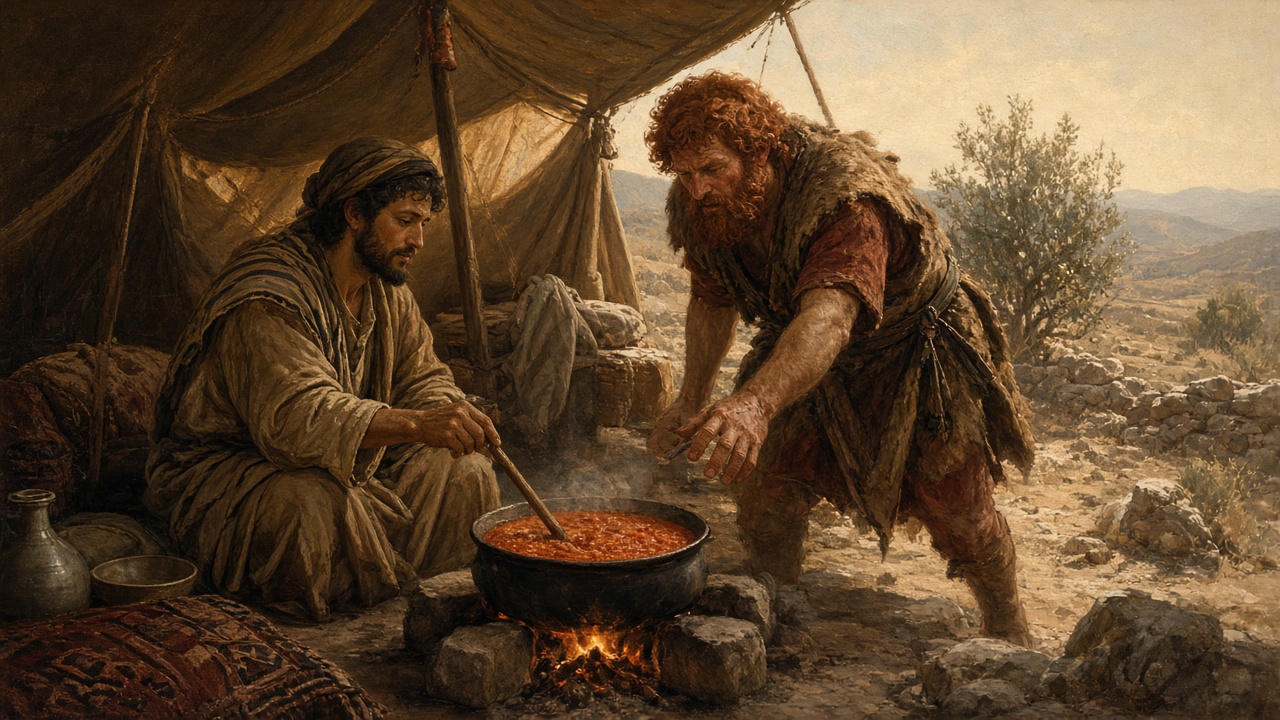
Esau Sells His Birthright
29And Jacob cooked pottage, and Esau came from the plain, fainting. 30And Esau said to Jacob, Let me taste of that red pottage, because I am fainting; therefore his name was called Edom. 31And Jacob said to Esau, Sell me this day thy birthright. 32And Esau said, Behold, I am going to die, and for what good does this birthright belong to me? 33And Jacob said to him, Swear to me this day; and he swore to him; and Esau sold his birthright to Jacob. 34And Jacob gave bread to Esau, and pottage of lentiles; and he ate and drank, and he arose and departed; so Esau slighted his birthright.
¿Sabías que…?
Los herederos de Abraham y los hermanos gemelos
- Cetura, cuyo nombre el Easton's Bible Dictionary (1897) explica como “incienso”, aparece aquí como otra esposa de Abraham. Ese diccionario dice que probablemente se casó con ella después de la muerte de Sara, aunque se desconoce su nacionalidad, y señala que 1 Crónicas la llama concubina. Ella le dio seis hijos, entre ellos Jocsán y Madián, padre de los madianitas; mientras Abraham aún vivía, dio regalos a los hijos de sus concubinas y los alejó de Isaac, enviándolos a la tierra de oriente.Fuentes: Keturah · Midian · el propio texto bíblico
- Isaac e Ismael juntos enterraron a Abraham en la cueva de Macpela, cerca de Mamre, en el campo que Abraham había comprado a Efrón el hitita, donde Sara ya había sido enterrada. El Easton's Bible Dictionary (1897) explica Macpela como “porción” o “cueva doble”, situada en la ladera de un monte al este de Hebrón y frente a Mamre, un lugar llamado las encinas —o, en un margen, los terebintos— de Mamre.Fuentes: Machpelah · Mamre · el propio texto bíblico
- Esaú, el gemelo primogénito de Rebeca, nació rojizo y cubierto de pelo como un abrigo de piel. El Easton's Bible Dictionary (1897) vincula el otro nombre, Edom, “rojo”, con el guiso rojo de lentejas por el que vendió el derecho de primogenitura, y explica a Jacob como “el que sigue los talones de otro” o “suplantador”, en consonancia con el relato de que Jacob nació agarrado al talón de Esaú. Esaú creció como un cazador hábil y hombre del campo, mientras que Jacob era un hombre tranquilo que se quedaba en casa.Fuentes: Esau (Edom) · Jacob (Israel) · el propio texto bíblico
Notas escritas con ayuda de IA a partir de fuentes abiertas (Theographic Bible Metadata, CC BY-SA 4.0; Easton’s Bible Dictionary, dominio público) y revisadas antes de publicarse.
Lugares de este capítulo
- East · Hoy: region around Amman · 31.955, 35.934 · versículo 6
- Machpelah · Hoy: Cave of the Patriarchs · 31.525, 35.111 · versículo 9
- Negeb · 31.245, 34.841 · versículo 11
- Assyria · 36.359, 43.153 · versículo 18
- Egypt · 30.129, 31.308 · versículo 18
Solo aparecen lugares identificados con alta confianza (90 % o más según las fuentes académicas reunidas por OpenBible). Mapa de la época: DARE (Digital Atlas of the Roman Empire), CC BY 4.0; mapa actual: © colaboradores de OpenStreetMap; lugares: OpenBible.info (CC BY 4.0).
Créditos y licencia de esta traducción
Translation of the Greek Septuagint into English by Sir Lancelot Charles Lee Brenton
Published in 1851, and now in the Public Domain.
If you find errors in the text, please report them so that we can correct them.
Títulos de sección adaptados de la Berean Standard Bible (dominio público); no forman parte del texto bíblico de esta traducción.
Fuente: http://ebible.org/eng-Brenton/ · eBible.org