Génesis 2
Brenton Septuagint Translation · Toca un versículo para ver sus referencias cruzadas.
The Seventh Day
1And the heavens and the earth were finished, and the whole world of them.
2And God finished on the sixth day his works which he made, and he ceased on the seventh day from all his works which he made. 3And God blessed the seventh day and sanctified it, because in it he ceased from all his works which God began to do.
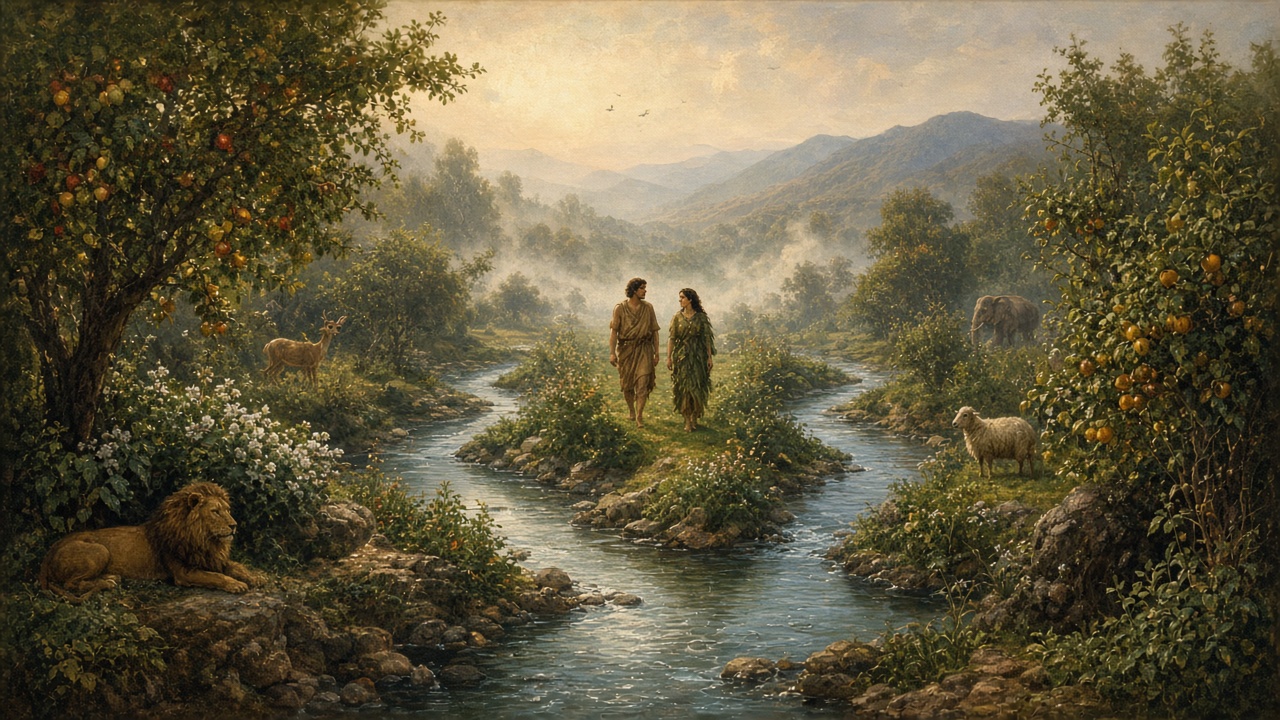
Man and Woman in the Garden
4This is the book of the generation of heaven and earth, when they were made, in the day in which the Lord God made the heaven and the earth, 5and every herb of the field before it was on the earth, and all the grass of the field before it sprang up, for God had not rained on the earth, and there was not a man to cultivate it. 6But there rose a fountain out of the earth, and watered the whole face of the earth. 7And God formed the man of dust of the earth, and breathed upon his face the breath of life, and the man became a living soul.
8And God planted a garden eastward in Edem, and placed there the man whom he had formed. 9And God made to spring up also out of the earth every tree beautiful to the eye and good for food, and the tree of life in the midst of the garden, and the tree of learning the knowledge of good and evil. 10And a river proceeds out of Edem to water the garden, thence it divides itself into four heads. 11The name of the one, Phisom, this it is which encircles the whole land of Evilat, where there is gold. 12And the gold of that land is good, there also is carbuncle and emerald. 13And the name of the second river is Geon, this it is which encircles the whole land of Ethiopia. 14And the third river is Tigris, this is that which flows forth over against the Assyrians. And the fourth river is Euphrates. 15And the Lord God took the man whom he had formed, and placed him in the garden of Delight, to cultivate and keep it. 16And the Lord God gave a charge to Adam, saying, Of every tree which is in the garden thou mayest freely eat, 17but of the tree of the knowledge of good and evil—of it ye shall not eat, but in whatsoever day ye eat of it, ye shall surely die.
18And the Lord God said, It is not good that the man should be alone, let us make for him a help suitable to him. 19And God formed yet farther out of the earth all the wild beasts of the field, and all the birds of the sky, and he brought them to Adam, to see what he would call them, and whatever Adam called any living creature, that was the name of it. 20And Adam gave names to all the cattle and to all the birds of the sky, and to all the wild beasts of the field, but for Adam there was not found a help like to himself. 21And God brought a trance upon Adam, and he slept, and he took one of his ribs, and filled up the flesh instead thereof. 22And God formed the rib which he took from Adam into a woman, and brought her to Adam. 23And Adam said, This now is bone of my bones, and flesh of my flesh; she shall be called woman, because she was taken out of her husband. 24Therefore shall a man leave his father and his mother and shall cleave to his wife, and they two shall be one flesh. 25And the two were naked, both Adam and his wife, and were not ashamed.
¿Sabías que…?
Adán, el Edén y los cuatro ríos
- Adán, que significa “rojo”, es una palabra babilónica y el nombre común del ser humano, con el mismo sentido en hebreo y en asirio. Se le dio al primer hombre. Fue formado del polvo de la tierra —de ahí el nombre— y Dios sopló en sus narices el aliento de vida.Fuentes: Adam · el propio texto bíblico
- Un río salía del Edén y se dividía en cuatro brazos: el Pisón, el Gihón, el Hidekel y el Éufrates. Algunos identifican el Pisón con el Fasis o el Halis; otros, con el Indo, el Ganges u otros ríos más. El Gihón ha sido identificado con el Nilo, y otros lo consideran el Oxo, el Araxes o el Ganges. El Hidekel es el Tigris, llamado por los acadios el río de Idikla; Gesenius entendió el nombre como “el Tigris rápido”.Fuentes: el propio texto bíblico · Pison · Gihon · Hiddekel
- El sitio del Edén, el jardín en el que vivieron los primeros padres, se ha discutido más que casi cualquier otra cuestión geográfica. Se ha situado en Armenia, en la región al oeste del mar Caspio, en Media, cerca de Damasco, en Palestina, en el sur de Arabia y en Babilonia. El Easton's Bible Dictionary (1897) lo busca a lo largo del Tigris y del Éufrates del Asia occidental, en la tierra de Sinar, o Babilonia.Fuentes: Eden
Notas escritas con ayuda de IA a partir de fuentes abiertas (Theographic Bible Metadata, CC BY-SA 4.0; Easton’s Bible Dictionary, dominio público) y revisadas antes de publicarse.
Lugares de este capítulo
- Assyria · 36.359, 43.153 · versículo 14
- Euphrates · Hoy: Euphrates River · 31.004, 47.442 · versículo 14
- Tigris · Hoy: Tigris River · 31.004, 47.442 · versículo 14
Solo aparecen lugares identificados con alta confianza (90 % o más según las fuentes académicas reunidas por OpenBible). Mapa de la época: DARE (Digital Atlas of the Roman Empire), CC BY 4.0; mapa actual: © colaboradores de OpenStreetMap; lugares: OpenBible.info (CC BY 4.0).
Créditos y licencia de esta traducción
Translation of the Greek Septuagint into English by Sir Lancelot Charles Lee Brenton
Published in 1851, and now in the Public Domain.
If you find errors in the text, please report them so that we can correct them.
Títulos de sección adaptados de la Berean Standard Bible (dominio público); no forman parte del texto bíblico de esta traducción.
Fuente: http://ebible.org/eng-Brenton/ · eBible.org