Éxodo 2
Brenton Septuagint Translation · Toca un versículo para ver sus referencias cruzadas.
The Birth and Adoption of Moses
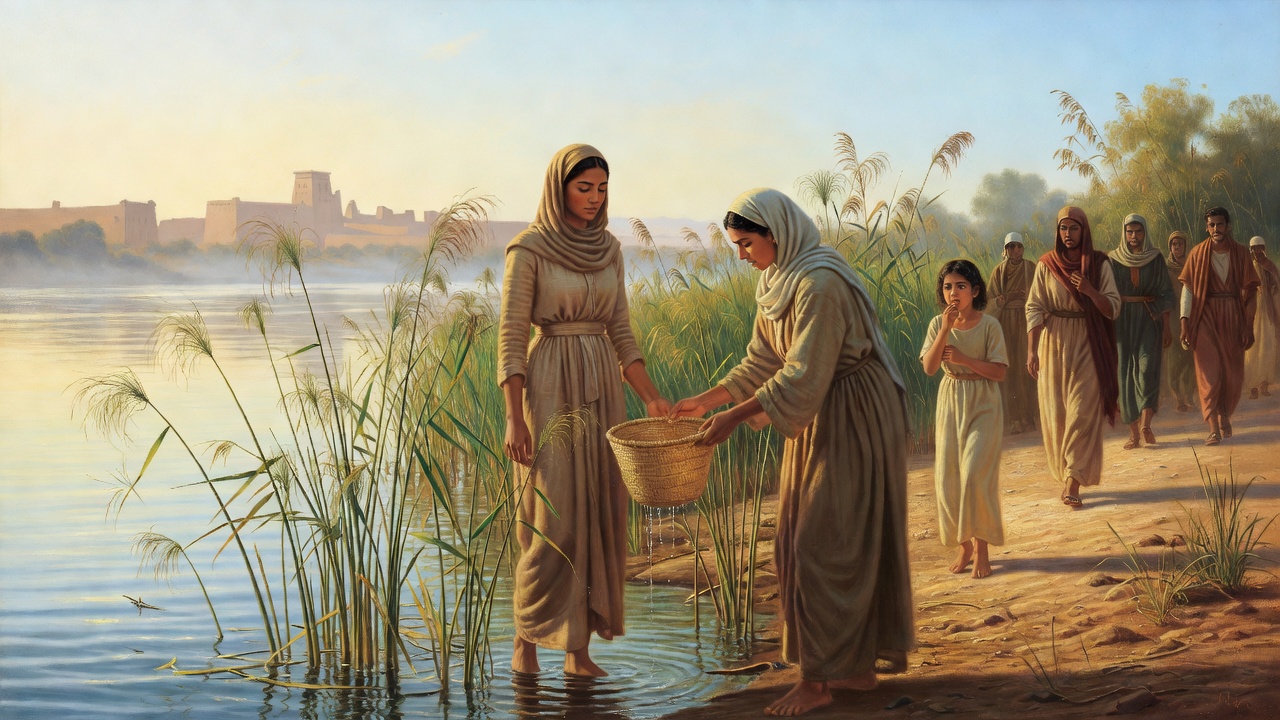
1And there was a certain man of the tribe of Levi, who took to wife one of the daughters of Levi. 2And she conceived, and bore a male child; and having seen that he was fair, they hid him three months. 3And when they could no longer hide him, his mother took for him an ark, and besmeared it with bitumen, and cast the child into it, and put it in the ooze by the river. 4And his sister was watching from a distance, to learn what would happen to him.
5And the daughter of Pharao came down to the river to bathe; and her maids walked by the river's side, and having seen the ark in the ooze, she sent her maid, and took it up. 6And having opened it, she sees the babe weeping in the ark: and the daughter of Pharao had compassion on it, and said, This is one of the Hebrews' children. 7And his sister said to the daughter of Pharao, Wilt thou that I call to thee a nurse of the Hebrews, and shall she suckle the child for thee? 8And the daughter of Pharao said, Go: and the young woman went, and called the mother of the child. 9And the daughter of Pharao said to her, Take care of this child, and suckle it for me, and I will give thee the wages; and the woman took the child, and suckled it. 10And when the boy was grown, she brought him to the daughter of Pharao, and he became her son; and she called his name, Moses, saying, I took him out of the water.
The Rejection and Flight of Moses
11And it came to pass in that length of time, that Moses having grown, went out to his brethren the sons of Israel: and having noticed their distress, he sees an Egyptian smiting a certain Hebrew of his brethren the children of Israel. 12And having looked round this way and that way, he sees no one; and he smote the Egyptian, and hid him in the sand. 13And having gone out the second day he sees two Hebrew men fighting; and he says to the injurer, Wherefore smitest thou thy neighbour? 14And he said, Who made thee a ruler and a judge over us? wilt thou slay me as thou yesterday slewest the Egyptian? Then Moses was alarmed, and said, If it be thus, this matter has become known. 15And Pharao heard this matter, and sought to slay Moses; and Moses departed from the presence of Pharao, and dwelt in the land of Madiam; and having come into the land of Madiam, he sat on the well. 16And the priest of Madiam had seven daughters, feeding the flock of their father Jothor; and they came and drew water until they filled their pitchers, to water the flock of their father Jothor. 17And the shepherds came, and were driving them away; and Moses rose up and rescued them, and drew water for them, and watered their sheep. 18And they came to Raguel their father; and he said to them, Why have ye come so quickly to-day? 19And they said, An Egyptian delivered us from the shepherds, and drew water for us and watered our sheep. 20And he said to his daughters, And where is he? and why have ye left the man? call him therefore, that he may eat bread. 21And Moses was established with the man, and he gave Sepphora his daughter to Moses to wife. 22And the woman conceived and bore a son, and Moses called his name Gersam, saying, I am a sojourner in a strange land.
God Hears the Cry of the Israelites
23And in those days after a length of time, the king of Egypt died; and the children of Israel groaned because of their tasks, and cried, and their cry because of their tasks went up to God. 24And God heard their groanings, and God remembered his covenant made with Abraam and Isaac and Jacob. 25And God looked upon the children of Israel, and was made known to them.
¿Sabías que…?
El nacimiento y la huida de Moisés
- La hija del faraón le puso al niño el nombre de Moisés y explicó que lo había sacado del agua. El Diccionario Bíblico de Easton (1897) relaciona su nombre con “sacado”, o con la palabra egipcia mesu, “hijo”, el elemento a partir del cual el diccionario también explica Ramsés como “hijo real”.Fuentes: el propio texto bíblico · Moses
- En Éxodo 2, una hija de Leví esconde a su hijo durante tres meses, y la hija del faraón, al hallarlo entre los juncos del Nilo, reconoce a un niño hebreo. El Diccionario Bíblico de Easton (1897) vincula la aflicción de los israelitas con “el nuevo rey que no conocía a José”, durante mucho tiempo tenido por Aahmes I, llamado Amosis por Josefo, aunque el diccionario, citando descubrimientos entonces recientes, lo identifica como Seti. Su penuria, dice la obra, comenzó después de que los hicsos, dueños de Egipto durante unos cinco siglos, fueron expulsados y se restauró la antigua dinastía.Fuentes: el propio texto bíblico · Pharaoh
- Después de que el faraón buscó matarlo, Moisés huyó a Madián y se sentó junto a un pozo; más tarde se casó con Séfora, una de las siete hijas del sacerdote de Madián. Los madianitas eran árabes nómadas, descendientes de Madián, el cuarto hijo de Abraham con Cetura, y apacentaban sus rebaños en la península del Sinaí y en el desierto al norte de la península arábiga. En este capítulo el sacerdote se llama Reuel, a quien el Diccionario Bíblico de Easton (1897) llama Raguel, y considera esa forma su nombre personal y a Jetro —“excelencia”— un título oficial, si es que ambos se identifican.Fuentes: el propio texto bíblico · Midian · Midian · Jethro
Notas escritas con ayuda de IA a partir de fuentes abiertas (Theographic Bible Metadata, CC BY-SA 4.0; Easton’s Bible Dictionary, dominio público) y revisadas antes de publicarse.
Lugares de este capítulo
- Nile · Hoy: Nile River · 31.465, 30.367 · versículos 3, 5
- Midian · 28.495, 35.012 · versículos 15, 16
- Egypt · 30.129, 31.308 · versículo 23
Solo aparecen lugares identificados con alta confianza (90 % o más según las fuentes académicas reunidas por OpenBible). Mapa de la época: DARE (Digital Atlas of the Roman Empire), CC BY 4.0; mapa actual: © colaboradores de OpenStreetMap; lugares: OpenBible.info (CC BY 4.0).
Créditos y licencia de esta traducción
Translation of the Greek Septuagint into English by Sir Lancelot Charles Lee Brenton
Published in 1851, and now in the Public Domain.
If you find errors in the text, please report them so that we can correct them.
Títulos de sección adaptados de la Berean Standard Bible (dominio público); no forman parte del texto bíblico de esta traducción.
Fuente: http://ebible.org/eng-Brenton/ · eBible.org