2 Samuel 11
Brenton Septuagint Translation · Toca un versículo para ver sus referencias cruzadas.
David and Bathsheba
1And it came to pass when the time of the year for kings going out to battle had come round, that David sent Joab, and his servants with him, and all Israel; and they destroyed the children of Ammon, and besieged Rabbath: but David remained at Jerusalem.
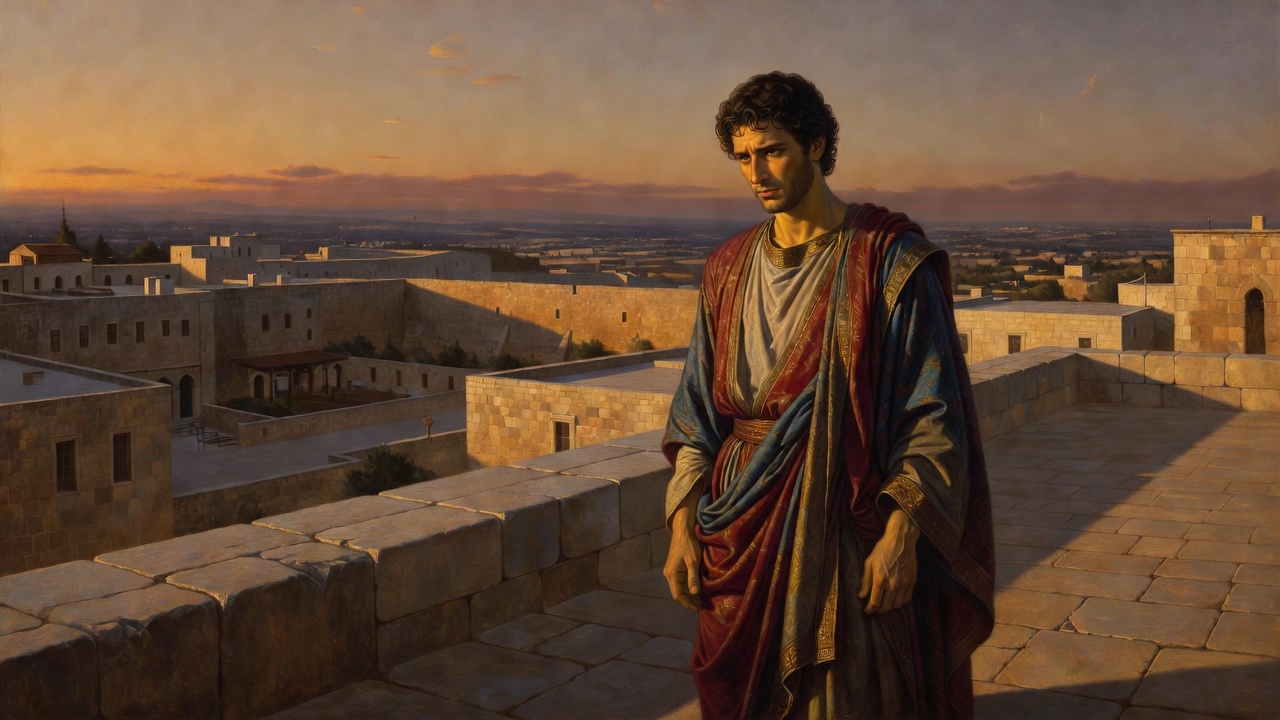
2And it came to pass toward evening, that David arose off his couch, and walked on the roof of the king's house, and saw from the roof a woman bathing; and the woman was very beautiful to look upon. 3And David sent and enquired about the woman: and one said, Is not this Bersabee the daughter of Eliab, the wife of Urias the Chettite?
4And David sent messengers, and took her, and went in to her, and he lay with her: and she was purified from her uncleanness, and returned to her house. 5And the woman conceived; and she sent and told David, and said, I am with child. 6And David sent to Joab, saying, Send me Urias the Chettite; and Joab sent Urias to David.
7And Urias arrived and went in to him, and David asked him how Joab was, and how the people were, and how the war went on. 8And David said to Urias, Go to thy house, and wash thy feet: and Urias departed from the house of the king, and a portion of meat from the king followed him. 9And Urias slept at the door of the king with the servants of his lord, and went not down to his house. 10And they brought David word, saying, Urias has not gone down to his house. And David said to Urias, Art thou not come from a journey? why hast thou not gone down to thy house? 11And Urias said to David, The ark, and Israel, and Juda dwell in tents; and my lord Joab, and the servants of my lord, are encamped in the open fields; and shall I go into my house to eat and drink, and lie with my wife? how should I do this? as thy soul lives, I will not do this thing. 12And David said to Urias, Remain here to-day also, and to-morrow I will let thee go. So Urias remained in Jerusalem that day and the day following.
13And David called him, and he ate before him and drank, and he made him drunk: and he went out in the evening to lie upon his bed with the servants of his lord, and went not down to his house.
David Arranges Uriah’s Death
14And the morning came, and David wrote a letter to Joab, and sent it by the hand of Urias. 15And he wrote in the letter, saying, Station Urias in front of the severe part of the fight, and retreat from behind him, so shall he be wounded and die.
16And it came to pass while Joab was watching against the city, that he set Urias in a place where he knew that valiant men were. 17And the men of the city went out, and fought with Joab: and some of the people of the servants of David fell, and Urias the Chettite died also.
18And Joab sent, and reported to David all the events of the war, so as to tell them to the king. 19And he charged the messenger, saying, When thou hast finished reporting all the events of the war to the king, 20then it shall come to pass if the anger of the king shall arise, and he shall say to thee, Why did ye draw nigh to the city to fight? knew ye not that they would shoot from off the wall? 21Who smote Abimelech the son of Jerobaal son of Ner? did not a woman cast a piece of a millstone upon him from above the wall, and he died in Thamasi? why did ye draw near to the wall? then thou shalt say, Thy servant Urias the Chettite is also dead.
22And the messenger of Joab went to the king to Jerusalem, and he came and reported to David all that Joab told him, all the affairs of the war. And David was very angry with Joab, and said to the messenger, Why did ye draw nigh to the wall to fight? knew ye not that ye would be wounded from off the wall? Who smote Abimelech the son of Jerobaal? did not a woman cast upon him a piece of millstone from the wall, and he died in Thamasi? why did ye draw near to the wall? 23And the messenger said to David, The men prevailed against us, and they came out against us into the field, and we came upon them even to the door of the gate. 24And the archers shot at thy servants from off the wall, and some of the king's servants died, and thy servant Urias the Chettite is dead also. 25And David said to the messenger, Thus shalt thou say to Joab, Let not the matter be grievous in thine eyes, for the sword devours one way at one time and another way at another: strengthen thine array against the city, and destroy it, and strengthen him.
David Marries Bathsheba
26And the wife of Urias heard that Urias her husband was dead, and she mourned for her husband. 27And the time of mourning expired, and David sent and took her into his house, and she became his wife, and bore him a son: but the thing which David did was evil in the eyes of the Lord.
¿Sabías que…?
David, Betsabé y Urías
- Urías es identificado como hitita y formaba parte del grupo de guerreros de élite de David, conocidos como los "valientes". Cuando fue llamado a Jerusalén desde el frente, se negó a disfrutar de la comodidad de su casa por solidaridad con sus compañeros y con el Arca del Pacto, que permanecían en tiendas en campo abierto.Fuentes: el propio texto bíblico · Uriah
- El asedio a Rabá, la ciudad principal de los amonitas al este del río Jordán, sirve de trasfondo para este capítulo. Aunque la primavera era la época acostumbrada en que los reyes salían a combatir, David se quedó en Jerusalén y encomendó la campaña militar a su comandante Joab.Fuentes: el propio texto bíblico · Rabbah · Joab
- Al instruir a su mensajero sobre las bajas ocurridas junto al muro de la ciudad, Joab recordó el precedente militar de la muerte de Abimélec en Tebes, donde una mujer lo mató arrojando una piedra de molino desde la muralla. El texto bíblico menciona al padre de Abimélec, Gedeón, con el nombre de Jerubeset.Fuentes: el propio texto bíblico · Jerubbesheth · Thebez
Notas escritas con ayuda de IA a partir de fuentes abiertas (Theographic Bible Metadata, CC BY-SA 4.0; Easton’s Bible Dictionary, dominio público) y revisadas antes de publicarse.
Lugares de este capítulo
- Ammon · 31.955, 35.934 · versículo 1
- Jerusalem · 31.777, 35.234 · versículos 1, 12, 22
- Rabbah · Hoy: Amman · 31.955, 35.934 · versículo 1
Solo aparecen lugares identificados con alta confianza (90 % o más según las fuentes académicas reunidas por OpenBible). Mapa de la época: DARE (Digital Atlas of the Roman Empire), CC BY 4.0; mapa actual: © colaboradores de OpenStreetMap; lugares: OpenBible.info (CC BY 4.0).
Créditos y licencia de esta traducción
Translation of the Greek Septuagint into English by Sir Lancelot Charles Lee Brenton
Published in 1851, and now in the Public Domain.
If you find errors in the text, please report them so that we can correct them.
Títulos de sección adaptados de la Berean Standard Bible (dominio público); no forman parte del texto bíblico de esta traducción.
Fuente: http://ebible.org/eng-Brenton/ · eBible.org