Génesis 44
Ekajuk Scriptures Bible Portions · Toca un versículo para ver sus referencias cruzadas.
Ebtuku Josef go atahng ebam ji Benjamin
1Josef kehm kake ntubesi alokeltum etahk ewe elle re <<Kak nsol alehke go abam ane baa, ana bo bahke ma sol, wo feere a akpohko asilva nya nne awohng awohng kak go ege nnyo ebam, 2wo kak ebtuku ebame, ebtuku asilva go nnyo ebam mi nkalla. Tob kak akpohko asilva nya á ko gunu nsol alehke go ege ebam.>> Ano wo á limi no ana Josef tong-e no. 3Re efungfu se, bo song tv bo re bo song a ebvankang ebo. 4Jol eji bo lohngo ejahbe jio bo gaam jen fee, Josef tongo ntubesia nlokeltum ewe re, <<Song toono ane baa anv anv, a lˈkpiri bo, tong bo re, <Jenji wahnge ḿ ma ko ebi, feere a nnoobo? 5Ebtuku asilva bia sang nsoo ewame kpo ko jo wo, fere jo bu elbua? Esab sab ejum ji ḿ ma lim.>>> 6Eji á song kpiri bo, alum nyanehm o nya á tongo bo. 7Bo kehm-e faange re, <<Jenji wahnge nsoo kpˈbungu elkohn ejum ana jia? Ndan gbaa re wahr alokeltum eba lim elkohn ejum ana jia! 8Kehn wahr lˈlohng go ndi a Kenan feere a akpohko silva ba ka-a nya e nyehne egahra abam. Jenji wahnge wahr bahke kehm vohko silva afii agul etahk nso? 9Lˈfere jol re nlokeltum ewa awohng awohng noa no bo bahke nyehne go ege, nong á kpo; wahr egom jehka bahke jolo alokeltum ba nsoo.>> 10<<Á kehm bungu re ebnob sehng, <<Nong jol ana a ma bung. Nne no bo lˈnyehn go ege ye wo bahke jolo nju enyame; wahn egom jehko ń nehm kpe li ebi.>> 11Bo nne awohng awohng foomo radde abam eje bum ndi fere fange anyo abam. 12Owo ntubesi alokeltum kehm kehme elfeede, bomo goji nnenkul abo tete ba rehng eji nkalla. Etuku bio bo nyehne go ebam ji Benjamin. 13Eji jolo ano bo kehm, yare abomo ebo. Owo bo kehm feere a nsol gbade ebvankang, fere feere go ejahbe. 14Ngare nyio Josef noa kpake li etahk, Juda a abonanyehn kehm ba gbo noongo go ege alata. 15Josef tongo bo re, <<Jen ji wahnge ḿ ma lim ana? Ń nehme kahn re nne ana me bahke ma seb ejum kahn go elbua?>> 16Juda kehm faange re, <<Jenjii e bahke tongo nsoo ewame? Jenji e bahke bungu? Anv e bahke tibi renan re wahr nehme kahn? Esowo eblennge abˈbi nya alokeltum eba, anv a wahr aju nya nsoo nya, wahr fono antahng a nne no bo nyehne nkob ege ebam.>> 17Owo Josef kehm bungu re, <<Ndan gbaa re, me n lim elkohn ejum ana jio! Nne no bo nyehne ebtuku go ege wo wo bahke jolo nju enyame, egom jehko feeren song tob nso ewahne go elkoono.>>
Juda gboongo ka Benjamin
18Owo Juda kehm song kpir-e fere tong-e re, <<Ntubesi ewame, nong nlokeltum ewa fil-a ndon. Nong me nlokeltum ewa bung moblum, Atahng ki-a rahk tob nlokeltum ewa, n kpˈkahne re, a li jang jang ana yefono Fero. 19Wo, ntubesi bahbe nlokeltum ewe re a kpˈkpi ndea afii mmonannyehn?> 20E faange re, <E kpˈkpi nde, yebkul, mmon no nse no nlum noa no bo jele ka-e, eji á ma kul, mmonannyehn noko ebkpo, ye ntahng ntahng wo ma sa go mmon a nnenkal noo. Á kpo kor nsoo sehng.> 21<A tongo nlokeltum ewa re, <<Ko-e ba, eji me n lˈnyehn-e antahng.>> 22E tongo ntubesi ewame re <<mmonse nnenlum noo nehm ma tahm nde sa; á lˈtahm-e sa, nde bahke kpoko.>> 23Wo a tongo nlokeltum ewa re, <Tohko tiki jol re, nkalla toon-n ba a, ń nehm kpe tiki nyehn esamahr ebame.> 24Eji e feere no kehnge goji nlokeltum ewa no li nsoo, e song tong-e ji ntubesi tong-r no. 25<<Owo nsoo ewahre kehm-r tongo re, <Songen wahn kpe song gunu abon nsol alehke.> 26Wo wahr tong-e re <<Wahr nehm feere je o, sehngem re no nkalla mmonnannee ewahre toon-r na, owo e bahke jeke. E nehm ma nyehn esamahr nne noo, tohko jol re nkalla mmonannee ewahre jolo anahre o.> 27<<Nlokeltum ewa nsoo ewame tong-r re, <Ń kpˈ kahne re, nkal ewame jele abon ba nlum abal ka-m. 28Awohng tahm-m a sa, n bungu re <<Etingitingi bo me-e jaake arohko arohko,>> We n nehme kpe tiki nyehn. 29Á lˈkpe rod noa tahm-m sa, ejum lˈlim-e, a bahke rodo esi abi ejame yel go elahm ndon ndon. 30Elkpin nsoo li are bob kpennge atem a elkpin monse nlum noa. Anv mmonse nlum noa tohko jol anahre, n lˈfeere goji nlokeltum ewa no li nsoo, 31a lˈnyehn re, mmonse nlum noa lim anahre, á bahke kpoko, alokeltum eba bahke rodo esi abi nsoo ewahre song kak elahm ndon ndon. 32Me nlokeltum ewa ko mmonse nlum go nkpaneka re m bahk-e kpuru ka nsoo ewahme. N tongo nsoo re, n tohk-e ko feere a ne ba ka-a, me wo bahke lehke ebi go ega esamahr, elkpin ename kpee. 33<<Anv titi nong me nlokeltum ewa sa a ana njua nsoo, go esi mmonse nlum noa, nong mmonse nlum toono abonanyehn song. 34M bahke limi renan kehm tahme kehnge goji nsoo ewame, mmonse nlum noa tohko jol aname? E,ee! Ka nongo me n nyehn ejum ndon ji bahke limi nsoo.>>
¿Sabías que…?
La copa escondida y la súplica de Judá
- Judá, el cuarto hijo de Jacob con Lea, habla por los hermanos y se ofrece a quedarse como esclavo en lugar del muchacho, para que Benjamín pueda volver con sus hermanos. El Diccionario Bíblico de Easton (1897) señala que Judá ya había intervenido para que se le perdonara la vida a José, y que tomó la delantera en los asuntos de la familia, incluso en la súplica registrada en este capítulo.Fuentes: Judah (patriarch) · el propio texto bíblico
- Benjamín era el menor de los dos hijos de Jacob con Raquel; ella murió al darlo a luz y lo llamó Benoni, "hijo de mi dolor", antes de que su padre lo llamara Benjamín. Los hermanos le dicen a José que el muchacho es el único hijo de su madre que aún vive y que su padre cree que el otro fue despedazado. Se lo dicen al propio José —el hijo mayor de Raquel, a quien Jacob amaba por ser el hijo de su vejez—, mientras todavía le hablan como a un señor igual al faraón.Fuentes: Benjamin (patriarch) · Joseph (son of Jacob) · el propio texto bíblico
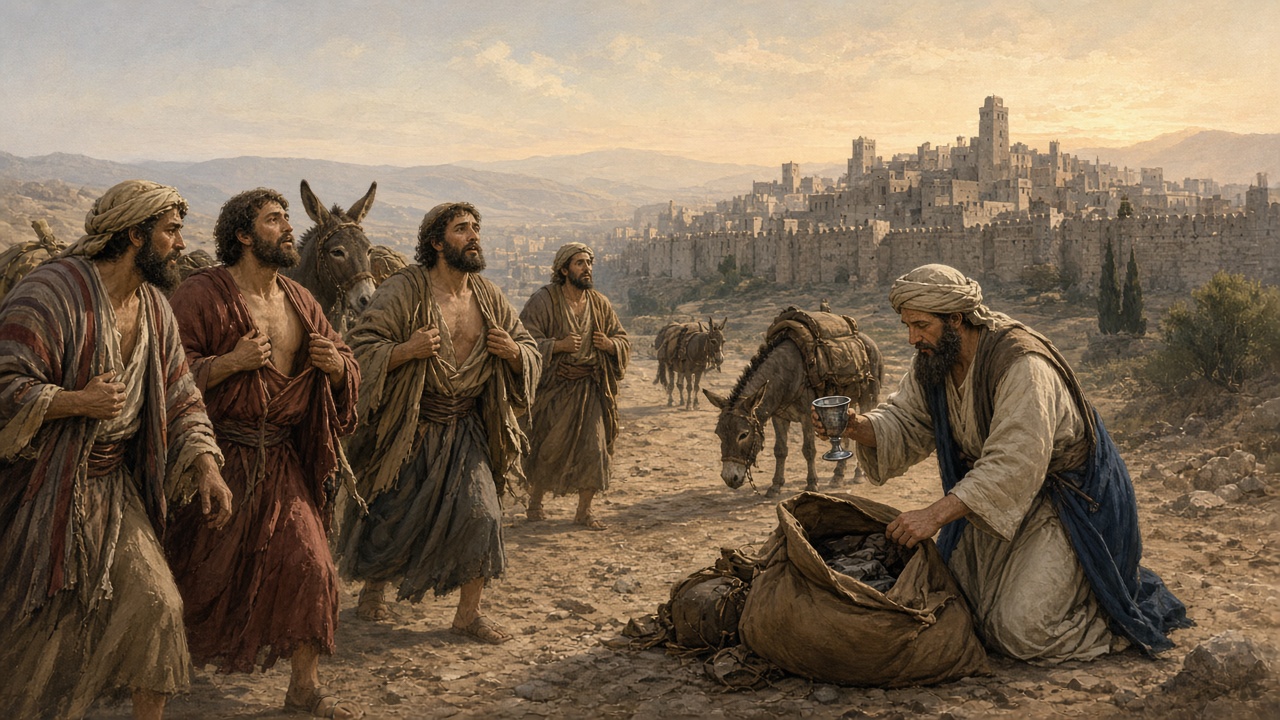
- Por orden de José, el mayordomo escondió la copa de plata de José —la copa de la que bebía y que usaba para la adivinación— en el saco de Benjamín, junto con la plata pagada por el grano. Cuando la encontraron, los hermanos rasgaron sus ropas y volvieron a la ciudad. José les preguntó entonces si no sabían que un hombre como él podía adivinar la verdad, aunque el relato muestra que él mismo había dispuesto que se hallara la copa.Fuentes: el propio texto bíblico
Notas escritas con ayuda de IA a partir de fuentes abiertas (Theographic Bible Metadata, CC BY-SA 4.0; Easton’s Bible Dictionary, dominio público) y revisadas antes de publicarse.
Lugares de este capítulo
- Canaan · 32.767, 35.333 · versículo 8
Solo aparecen lugares identificados con alta confianza (90 % o más según las fuentes académicas reunidas por OpenBible). Mapa de la época: DARE (Digital Atlas of the Roman Empire), CC BY 4.0; mapa actual: © colaboradores de OpenStreetMap; lugares: OpenBible.info (CC BY 4.0).
Créditos y licencia de esta traducción
Ekajuk Scriptures Bible Portions
Ekajuk: Ekajuk Scriptures Bible Portions (Bible)
copyright © 2024 Luke Initiative for Scripture Translation and The Seed Company
Language: Ekajuk
Contributor: Luke Initiative for Scripture Translation
This translation is made available to you under the terms of the
Creative Commons Attribution Share-Alike license 4.0.
You have permission to share and redistribute this Bible translation in any format and to make reasonable revisions and adaptations of this translation, provided that:
You include the above copyright and source information.
If you make any changes to the text, you must indicate that you did so in a way that makes it clear that the original licensor is not necessarily endorsing your changes.
If you redistribute this text, you must distribute your contributions under the same license as the original.
Pictures included with Scriptures and other documents on this site are licensed just for use with those Scriptures and documents.
For other uses, please contact the respective copyright owners.
Note that in addition to the rules above, revising and adapting God's Word involves a great responsibility to be true to God's Word. See Revelation 22:18-19.
2025-07-02
Fuente: http://ebible.org/eka/ · eBible.org