Génesis 38
Ekajuk Scriptures Bible Portions · Toca un versículo para ver sus referencias cruzadas.
Juda abola Tamar
1Ngare nyio Juda yake abonanyehn ebe kehm tahme re á song jol a nnelohng Adulam no bo jo lung-e re Hira. 2Gona wo Juda kpiri mmonse no nkal, nde bo jolung-e Sua ji lohng go Kenan. Á ko-e go elbal, kehm noongo a ne, 3á sa ela jel mmon no nlum no á gung-e mbing re Er. 4Á kpe sa ela jel mmon no nlum no á gung-e mbing re Onan. 5Á kpe bulu kpe sa ela jel mmon no nlum no á gung-e mbing re Sela, á jel-e go Kejib. 6Juda ko nkal ka ngbokambang a mmon ewe no nlum Er, mbing enye bo jo lung-e re Tamar. 7Ngbokambang a mmon ewe Er jolo nne no jo lim abˈbi go ejang bi Jehova, wahng ka Jehova wul-e. 8Owo Juda kehm bungu tong Onan re, <<Song noongo a nkala mmonanne, wo ruru eltum ene ana nnar a mmonanyehn nne, eji a lˈjel abon ka mmonanne.>> 9Onan kahne kpee re, mmon noo nehm jol no we. Owo wahnge ngare anyehng anyehng nyi á lˈnoongo a nkala mmonannyehn, á jo fere fonngo ebjing wohng go ndi, eji á lˈkˈjel abon ka mmonannyehn. 10Ji Onan jo lim o jolo ebˈbi go ejang bi Jehova, Jehova tob wul-e. 11Juda kehm tongo Tamar nnar ewe re,<<Jol go etahk nso ana nkal ebun tete mmon ewame Sela gbal,>>Á bele ntir re, á bahke tob kpo, ana abonanyehn.>> Ano wo Tama mehle no song lene go etahk nde. 12Eji ma kang afung gbalee nkala Juda, mmon no nkal no Sua, kehm kpoko. Eji Juda ma noongo elkv mal, á mehle tahm go Timna, goji ane kpo kpud anyar ejoro ebe, nte ewe Hira ji lohng go Adulam toon-e je o. 13Ana bo tongo Tama re, Nde nlum wa fi mbang mbang asongo go Timna re á song kpud anyar ejoro ebe,>> 14Tama kehm yehke nsol nkalebun, kehm rodo mbomo konngo bulu elne eji nnene lˈki-e liingi, mehl song ji go mbang nyi li rehng go Enayim go mbang nyi li tahm go Timna. Á sebe kahn re jol eji Sela ma gbˈgbal o, bo we nehme ka á jol nkal ewe. 15Eji Juda nyehn-e no, Juda tiri re nne asˈsa wo, tib yebkonngo esamahr ebe. 16Juda kahnem re nkala mmon ewe wo, á song kpir-e o nkpe a mbang, kehm bungu re, <<Ba me, me n nkang a na.>> Tama kehm-e bahbe re, <<Jenji á bahk-m kake a lˈnoongo aname?>> 17Juda kehm-e faange re, <<M bahke tumu mmon mbul no nse tv-a go ellong ebul ebame. Tama kehm-e tongo re, <<Á bahk-m ma yahke ejum ji m bahke bumu ana ejum ntianse tete á tum mmona mbul noo tv-m?>> 18Juda kehm bungu re, <<Ejum ajii á kpˈsebe re me ka-a ana atianse? Tama kehm faange re, <<Yake ejum elliingi eja a nlehke eme, a ebti efilebo bi wob-a ebo ka-m.>> Á kehm-e kake, noongo a ne, á soro sa ela ka Juda. 19Eji ma jol ano, Tama kehm feere go etahk, song lennge mbomo mi á konngo elne, rod abomo nkalebun bobo ana wuku wuku. 20Eji ejum jio ma sehng, Juda kehm kake nte ewe Hira ji lohng go Adulam mombul re á song ka nnenkal noo fere ko nsol enye ba ka-e. Eji Hira je no á we kpeem nyehn. 21Owo á kehm bahb aneblum ba lene o re, <<Nne a asˈsa no jo kono eljehke nkpe a mbang nyi li asongo Enayim mee? Bo kehm-e faange re, <<E ka bˈbel nne asˈsa ao.>> 22Owo Hira kehm feere song tong Juda re,<<M we nyehnem edi ajehng ajehng, aneblum ba li ejahbe jio kpˈbungu re nne asˈsa ka jˈjol ona.>> 23Juda kehm bungu re, <<Nong á bum nsol nyi n ka-e no, eji e lˈk jol ejum asol. Kehn n tˈtumu mombul ana e toobo no, á we nyehnem.>> 24Eji yahke biingi nnyahng era, bo kehm tongo Juda re, <<Tama nkala mmon ewa kpˈjene yannge ana nne asˈsa, anv, tib esi jia, yebsa ela.>>Juda kehm bungu re, <<Koon ye ba, wahn ba jahm-e agun á kpo!>> 25Eji bo me-e rod re bo song wul, owo á tumu etib tv nde nlum re, <<Nne no kpi nsol nyia, ye wo ma-m kak ela. Seenge nˈnob. Nne awoo kpi ejum elliingi jia a nlehke eme, a ebti efilebo bia?>> 26Juda soro liingi nsol nyio tvtv, kehm bungu re, <<Tama wo ga li etingitingi nne sehnge me, tib m taam-m re Sela mmon ewame ko-e go elbal.>> Juda kpeem tiki noongo a Tama. 27Eji ba rehng ngare ejel, bo sebe kahn re Tama jolo ela ayafele. 28Ana á jo rahng ejel, mmon awohng gbo mbang yehke ebo ebe. Mbohngo ejel kehm tubu mmon noo ejahm, gba-e mbila mbomo go ege ebo, kehm bungu re, <<Noa wo gbo mbang lohng.>> 29Á kehm fere tohng ebo ebe kak atahng, mmonannyehn fere lohng! Mbohngo ejel kehm biingi re, <<Lohngo renan!>> Á limi renan a ma bohngo lohng?>> Bo kehm gungu mbing re Pereji 30Owo mmonannyehn no bo kahn-e mbila mbomo go ebo kehm lohngo, bo ka-e mbing re Jera.
¿Sabías que…?
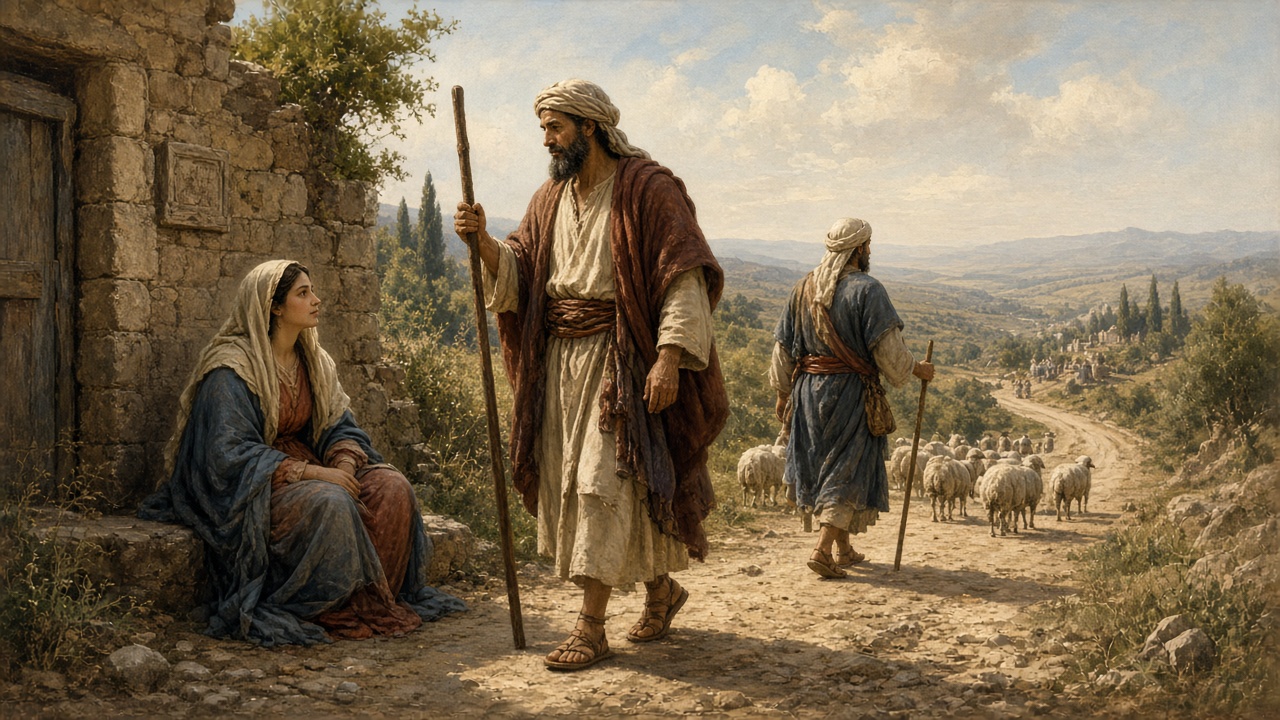
Judá y Tamar
- Poco después de que José fue vendido a los ismaelitas, Judá dejó a sus hermanos y se estableció cerca de Hira, un adulamita, y se casó con la hija de Súa, un cananeo. Ella le dio a Er, Onán y Sela; Sela nació en Quezib, cuyo nombre significa engañoso y probablemente es el mismo lugar que Aczib.Fuentes: Judah (patriarch) · Shuah · Chezib · el propio texto bíblico
- Judá tomó a Tamar como esposa para su primogénito, Er. Después de que Er murió, le dijo a Onán que se acostara con ella, cumpliera el deber de cuñado y levantara descendencia para Er, pero Onán derramaba su semilla en la tierra para que el hijo no le perteneciera. El Diccionario Bíblico de Easton (1897) compara ese episodio con Deuteronomio 25:5 y Mateo 22:24; Onán murió antes de que la familia de Jacob bajara a Egipto, y Judá nunca entregó a Tamar a Sela, como había prometido.Fuentes: Tamar · Onan · el propio texto bíblico
- Después de que murió la hija de Súa, Judá y su amigo Hira subieron adonde sus esquiladores en Timnat, lugar que el Diccionario Bíblico de Easton (1897) describe como una ciudad de Judá a unas veinte millas al oeste de Jerusalén. Tamar se cubrió el rostro con un velo y esperó en Enaim, en el camino a Timnat —probablemente Enam, una ciudad de la llanura o Sefelá—, y Judá pensó que era una prostituta porque tenía el rostro cubierto. Más tarde dio a luz gemelos, y el niño que se abrió paso primero recibió el nombre de Fares, nombre que significa brecha.Fuentes: Timnah · Enaim · Pharez · el propio texto bíblico
Notas escritas con ayuda de IA a partir de fuentes abiertas (Theographic Bible Metadata, CC BY-SA 4.0; Easton’s Bible Dictionary, dominio público) y revisadas antes de publicarse.
Créditos y licencia de esta traducción
Ekajuk Scriptures Bible Portions
Ekajuk: Ekajuk Scriptures Bible Portions (Bible)
copyright © 2024 Luke Initiative for Scripture Translation and The Seed Company
Language: Ekajuk
Contributor: Luke Initiative for Scripture Translation
This translation is made available to you under the terms of the
Creative Commons Attribution Share-Alike license 4.0.
You have permission to share and redistribute this Bible translation in any format and to make reasonable revisions and adaptations of this translation, provided that:
You include the above copyright and source information.
If you make any changes to the text, you must indicate that you did so in a way that makes it clear that the original licensor is not necessarily endorsing your changes.
If you redistribute this text, you must distribute your contributions under the same license as the original.
Pictures included with Scriptures and other documents on this site are licensed just for use with those Scriptures and documents.
For other uses, please contact the respective copyright owners.
Note that in addition to the rules above, revising and adapting God's Word involves a great responsibility to be true to God's Word. See Revelation 22:18-19.
2025-07-02
Fuente: http://ebible.org/eka/ · eBible.org