Lucas 15
Beibel: okanisi tongo · Toca un versículo para ver sus referencias cruzadas.
A toli fu a sikapu di be lasi
1Ma namo, wan dei, ne den sama di e piki lantimoni anga den sama di be abi polinen a kondee go aliki Masaa Jesesi. 2Ne den Faliseiman anga den leliman fu Dyuweiti si Masaa Jesesi e hulu anga den takuu libi sowtu sama de. Ne den teke Masaa Jesesi fu ogii. Den taki: “A man ya na wan bunbun sama tan so? Ne fa a waka ai hulu den takuu libi sowtu sama de? Son toon seefi a nái sen fu nyan anga den. Da na wan bunbun sama tan so?”
3Ne di Masaa Jesesi sabi taki, na so den e kuutu en, ne a gi den wan ageisi toli fu soi den saide meke ai du dati. A taki: 4“U aliki mi bun! Meke u taki wan fu u abi wan ondoo sikapu. Ne i tyai den go poti a sabana fu den nyan. Ne wan fu den komoto a den taawan mindii go lasi, san yu o du? Yu ná o seeka den taa neigintenti a neigin te a kaba, da i go suku awan kodo di lasi fu te i fende en, no? 5Da, te i fende en kaba, da yu o diki en poti a sikoo anga gaan piisii, da i go a kondee. Da yu o kai den mati fi yu anga den sama di e tan lontu yu, da i taigi den taki: ‘U meke piisii anga mi! Bika wan sikapu fu mi be lasi, ma mi fende en baka.’ 7We, fa i si ala sama e piisii anga yu de, na soseefi piisii de a Masaa Gadu tu, te wan takuulibi sama daai libi. Da den e piisii anga en, moo enke den neigintenti a neigin, di ná abi fu daai libi moo.”
A toli fu a solufu moni di be lasi
8Ne Masaa Jesesi taigi den baka taki: “We soseefi, efu wan uman abi tin solufu moni, ne wan kai lasi a ini en osu. Na leti a o leti faya e sibi a hii osu, e suku fu te a fende en baka, no? 9Da, te a fende en, da a o kai den mati fi en anga ala den sama di e tan lontu en, da a taigi den taki: ‘U meke piisii anga mi. Bika wan solufu moni fu mi be lasi, ma mi fende en baka.’ 10We, fa i si den sama e piisii fu di den fende awan kodo solufu moni di be lasi de, da na soseefi den Basiya fu Masaa Gadu Kondee*f15* seefi e piisii tu, te wan kodo takuulibi sama daai en libi.”
A toli fu a manpikin di be de fu // go kaba a soso
11Ne Masaa Jesesi taigi den baka taki: “Wan man be de. Da a be abi tu manpikin. 12Di den de, te wan dei, ne a moo pikinwan kon ne en taki: ‘Mi dda! Mi wani i paati a gudu, da i gi mi fu mi se di mi be o fende wanten. Ne a dda paati a gudu, ne a gi den manpikin fu den se.’
13“Da wantu dei a baka, ne a moo pikinwan teke ala en gudu, ne a go a wan faawe kondee. Da na a pe a poli ala a moni fi en anga yayo libi. 14Ne di a de te wan pisi, ne wan gaan angiiten kon na a kondee. Ne ai pina tee, na fu dede namo. Bika a á be abi ná wan enkii moni moo. A be poli ala fosi a gaan angiiten ya doo. 15Ne a go suku wooko a wan sama fu a kondee. Ne a sama teke en a wooko fu ai luku den agu fi en gi en. 16Angii kii en te, a be wani den nyanyan fu den agu fu nyan. Ma dati seefi den á wani gi en.
17“Ne a de ape, te wan pisi, ne a kisi enseefi. Ne a taki: ‘San! Na mi kon tan so? Mi, di mi dda abi onmen tenti wookoman e gi nyanyan den e nyan, te den bee fuu. Ne na mi kon tan ya e pina a pina ya? 18I sabi san? Mi o daai go baka a mi dda. Da mi o taigi en taki: “Mi dda. Mi du ogii anga yu anga Masaa Gadu seefi. 19Da mi á waiti moo seefi fi i oli mi enke wan manpikin fi yu. Ma gaantangi baa, teke mi enke wan wookoman fi yu namo a wooko.” ’
20“Ne a opo, ne a daai go ne en dda baka. Ne a waka te a opo uku. A di en dda luku, ne a si wan sama, te a faawe anda e kon. Ne tyali fu a pikin kisi en. Ne a dyombo peb, lon go miti en a pasi. Ne a kisi en gwulu baasa, bosi, piisii anga en, te a bigi. 21Ne a pikin taki: ‘Mi dda! Mi á waiti sai fu yu oli mi enke yu manpikin moo. Bika, mi du ogii anga yu anga Masaa Gadu seefi. Ma gaantangi! Teke mi a wooko enke wan wookoman fi yu namo, baa?’
22“Ma, fosi a kaba taki, ne a dda bali gi den wookoman taki: ‘U esi go teke den moo waiti koosi kon wei gi en. U tyai wan linga kon wei ne en finga gi en. U tyai susu kon gi en meke a wei ne en futu. 23Da u go kii a moo fatu kaw tyai kon, meke u boli nyan meke piisii anga a manpikin fu mi ya. 24Bika a manpikin fu mi ya, be lasi fu go kaba a soso, ma a daai kon baka.’ Ne den meke gaan piisii anga en.
25“Da a ten de, da a gaan baala be de a ini goon e wooko. Ne di a komoto a goon e kon, ne a yee den e pee, e meke piisii e dansi. 26Ne a kai wan fu den wookoman fi en dda, ne a akisi en taki: ‘San pasa ya?’ 27Ne a piki en taki: ‘We, na a pikin baala fi yu di i si be gwe, ne en daai kon baka a osu. Ne i si a dda kii a fatu kaw e meke piisii anga en, fu di a daai kon gusontu gusontu libilibi a osu baka.’
28“Ne di a gaan baala yee so, ne en ati boon te, a á wani go a ini osu. Ne di en dda yee so, ne a go ne en. Ne a taigi en taki: ‘Biya, kon a osu!’ 29Ne a taki: ‘Nono! Mi ná o kon a osu. Bika luku on langa mi anga yu de ya. Ná wan dei di mi pasa i mofu, gaanengee gi yu. Ala san i sende mi, mi e du enke fa i sende mi. Mi e wooko e naki mi sikin gi yu enke sitaafuman. Ma ná wan pikin kaabita seefi di i gi mi, fu mi kii nyan meke piisii anga den mati fu mi. 30Ma di a manpikin fi yu di teke i gudu go poli anga wisiwasi yayo libi daai kon baka, ne i kii a fatu kaw, meke sowan gaan piisii gi en.’
31“Ne a dda piki en taki: ‘We, pikin oo! Alaten mi anga yu de makandii ya. Da ala san mi abi, na fi yu. 32I baala be lasi, fu go kaba a soso. Ma now a daai kon a osu anga libi baka. Da taa fasi á de moo enke, na fu meke piisii anga en namo, da a kaba. Bika a be lasi, ma u fende en baka.’ ”
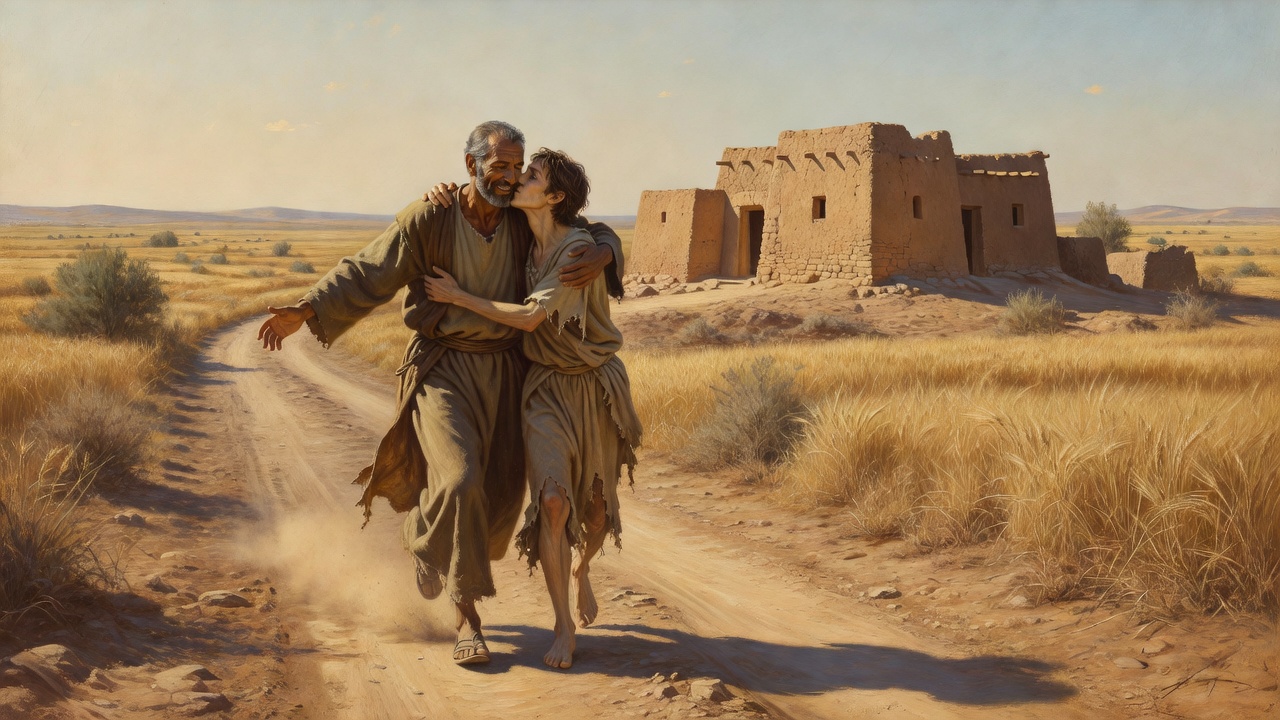
¿Sabías que…?
Perdido y encontrado
- Los recaudadores de impuestos y los pecadores se estaban reuniendo para escuchar a Jesús, y los fariseos y los escribas comenzaron a murmurar que él acoge a los pecadores y come con ellos. Jesús entonces les contó parábolas sobre una oveja perdida, una moneda de plata perdida y un hijo perdido.Fuentes: el propio texto bíblico
- La enseñanza y la sanidad en Perea hacia Jerusalén se registran como comenzando en el año 30 d.C. con una duración de un día.Fuentes: Teaching and Healing in Perea to Jerusalem
Notas escritas con ayuda de IA a partir de fuentes abiertas (Theographic Bible Metadata, CC BY-SA 4.0; Easton’s Bible Dictionary, dominio público) y revisadas antes de publicarse.
Créditos y licencia de esta traducción
Beibel: okanisi tongo
New Testament in Eastern Maroon Creole (NS:djk:Eastern Maroon Creole)
copyright © 2009 Wycliffe Bible Translators, Inc.
Language: Eastern Maroon Creole
Translation by: Wycliffe Bible Translators, Inc.
Eastern Maroon Creole
djk
Suriname
Copyright Information
© 2009, Wycliffe Bible Translators, Inc. All rights reserved.
This translation text is made available to you under the
terms of the Creative Commons License: Attribution-Noncommercial-No Derivative Works.
( http://creativecommons.org/licenses/by-nc-nd/3.0/ )
In addition, you have permission to port the text to different file formats, as long as you
do not change any of the text or punctuation of the Bible.
You may share, copy, distribute, transmit, and extract portions
or quotations from this work, provided that you include the above copyright
information:
You must give Attribution to the work.
You do not sell this work for a profit.
You do not make any derivative works that change any of the actual words or punctuation of the Scriptures.
Permissions beyond the scope of this license may be
available if you contact
us with your request.
The New Testament
in Eastern Maroon Creole
© 2009, Wycliffe Bible Translators, Inc. All rights reserved.
This translation is made available to you under the terms of the
Creative Commons Attribution-Noncommercial-No Derivatives license 4.0.
You may share and redistribute this Bible translation or extracts from it in any format, provided that:
You include the above copyright and source information.
You do not sell this work for a profit.
You do not change any of the words or punctuation of the Scriptures.
Pictures included with Scriptures and other documents on this site are licensed just for use with those Scriptures and documents.
For other uses, please contact the respective copyright owners.
2014-04-22
Fuente: http://ebible.org/djkNT/ · eBible.org