Génesis 16
Nǫ̀htsı̨̨ Nı̨̨htł'è · Toca un versículo para ver sus referencias cruzadas.
Hagar eyıts'ǫ weza Ishmael
1Abram wets'èkeè Sarayı wezaa gòı̨lè-le, hanìkò ts'èko yegha eghàlaedaa elı̨ı̨ sìı Hagar wìyeh. Eyı ts'èko sìı Egypt got'ı̨į̀ gots'ǫ hǫt'e. 2Eyıt'à Sarayı Abram ts'ǫ̀ hadı, “Gots'ǫ̀ K'àowo chekoa seghàı̨la-le t'à ts'èko segha eghàlaedaa sìı wet'àı̨tè, edahxǫ wets'ıhɂǫ̀ chekoa sets'ǫ welì,” hadı.
Abram edets'èkeè k'èhoı̨ɂǫ. 3Abram hoònǫ xo Kanan nèk'e nàı̨dè tł'axǫǫ̀ wets'èkeè Sarayı ts'èko yegha eghàlaedaa sìı wedǫǫ̀ wets'èkeè elı̨ ha ededǫǫ̀ ghàyı̨ı̨htı̨. 4Eyıt'à Abram Hagar t'àı̨tè t'à eyı ts'èko hotıeda-le ajà.
Hotıeda-le edek'èhoèhzà t'à Sarayı nèlı̨-le ajà. 5Eyıt'à Sarayı ededǫǫ̀ Abram ts'ǫ̀ hadı, “Nı̨ net'àat'à daehɂa hǫt'e. Ts'èko segha eghàlaedaa neghàehtı̨ı̨ sìı hotıeda-le edek'èhoèhzà t'à senèèlı̨-le. Gots'ǫ̀ K'àowo segha nesınìyawehtı,” yèhdı.
6Abram yets'ǫ̀ hadı, “Ts'èko negha eghàlaedaa sìı nı̨ wets'ǫ̀ k'àı̨wo hǫt'e. Dàwı̨ı̨le ha newǫǫ sìı hawı̨ı̨le,” yèhdı. Eyıt'à Sarayı Hagar tsį̀ı̨hɂa t'à eyı ts'èko yech'à kwı̨èhsa.
7Gots'ǫ̀ K'àowo weyak'eet'ı̨į̀ ekìı-ka nèk'e tı-xàewìı gà yegòhɂǫ. Eyı dèè goyìı tı-xàewìı sìı kǫ̀ta Shur gòyeh ts'ǫ̀ tı̨lı nıɂàa gà hǫt'e. 8Yak'eet'ı̨į̀ yets'ǫ̀ hadı, “Hagar, Sarayı wegha eghàlaı̨daa anet'ee sìı edı̨į̀ gots'ǫ anet'ı̨? Eyıts'ǫ edı̨į̀ ts'ǫ̀ anet'ı̨?” yèhdı.
Hagar yets'ǫ̀ hadı, “Sets'ǫ̀ k'àowo Sarayı wech'à kwı̨èhsa,” hadı.
9Yak'eet'ı̨į̀ yets'ǫ̀ hadı, “Nets'ǫ̀ k'àowo wets'ǫ̀ anaąde, eyıts'ǫ wek'èanet'e,” yèhdı. 10Eyıts'ǫ yak'eet'ı̨į̀ hayèhdı, “Nets'ıhɂǫ̀ǫ-dǫǫ̀ łǫ geet'è agehłe ha. Sıì gı̨ı̨tłǫ t'à dǫ wı̨ı̨zìı gogıhtà ha nıìle,” yèhdı.
11Gots'ǫ̀ K'àowo weyak'eet'ı̨į̀ yets'ǫ̀ hanaedı, “Dıì chekoa nets'ǫ sìı dǫzhìa nìı̨htè ha. Dànì nexè hoìla hòɂǫǫ sìı gots'ǫ̀ K'àowo yek'èezǫ t'à, Ishmael wìyeh awı̨ı̨le ha. 12Dǫ wekwì nàtsoo elı̨ ha. Dǫ hazǫǫ̀ k'èch'a eda ha, eyıts'ǫ dǫ hazǫǫ̀ gık'èch'a geeda ha. Eyıts'ǫ edèot'ı̨ hazǫǫ̀ gok'èch'a k'ehoɂa ha,” yak'eet'ı̨į̀ yèhdı.
13Gots'ǫ̀ K'àowo yets'ǫ̀ goı̨dee sìı Hagar yıızì whehtsı̨, hadı, “Nı̨, Nǫ̀htsı̨ seghàedaa anet'e, Seghàedaa elı̨ı̨ sìı dıì weehɂı̨,” hadı. 14Eyı ts'ıhɂǫ̀ eyı tık'è gòɂǫǫ sìı Ber-Lahaı-Roı wìyeh hǫt'e. Įłaà ekǫ gòɂǫ hǫt'e, kǫ̀ta Kadesh eyıts'ǫ kǫ̀ta Bered wege gòɂǫ hǫt'e. 15Eyıt'à Hagar Abram gha chekoa nìı̨htı̨. Abram eyı ts'èko chekoa nìı̨htı̨ı̨ sìı Ishmael wìyeh ayį̀į̀là. 16Abram ek'èdı̨ènǫ-daats'ǫ̀-ek'ètaı (86) weghoò ekò Hagar wezaa Ishmael wegǫ̀hłı̨.
¿Sabías que…?
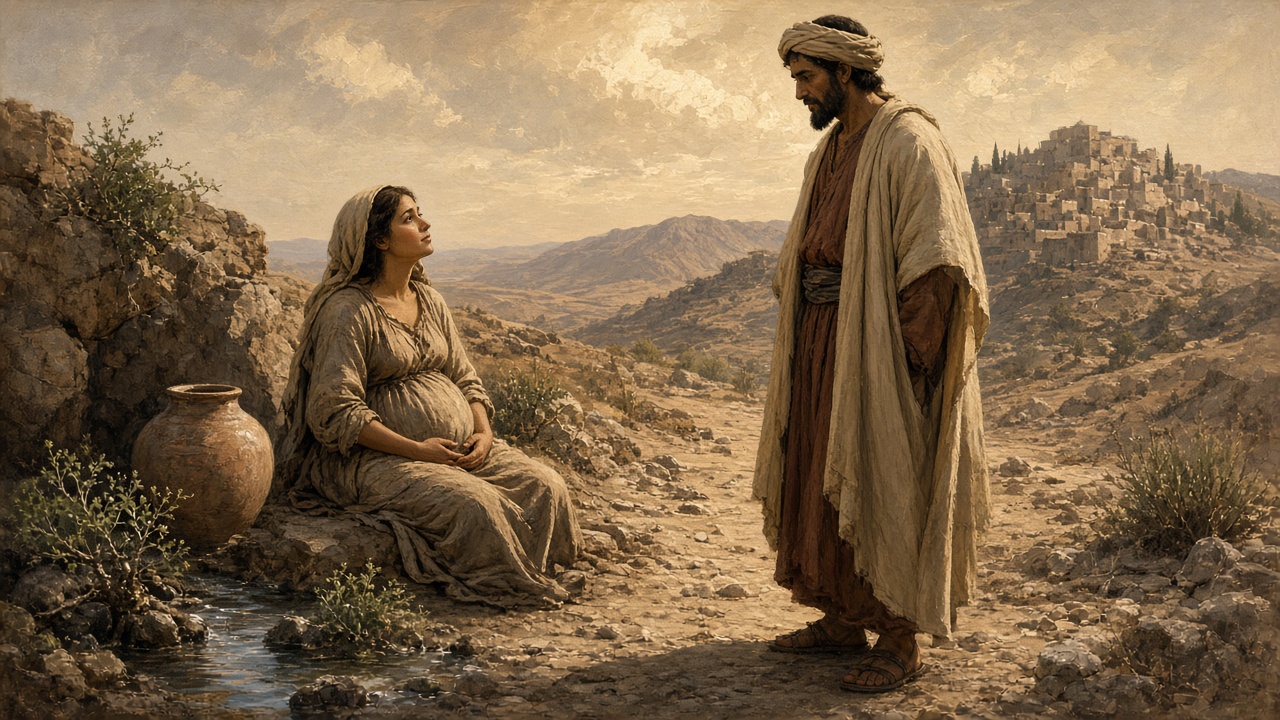
La huida de Agar y el nacimiento de Ismael
- Agar, sierva egipcia de Sarai, lleva un nombre que se entiende como “huida” o, según otros, “extranjera”. Después de que Abram vivió diez años en Canaán, Sarai se la entregó como esposa secundaria, con la esperanza de formar una familia por medio de ella.Fuentes: Hagar · el propio texto bíblico
- Cuando Sarai la trató con dureza, Agar huyó por el camino de Shur, a través del desierto que quedaba entre ella y Egipto, al parecer con la intención de volver con sus parientes. El ángel del Señor la encontró junto a un manantial. Shur, que significa “muro”, era un desierto en la frontera noreste de Egipto, probablemente llamado así por unas fortificaciones fronterizas que iban de Pelusio a Heliópolis.Fuentes: el propio texto bíblico · Hagar · Shur
- Agar llamó al Señor que le habló “el Dios que me ve”, y el pozo recibió el nombre de Beer-lahai-roi, “el pozo del Dios visible”, entre Cades y Bered, una ciudad en el sur de Palestina, en el desierto de Shur. Ella regresó a la tienda de Abram, e Ismael, su hijo mayor, nació en Mamre cuando Abram tenía ochenta y seis años; Abram le puso el nombre que el ángel había anunciado, porque el Señor había oído su aflicción.Fuentes: el propio texto bíblico · Hagar · Bered · Ishmael (Son of Hagar)
Notas escritas con ayuda de IA a partir de fuentes abiertas (Theographic Bible Metadata, CC BY-SA 4.0; Easton’s Bible Dictionary, dominio público) y revisadas antes de publicarse.
Lugares de este capítulo
- Canaan · 32.767, 35.333 · versículo 3
Solo aparecen lugares identificados con alta confianza (90 % o más según las fuentes académicas reunidas por OpenBible). Mapa de la época: DARE (Digital Atlas of the Roman Empire), CC BY 4.0; mapa actual: © colaboradores de OpenStreetMap; lugares: OpenBible.info (CC BY 4.0).
Créditos y licencia de esta traducción
Nǫ̀htsı̨̨ Nı̨̨htł'è
Dogrib: Dogrib Genesis & New Testament New Testament & Portions of Old Testament
copyright © 2009 Canadian Bible Society
Language: Dogrib
Translation by: Canadian Bible Society
Tłı̨chǫ Genesis and New Testament
About Tłı̨chǫ
Tłı̨chǫ (Dogrib) is a Na-Dene (Athabaskan) language. It is spoken by the First Nations Tłı̨chǫ people in the Northwest Territories in Canada. It has the largest number of speakers of any of the Aboriginal language communities in the NWT, and is one of the official languages of the Northwest Territories.
About This Translation
This translation includes the book of Genesis and the New Testament in Tłı̨chǫ. The first edition of the Tłı̨chǫ New Testament was published in 2003. It was a historic event, as it was the first time in more than a hundred years that a complete New Testament was published for one of the Dene First Nations in the Territories. The first edition was well received and quickly sold out. In the meantime the book of Genesis had been completed. Consequently, the 2008 reprint of the Tłı̨chǫ New Testament included Genesis.
Though this translation of the New Testament and Genesis took a total of ten years, the people who worked on it built on years of labor invested by the Tłı̨chǫ people, elders, priests and missionaries, translators, educators, and linguists. The material contained in this book was checked and approved by consultants from Wycliffe Bible Translators and the Canadian Bible Society.
If you are interested in obtaining a printed copy of this Bible, please contact the Canadian Bible Society at http://www.biblescanada.com .
Copyright Information
Dogrib Genesis and New Testament © 2003, 2008 Canadian Bible Society
The text of the Bible in Tłı̨chǫ that appears in this electronic format or website is for personal use only.
Up to five hundred (500) verses of the Bible text in any form (written, visual, electronic or audio) may be quoted without permission. The quoted verses may not be more than 50% of a complete book of the Bible, or more than 25% of the total text of the work in which they are quoted. Prior written permission must be obtained for any other use of the text. Copyright acknowledgement must in all cases appear on the title or copyright page.
For more information on copyright conditions or to apply, visit http://www.biblesociety.ca/copyright .
This translation is made available to you under the terms of the
Creative Commons Attribution-Noncommercial-No Derivatives license 4.0.
You may share and redistribute this Bible translation or extracts from it in any format, provided that:
You include the above copyright and source information.
You do not sell this work for a profit.
You do not change any of the words or punctuation of the Scriptures.
Pictures included with Scriptures and other documents on this site are licensed just for use with those Scriptures and documents.
For other uses, please contact the respective copyright owners.
2014-04-22
Fuente: http://ebible.org/dgrDOGNT/ · eBible.org