Génesis 11
Nǫ̀htsı̨̨ Nı̨̨htł'è · Toca un versículo para ver sus referencias cruzadas.
Dǫ kǫ̀godeè Babel gà yayıhòłèe gogehtsı̨
1Ekìıyeè k'e dıı nèk'e dǫ hazǫǫ̀ yatı ı̨łè zǫ t'à gogede ı̨lè, eyıt'à dǫ hazǫǫ̀ ełegıìkw'o ı̨lè. 2Dǫ sa kàɂàa ts'ǫnèe k'ehogehde ekò dèè wek'e shìh gǫ̀hłı̨-le k'e nègı̨ı̨de. Ekǫ nàgedè agejà.
3Ełets'ǫ̀ hagedı, “Ehtł'è kwe lade gha kwe-satsǫ̀ yìı hòtł'ò et'è ats'ııle,” gedı. Kwe tàet'aa t'à aget'ı̨-le, hanìkò kwe whet'ee t'à aget'ı̨. Eyıts'ǫ kwedzeè t'à kwe ełexıìht'eè agehɂı̨ t'à t'asìı gehtsı̨. 4Eyı tł'axǫǫ̀ k'achı̨ ełets'ǫ̀ hagedı, “Edegha kǫ̀godeè gots'ıhtsı̨, eyıts'ǫ yayıhòłèe yat'a xèedìı gots'ıhtsı̨. Hanì-ı̨dè goızì nechàa edegha ts'ehtsı̨ ha, eyıts'ǫ hazǫǫ̀ nèk'e ts'ǫ̀ ehkèts'edè ha-le,” gedı.
5Hanìkò gots'ǫ̀ K'àowo gots'ǫ̀ ı̨zhıì ajà, kǫ̀godeè gogehtsı̨ı̨ sìı ghàı̨dà, eyıts'ǫ yayıhòłèe sı ghàı̨dà. 6Gots'ǫ̀ K'àowo hadı, “Dǫ ı̨łè xàɂaa agı̨ı̨t'e xè hazǫǫ̀ yatı ı̨łè zǫ t'à gogede. Eyı hanì eghàlageeda ha dìì-le nı̨dè t'asìı wı̨ı̨zìı gıgha dìì gǫ̀hłı̨ ha nıìle. 7Gıts'ǫ̀ ats'ııde, gıyatıì eładı̨ı̨ xàɂaa ats'ııle, hanì-ı̨dè ełegıìkw'o ha-le,” hadı.
8Eyıt'à gots'ǫ̀ K'àowo sìı dıı nèk'e hazǫǫ̀ ts'ǫ̀ dǫ ehkègı̨ı̨deè agǫ̀ǫ̀là, eyıt'à eyı kǫ̀godeè ghǫ nagı̨ı̨t'e-le. 9Gots'ǫ̀ K'àowo dǫ gıyatıì eładı̨ı̨ xàɂaa ayį̀į̀là t'à eyı kǫ̀godeè sìı Babel gòyeh ajà. Ekǫ gots'ǫ sìı gots'ǫ̀ K'àowo dıı nèk'e hazǫǫ̀ ts'ǫ̀ dǫ ehkègı̨ı̨deè agǫ̀ǫ̀là.
Shem wets'ıhɂǫ̀ǫ-dǫǫ̀ Abram gots'ǫ̀
10Dıı sìı Shem wegodıì hǫt'e:
Tı dèè goteètł'ı gots'ǫ nàke xo k'ehǫǫwo eyıts'ǫ Shem ı̨łèakw'eènǫ weghoò ekò weza Arfakad wegǫ̀hłı̨. 11Weza Arfakad wegǫ̀hłı̨ tł'axǫǫ̀ Shem sı̨làekw'eènǫ (500) weghoò ts'ǫ̀ ı̨dà. Weza eyıì-le łǫ gòı̨lè eyıts'ǫ wetì sı łǫ gòı̨lè.
12Arfakad taènǫ-daats'ǫ̀-sı̨làı (35) weghoò ekò weza Shelah wegǫ̀hłı̨. 13Weza Shelah wegǫ̀hłı̨ tł'axǫǫ̀ Arfakad dı̨akw'eènǫ-daats'ǫ̀-taı (403) xo ts'ǫ̀ ı̨dà. Weza eyıì-le łǫ gòı̨lè eyıts'ǫ wetì sı łǫ gòı̨lè.
14Shelah taènǫ weghoò ekò weza Eber wegǫ̀hłı̨. 15Weza Eber wegǫ̀hłı̨ tł'axǫǫ̀ Shelah dı̨akw'eènǫ-daats'ǫ̀-taı (403) xo ts'ǫ̀ ı̨dà. Weza eyıì-le łǫ gòı̨lè eyıts'ǫ wetì sı łǫ gòı̨lè.
16Eber taènǫ-daats'ǫ̀-dı̨ (34) weghoò ekò weza Peleg wegǫ̀hłı̨. 17Wezaa Peleg wegǫ̀hłı̨ tł'axǫǫ̀ Eber dı̨akw'eènǫ-daats'ǫ̀-taènǫ (430) xo ts'ǫ̀ ı̨dà. Weza eyıì-le łǫ gòı̨lè eyıts'ǫ wetì sı łǫ gòı̨lè.
18Peleg taènǫ weghoò ekò weza Reyu wegǫ̀hłı̨. 19Weza Reyu wegǫ̀hłı̨ tł'axǫǫ̀ Peleg nàkeakw'eènǫ-daats'ǫ̀-łǫǫ̀tǫ (209) xo ts'ǫ̀ ı̨dà. Weza eyıì-le łǫ gòı̨lè eyıts'ǫ wetì sı łǫ gòı̨lè.
20Reyu taènǫ-daats'ǫ̀-nàke (32) weghoò ekò weza Serug wegǫ̀hłı̨. 21Weza Serug wegǫ̀hłı̨ tł'axǫǫ̀ Reyu nàkeakw'eènǫ-daats'ǫ̀-łǫ̀hdı̨ (207) weghoò ts'ǫ̀ ı̨dà. Weza eyıì-le łǫ gòı̨lè eyıts'ǫ wetì sı łǫ gòı̨lè.
22Serug taènǫ weghoò ekò weza Nahor wegǫ̀hłı̨. 23Wezaa Nahor wegǫ̀hłı̨ tł'axǫǫ̀ Serug nàkeakw'eènǫ (200) weghoò ts'ǫ̀ ı̨dà. Weza eyıì-le łǫ gòı̨lè eyıts'ǫ wetì sı łǫ gòı̨lè.
24Nahor naènǫ-daats'ǫ̀-łǫǫ̀tǫ (29) weghoò ekò wezaa Terah wegǫ̀hłı̨. 25Wezaa Terah wegǫ̀hłı̨ tł'axǫǫ̀ Nahor ı̨łèakw'eènǫ-daats'ǫ̀-hoònǫ-daats'ǫ̀-łǫǫ̀tǫ (119) weghoò ts'ǫ̀ ı̨dà. Weza eyıì-le łǫ gòı̨lè eyıts'ǫ wetì sı łǫ gòı̨lè.
26Terah łǫ̀hdı̨ènǫ weghoò tł'axǫǫ̀ weza taı gòı̨lè; Abram, Nahor eyıts'ǫ Haran gıgǫ̀hłı̨.
27Dıı sìı Terah wegodıì hǫt'e:
Terah weza taı gǫ̀hłı̨, Abram, Nahor eyıts'ǫ Haran gìyeh. Haran ededı̨ sìı Lot wetà hǫt'e. 28Haran wetà Terah ı̨łaà eda et'ıì Haran kǫ̀godeè Ur gòyeh ełaı̨wo. Ekǫ Kaldea got'ı̨į̀ gınèk'e wegǫ̀hłı̨ ı̨lè. 29Abram eyıts'ǫ Nahor į̀łah hoget'ı̨ ı̨lè. Abram wets'èkeè Sarayı wìyeh, eyıts'ǫ Nahor wets'èkeè Mılkah wìyeh. Eyı ts'èko sìı Haran wetì hǫt'e. Haran sìı Mılkah eyıts'ǫ Iskah gıtà hǫt'e. 30Sarayı chekoa wets'ǫ ha dìì t'à weza gǫ̀hłı̨-le.
31Terah edeza Abram, eyıts'ǫ edekwı Lot (Haran weza) eyıts'ǫ weza ts'èkeè Sarayı edexè goòwa. Kanan nèk'e ts'ǫ̀ agede ha gı̨ı̨wǫ t'à Kaldea got'ı̨į̀ gınèk'e kǫ̀godeè Ur gòyeh gots'ǫǫ̀ xàgeède. Hanìkò kǫ̀godeè Haran gòyeh ts'ǫ̀ nègı̨ı̨de ekò ekǫ nàgedè agejà.
32Terah nàkeakw'eènǫ-daats'ǫ̀-sı̨làı (205) weghoò ts'ǫ̀ ı̨dà, eyı tł'axǫǫ̀ kǫ̀godeè Haran ekǫ ełaı̨wo.
¿Sabías que…?
Babel y el camino desde Ur
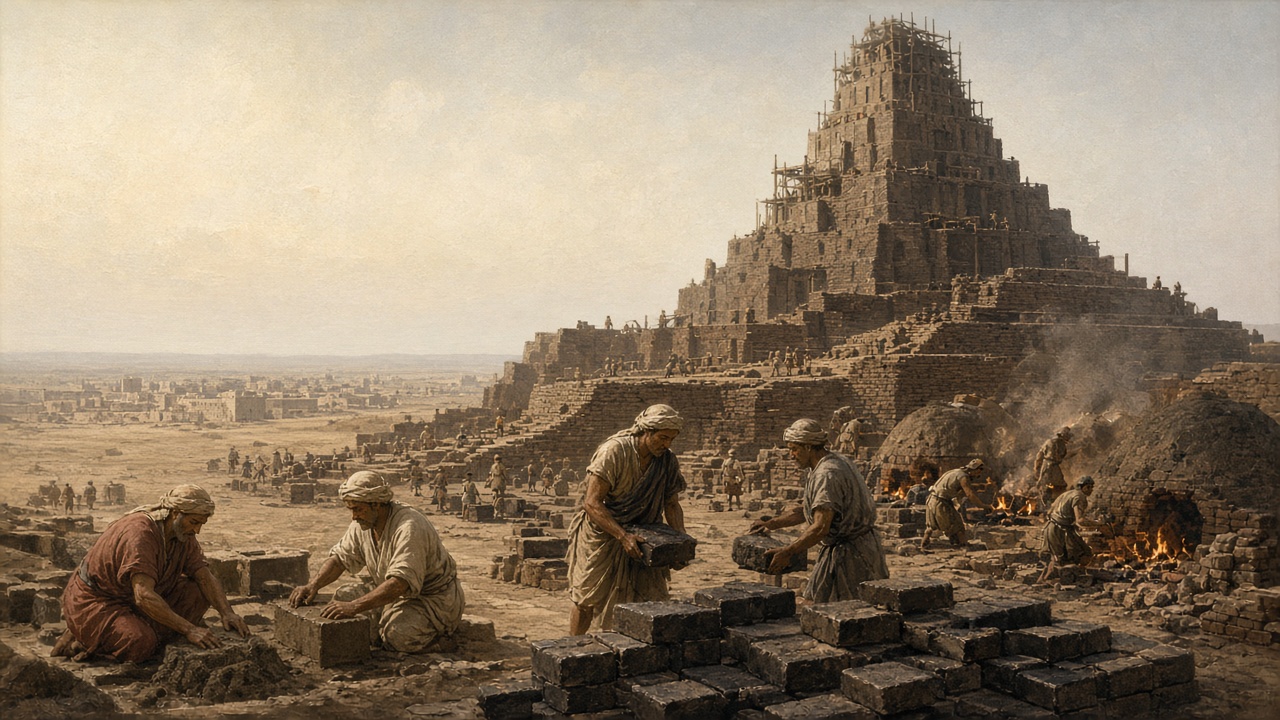
- En este capítulo, unos viajeros se establecen en una llanura de Sinar y construyen con ladrillo cocido y asfalto, en lugar de piedra y mezcla. Un diccionario considera Sinar, probablemente, como Babilonia o el sur de Mesopotamia, que se extiende casi hasta el golfo Pérsico, dice que allí se construyó la torre de Babel y describe a los primeros habitantes de la tierra como gente que hacía ladrillos y edificaba ciudades.Fuentes: el propio texto bíblico · Shinar
- La ciudad inconclusa recibe el nombre de Babel porque, según el relato, allí el Señor confundió la lengua de todo el mundo y dispersó a la gente. Un diccionario explica el nombre como 'confusión' y sugiere que la torre se pensó, probablemente, como un punto de reunión en la extensa llanura de Sinar, tras una migración desde las tierras altas de Armenia, para que los constructores no se dispersaran.Fuentes: el propio texto bíblico · Babel
- El capítulo termina con Taré saliendo de Ur de los caldeos hacia Canaán, con Abram, Sarai y su nieto Lot, y estableciéndose luego en Harán, donde muere a los 205 años; su hijo Harán ya había muerto en Ur. Un diccionario llama a Ur lugar de nacimiento de ese hijo, la ciudad más grande de Sinar o de la Caldea del norte, y un centro de comercio y poder político, y sitúa Harán, hoy Harran y llamada Charrán en el Antiguo Testamento griego y en Hechos, junto al Belik, afluente del Éufrates en la Alta Mesopotamia, donde Abram permaneció hasta la muerte de Taré.Fuentes: el propio texto bíblico · Terah · Ur of the Chaldees · Haran
Notas escritas con ayuda de IA a partir de fuentes abiertas (Theographic Bible Metadata, CC BY-SA 4.0; Easton’s Bible Dictionary, dominio público) y revisadas antes de publicarse.
Lugares de este capítulo
- Shinar · Hoy: Babylonia · 32.543, 44.422 · versículo 2
- Chaldea · 30.962, 46.104 · versículos 28, 31
- Canaan · 32.767, 35.333 · versículo 31
- Haran · Hoy: Harran · 36.864, 39.033 · versículos 31, 32
Solo aparecen lugares identificados con alta confianza (90 % o más según las fuentes académicas reunidas por OpenBible). Mapa de la época: DARE (Digital Atlas of the Roman Empire), CC BY 4.0; mapa actual: © colaboradores de OpenStreetMap; lugares: OpenBible.info (CC BY 4.0).
Créditos y licencia de esta traducción
Nǫ̀htsı̨̨ Nı̨̨htł'è
Dogrib: Dogrib Genesis & New Testament New Testament & Portions of Old Testament
copyright © 2009 Canadian Bible Society
Language: Dogrib
Translation by: Canadian Bible Society
Tłı̨chǫ Genesis and New Testament
About Tłı̨chǫ
Tłı̨chǫ (Dogrib) is a Na-Dene (Athabaskan) language. It is spoken by the First Nations Tłı̨chǫ people in the Northwest Territories in Canada. It has the largest number of speakers of any of the Aboriginal language communities in the NWT, and is one of the official languages of the Northwest Territories.
About This Translation
This translation includes the book of Genesis and the New Testament in Tłı̨chǫ. The first edition of the Tłı̨chǫ New Testament was published in 2003. It was a historic event, as it was the first time in more than a hundred years that a complete New Testament was published for one of the Dene First Nations in the Territories. The first edition was well received and quickly sold out. In the meantime the book of Genesis had been completed. Consequently, the 2008 reprint of the Tłı̨chǫ New Testament included Genesis.
Though this translation of the New Testament and Genesis took a total of ten years, the people who worked on it built on years of labor invested by the Tłı̨chǫ people, elders, priests and missionaries, translators, educators, and linguists. The material contained in this book was checked and approved by consultants from Wycliffe Bible Translators and the Canadian Bible Society.
If you are interested in obtaining a printed copy of this Bible, please contact the Canadian Bible Society at http://www.biblescanada.com .
Copyright Information
Dogrib Genesis and New Testament © 2003, 2008 Canadian Bible Society
The text of the Bible in Tłı̨chǫ that appears in this electronic format or website is for personal use only.
Up to five hundred (500) verses of the Bible text in any form (written, visual, electronic or audio) may be quoted without permission. The quoted verses may not be more than 50% of a complete book of the Bible, or more than 25% of the total text of the work in which they are quoted. Prior written permission must be obtained for any other use of the text. Copyright acknowledgement must in all cases appear on the title or copyright page.
For more information on copyright conditions or to apply, visit http://www.biblesociety.ca/copyright .
This translation is made available to you under the terms of the
Creative Commons Attribution-Noncommercial-No Derivatives license 4.0.
You may share and redistribute this Bible translation or extracts from it in any format, provided that:
You include the above copyright and source information.
You do not sell this work for a profit.
You do not change any of the words or punctuation of the Scriptures.
Pictures included with Scriptures and other documents on this site are licensed just for use with those Scriptures and documents.
For other uses, please contact the respective copyright owners.
2014-04-22
Fuente: http://ebible.org/dgrDOGNT/ · eBible.org