Daniel 9
Thai Phum Holy Bible · Toca un versículo para ver sus referencias cruzadas.
A taminaw hanlah Daniel ratoumnae
1Ahasuerus capa, Darius, Medes catoun hah, Babilon siangpahrang lah a bawinae a kum pahni navah, 2profet Jeremiah koe BAWIPA ni poe e a lawk, Jerusalem kho a rawk teh, kum 70 touh a ro han tie hah kai Daniel ni cakathoung lahoi ka panue. 3Hatdawkvah, rawca ka hai, buri ka kho, hraba kâphuen teh Cathut koe ratoum laihoi kahei, 4Hottelah, Cathut koe kâpâpho laihoi ka ratoum e teh, ama ka lungpataw niteh, a poe e kâpoelawknaw ka tarawi e koe, a lawkkam kacak ni teh lungmakung, ka lentoe niteh, takikathopounge Cathut, 5na patoun e hoi kâ poe e dawk hoi ka cei payon awh teh, ka payon awh toe. Kamsoum hoe lah kho ka sak e teh, nang na taran awh toe. 6Siangpahrangnaw, kahrawikungnaw, napanaw hoi ram thung kaawm naw koe, nange kâ lahoi lawk ka dei e profetnaw e lawk hai ka ngai awh hoeh toe. 7Oe Bawipa lannae teh nange doeh. Nang na taran kecu dawk na pâlei teh, ram hnai ram hlanae koe, khoram tangkuem kaawm e Judahnaw, Jerusalem kho kaawm e Isarelnaw puenghoi kaimouh teh sahnin e patetlah kaya awh toe. 8Oe Bawipa, nang koe ka yon awh kecu dawk, kaimae siangpahrang, kahrawikungnaw, napanaw hoi kaimouh teh ka kaya awh toe. 9Kaimouh ni nang na ka taran nakunghai, lungmanae hoi ngaithoumnae teh, kaimae Cathut nama e doeh. 10Maimae Cathut ni profetnaw hno lahoi maimouh koe na poe e tarawi hane kâlawknaw hah banglahai ngai laipalah ka o awh toe. 11Atangcalah Isarelnaw pueng ni na lawk ka ngai awh laipalah, lam ka payon awh teh, kâlawk ka tapoe awh toe. Hatdawkvah, Cathut e san Mosi e kâlawk dawk thut lah kaawm e thoebonae teh, kaimouh lathueng awi lah ao toe. 12Kaimouh koe dei e lawk hoi lawkcengkungnaw koe dei e lawk, rawknae kalenpoung teh kaimouh lathueng a phasak toe. Bangkongtetpawiteh, Jerusalem vah rawknae phasak e patetlah kalvan rahim alouke ram dawk phat sak boihoeh. 13Mosi e kâlawk dawk thut tangcoung patetlah rawknae pueng teh kaimouh lathueng a pha toe. Hatei, payonpakainae kamlang takhai teh, a lawkkatang panue thai nahanelah, BAWIPA Cathut koe kâhet awh hoeh toe. 14Hatdawkvah, Cathut ni rawknae hah a sin teh, maimae lathueng a pha sak e doeh. Bangkongtetpawiteh, a lawkngai awh hoeh nakunghai, Cathut teh, a lan, maimouh lathueng hno a sak e pueng teh a thuem doeh.
15Atuvah, Oe BAWIPA Cathut, Izip ram thung hoi thaonae kut hoi a taminaw katâcawtkhaikung hoi, atu totouh minhawi min kamthang nahanlah kasakkung, kaimouh teh, ka yon awh toe, hno kahawihoeh ka sak awh toe. 16Oe Bawipa, na lannae pueng patetlah lungkhuek lungphuennae teh, kathounge mon, Jerusalem kho dawk hoi na takhoe pouh haw telah ka kâhei. Bangkongtetpawiteh, kaimae yonnae hoi mintoenaw e yonnae kecu dawk Jerusalem kho hoi na taminaw teh tengpam kaawm e naw koe pathoe han kawilah ka o awh toe. 17Hatdawkvah, Oe Cathut, na san kai ni ka hei e hoi ka ratoum e hah na thai pouh haw. Bawipa ama hane kecu dawk, kingkadi e a thoungnae hmuen koe na minhmai angnae ni pheng ang sak haw. 18Oe Cathut, hnâpakeng nateh thai haw. Na mit padai nateh, kaimae rawknae hoi na min lahoi phung e khopui hah khenhaw! Kaimouh teh, mae hawinae kâuep awh hoeh, ka lentoe e na lungmanae dawk hoi doeh nama koe ka ratoum awh. 19Oe Cathut na thai pouh haw. Oe Cathut yonnae na ngaithoum haw. Oe Cathut thai nateh sak haw. Nama hane dawk rap awm hanh. Bangkongtetpawiteh, nama e kho, nama e taminaw teh na min lahoi phung e doeh, telah a ratoum.
Yat 70 sut deingainae
20Hottelah, kama e yonnae hoi ka tami Isarelnaw e yonnae pâpho laihoi ngaithoum nahanelah kâhei ratoum laihoi, Cathut hmalah Cathut e mon kathoung hanelah ka kâhei lahunnah, 21ratoum laihoi lawk ka dei lahunnah, yampa e vision dawk kamnuek e Gabriel karangpoung lah kamleng laihoi tangminlah thuengnae tueng nah kai koe a tho teh, 22na ka panue sak hnukkhu, Daniel, nang ni panuenae apap nahanelah, nang koe ka tho toe. 23Na ratoum tahma vah kâ poelah ao dawkvah, nang koe dei hanelah kai ka tho toe. Nang teh puenghoi pahren ka tho e lah na o. Hatdawkvah vision thai panuek nahane kâ ao. 24Kâtapoenae pout sak hane hoi, yonnae pout sak hane, payonae dawk kâmaihawinae sak hane, payonnae thoungsak nahane hoi, a yungyoe lannae thokhai hane hoi, vision hoi sutdeilawk kin hane hoi, hmuen kathoung poung satui awi hanelah, na taminaw hoi kho kathoung hanelah yat 70 touh tâtueng e lah ao toe. 25Hatdawkvah, Jerusalem kho bout sak hanelah kâ poe hnin hoi Khrih Bawipa totouh yat 7 touh hoi yat 62 touh a ro han tie hah panuek lawih. Rucatnae tueng dawk lamnaw hoi tapang sak lah ao han. 26Hote yat 62 aloum hnukkhu, Khrih teh kâ hmawt laipalah thei lah ao han. Hathnukkhu ka tho e Bawi hoi taminaw ni khopui hoi hmuen kathoung hah raphoe awh vaiteh, tuikalen thonae lahoi rawknae ao han. Apout totouh kâtuknae awm vaiteh, rawknae teh pouk tangcoung lah ao. 27Yat touh hanelah taminaw hoi lawkkam sak awh vaiteh, hote a yat tangawn navah, thuengnae hoi poenae hah a pout sak han. Panuet ka tho poung e a som dawk karaphoekung phat vaiteh, poutnae koe ka phat hanelah pouk tangcoung e totouh lungkhueknae teh ahni dawk awi hanlah ao han telah atipouh.
¿Sabías que…?
La oración de Daniel y las setenta semanas
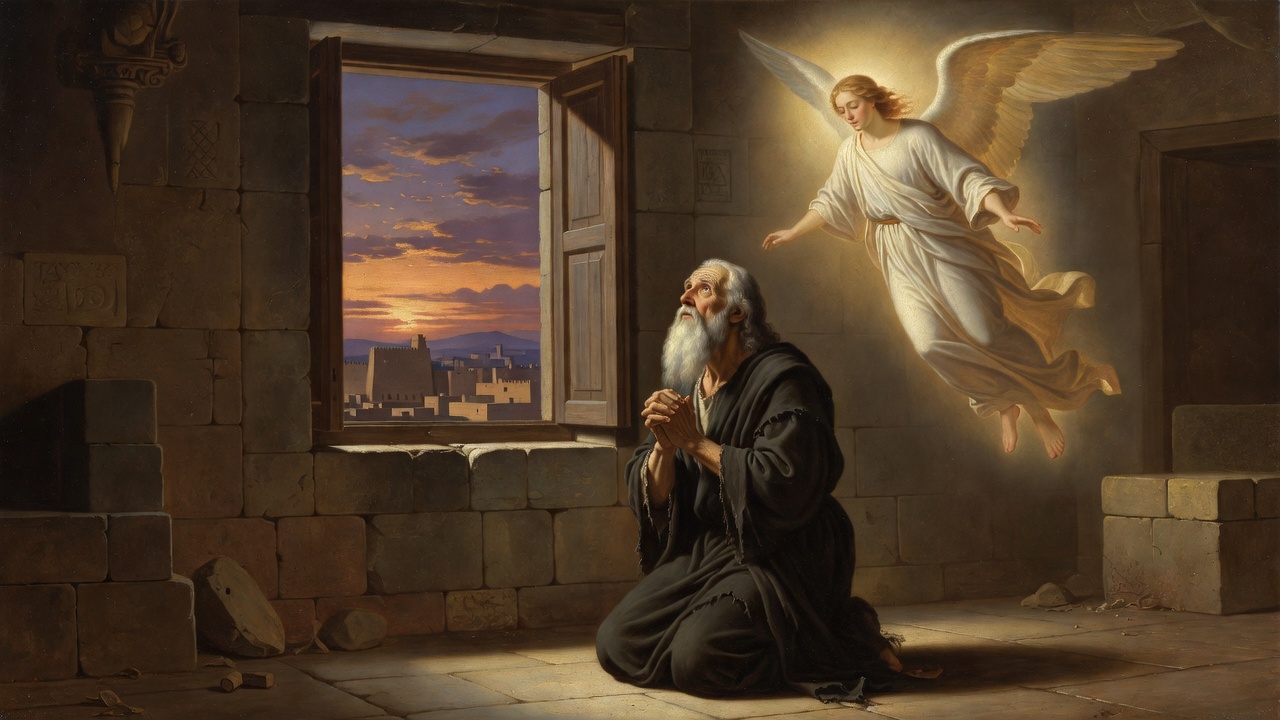
- Daniel comprendió, a través de los escritos sagrados con la profecía de Jeremías, que la desolación de Jerusalén duraría setenta años. Esto lo impulsó a buscar a Dios con profunda intercesión, ayuno, cilicio y ceniza, confesando los pecados de su pueblo.Fuentes: el propio texto bíblico · Jeremiah
- Mientras Daniel oraba a la hora del sacrificio de la tarde, el ángel Gabriel —cuyo nombre significa "Campeón de Dios"— se le acercó para darle entendimiento. Gabriel le comunicó la profecía de las "setenta semanas" decretadas para la ciudad santa y su pueblo.Fuentes: el propio texto bíblico · Gabriel
- En su oración de confesión, Daniel reconoció que la calamidad sobre Jerusalén y la dispersión del pueblo cumplían directamente el juramento y la maldición escritos en la Ley de Moisés.Fuentes: el propio texto bíblico · Moses
Notas escritas con ayuda de IA a partir de fuentes abiertas (Theographic Bible Metadata, CC BY-SA 4.0; Easton’s Bible Dictionary, dominio público) y revisadas antes de publicarse.
Lugares de este capítulo
- Chaldea · 30.962, 46.104 · versículo 1
- Jerusalem · 31.777, 35.234 · versículos 2, 7, 12, 16, 20, 25
- Egypt · 30.129, 31.308 · versículo 15
- Most Holy Place · Hoy: on Mount Moriah · 31.778, 35.236 · versículo 24
Solo aparecen lugares identificados con alta confianza (90 % o más según las fuentes académicas reunidas por OpenBible). Mapa de la época: DARE (Digital Atlas of the Roman Empire), CC BY 4.0; mapa actual: © colaboradores de OpenStreetMap; lugares: OpenBible.info (CC BY 4.0).
Créditos y licencia de esta traducción
Thai Phum Holy Bible
The Holy Bible in the Thaiphum Chin language of Myanmar
Copyright © 2020 Batupuei Christian Fellowship
Language: Thai Phum (Chin, Thaiphum)
Translation by: Batupuei Christian Fellowship
copyright only valid in Myanmar; Public Domain elsewhere
This translation is made available to you under the terms of the
Creative Commons Attribution Share-Alike license 4.0.
You have permission to share and redistribute this Bible translation in any format and to make reasonable revisions and adaptations of this translation, provided that:
You include the above copyright and source information.
If you make any changes to the text, you must indicate that you did so in a way that makes it clear that the original licensor is not necessarily endorsing your changes.
If you redistribute this text, you must distribute your contributions under the same license as the original.
Pictures included with Scriptures and other documents on this site are licensed just for use with those Scriptures and documents.
For other uses, please contact the respective copyright owners.
Note that in addition to the rules above, revising and adapting God's Word involves a great responsibility to be true to God's Word. See Revelation 22:18-19.
2024-05-01
Fuente: http://ebible.org/cth/ · eBible.org