2 Crónicas 4
Thai Phum Holy Bible · Toca un versículo para ver sus referencias cruzadas.
Bawkim pahlawngnae
1Hahoi, rahum khoungroe, ayung dong 20, adangka dong 20, arasang dong 10 touh a sak.
2Hahoi rahum tuiim hah, a tâphai hoi a tâphai rahak dong 10, arasang dong 5 touh e hah a sak. A tâphai petkâkalup lah dong 30 touh a pha. 3A tâphai rahim lah tuium ka yam e mei ni koung a ramuk teh dong touh dawk hrahra touh rahum tuiim petkâkalup lah ao. Tuiumkung mei teh 20 touh lah ao teh, rahum tuiim dawk mek hlunsin lah ao . 4Hahoi, maitotan 12 touh dawk patue e lah ao. Kathum touh atunglah a kangvawi teh, kathum touh kanîloumlah a kangvawi, kathum touh akalah a kangvawi teh, kathum touh kanîtholah a kangvawi. A hnuklah laheibaw koung a kâhmo sak. 5Tuiim teh kut sum touh hane a tha, a tâphai teh manang tâphai patetlah ao teh, lili pei hoi pahlawng e lah ao teh, bath tuium 3,000 touh a cawng.
6Pâsu nahanelah kawlung 10 touh a sak teh, avoilah panga touh, aranglah panga touh a ta. Hotnaw teh hmaisawi thuengnae poe hane pâsu nahanelah ao teh, rahum tuiim teh vaihmanaw kamhluk nahanelah doeh. 7Sui hmaikhoknaw hra touh hai ahmaloe e patetlah a sak teh, Bawkim thung avoilah panga touh, aranglah panga touh a hruek. 8Caboi hra touh a sak teh, Bawkim thung avoilah panga touh, aranglah panga touh a hruek. Hahoi suikawlung 100 touh hai a sak.
9Hothloilah, vaihmanaw hanelah thongma hoi, alawilah thongma kakawpoung hah a sak teh, thopui hai a sak teh, tho teh rahum hoi a betsin. 10Tuiim teh im e aranglah, kanîtholah, akalah kangvawi lah a hruek. 11Huram ni hlaam hoi hraba kawnnae hoi kawlung hah a sak. Hottelah Cathut im hanelah siangpahrang Solomon ni a sak pouh e thaw teh, Huram ni a cum pouh. 12Hlaam patetlah ka co e khom kahni touh e a som vah, ailo patetlah ka co e kahni touh hoi khom e som dawk e ailo patetlah ka co ni teh ka kâkayo e dawk tarikcik e kahni touh hoi, 13Hote kâkayonae tarikcik kahni touh hanelah talepaw cumpali touh hoi, khom kahni touh e som dawk ailo patetlah ka co e kayo nahane tarikcik reira lah talepaw a rui kahni touh reira hoi a sak. 14Khoungroe hoi khoungroe dawk pâhung e kawlung hai a sak. 15Tuiim buet touh hoi a rahim vah maitotan 12 touh hoi hlaamnaw, hrabanaw kawnnae hoi, cingconaw, hoi hlaumhlaamnaw pueng hai a sak. 16Solomon siangpahrang hanelah Huram ni a sak e BAWIPA e im dawk e puengcangnaw pueng teh loukloukkaang e rahum hoi koung sak e lah ao. 17Hotnaw teh, Jordan tanghling Sukkoth kho hoi Zeredah kho rahak tangpung talai hmuen koe siangpahrang ni a sak. 18Hot patetlah, Solomon ni hnopai moikapap a sak teh, rahum teh boeba khing thai lah awm hoeh.
19Solomon ni Cathut im vah hnopai kaawm e pueng a sak. suikhoungroe, vaiyei tanae caboi, 20A hmuen kathounge koe paang hane hmaiimkhoknaw, hote hmaiim teh suituici hoi doeh a sak. 21A pei hoi hmaiimnaw, paiteinaw hai suituici hoi a sak. 22Paitei, tongben, pacen, hraba hlaamnaw pueng suituici hoi doeh sak e lah ao. Imthung kathoungpounge hmuen athung lae tho hoi Bawkim alawilah e thonaw hai sui hoi doeh a sak.
¿Sabías que…?
Mobiliario para el Templo
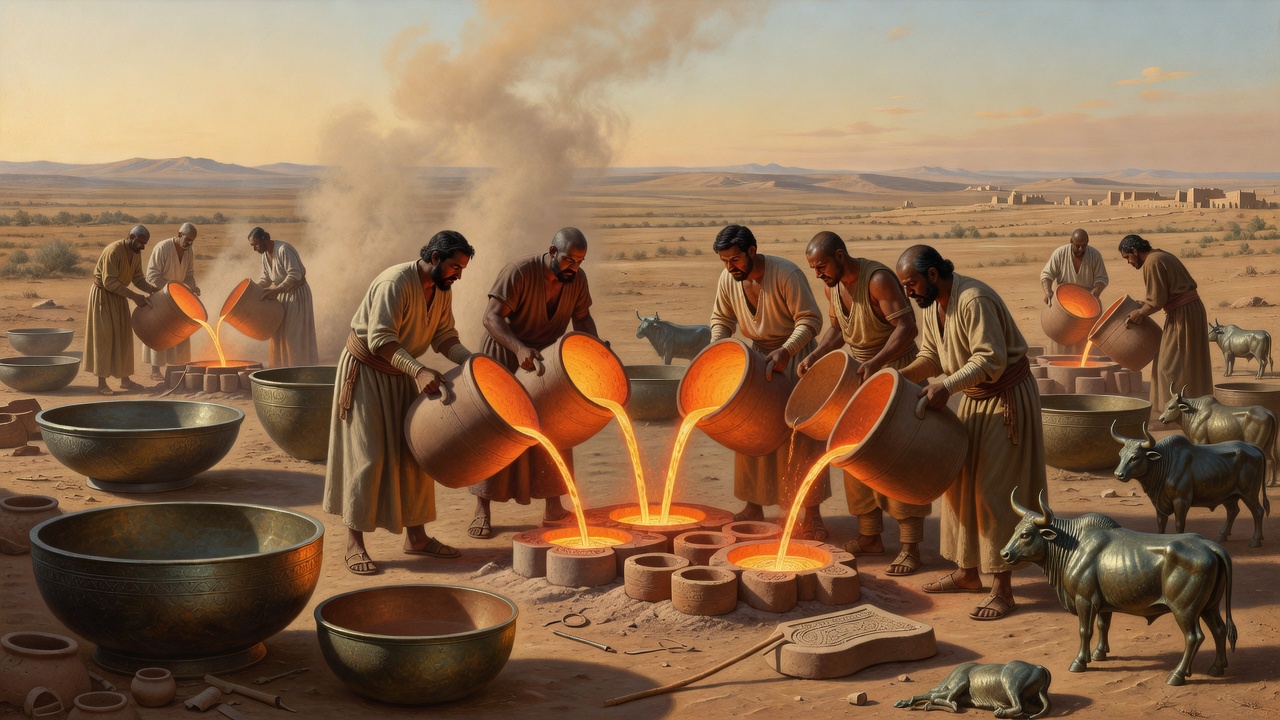
- Los grandes objetos de bronce para el templo, incluido el colosal depósito conocido como el Mar y los doce bueyes que lo sostenían, se fundieron en moldes de barro en la llanura del Jordán, entre Sucot y Sereda (también llamada Saretán). Esta compleja labor metalúrgica fue dirigida por el maestro artesano Hiram-abí.Fuentes: el propio texto bíblico · Hiram · Zeredah
- El gran Mar de metal fundido tenía un borde en forma de flor de lirio y almacenaba agua destinada exclusivamente para que los sacerdotes se lavaran antes de sus labores sagradas. Diez fuentes separadas se reservaban para lavar las piezas de los animales ofrecidos en holocausto.Fuentes: el propio texto bíblico
- En el interior del templo, Salomón dispuso diez candelabros y diez mesas de oro puro para los panes de la proposición, así como puertas de oro hacia el Lugar Santísimo y numerosos utensilios dorados, tales como tazones, incensarios y despabiladeras.Fuentes: el propio texto bíblico · Most Holy Place
Notas escritas con ayuda de IA a partir de fuentes abiertas (Theographic Bible Metadata, CC BY-SA 4.0; Easton’s Bible Dictionary, dominio público) y revisadas antes de publicarse.
Lugares de este capítulo
- Jordan · Hoy: Jordan River · 31.761, 35.558 · versículo 17
- Most Holy Place · Hoy: on Mount Moriah · 31.778, 35.236 · versículos 20, 22
Solo aparecen lugares identificados con alta confianza (90 % o más según las fuentes académicas reunidas por OpenBible). Mapa de la época: DARE (Digital Atlas of the Roman Empire), CC BY 4.0; mapa actual: © colaboradores de OpenStreetMap; lugares: OpenBible.info (CC BY 4.0).
Créditos y licencia de esta traducción
Thai Phum Holy Bible
The Holy Bible in the Thaiphum Chin language of Myanmar
Copyright © 2020 Batupuei Christian Fellowship
Language: Thai Phum (Chin, Thaiphum)
Translation by: Batupuei Christian Fellowship
copyright only valid in Myanmar; Public Domain elsewhere
This translation is made available to you under the terms of the
Creative Commons Attribution Share-Alike license 4.0.
You have permission to share and redistribute this Bible translation in any format and to make reasonable revisions and adaptations of this translation, provided that:
You include the above copyright and source information.
If you make any changes to the text, you must indicate that you did so in a way that makes it clear that the original licensor is not necessarily endorsing your changes.
If you redistribute this text, you must distribute your contributions under the same license as the original.
Pictures included with Scriptures and other documents on this site are licensed just for use with those Scriptures and documents.
For other uses, please contact the respective copyright owners.
Note that in addition to the rules above, revising and adapting God's Word involves a great responsibility to be true to God's Word. See Revelation 22:18-19.
2024-05-01
Fuente: http://ebible.org/cth/ · eBible.org