Cantares 7
Paipel · Toca un versículo para ver sus referencias cruzadas.
1En nöün king föpwül,
a fokun öch pecheöm lon ipwom sus.
Sengesengen wänükum a usun chök chipwechipwen fau aüchea,
förien eman mi silelap.
2Iwe, pwuom a wewe ngeni eu kap mi ur ren wain mi anö,
nge lukom a wewe ngeni eu chukun föün wiich,
kiop ra nom pwelin ünükün.
3Oupwum kewe ra usun chök apanen chia lippwe.
4Iwe, üom a usun chök eu imw tekia a för seni ngiin äläfan,
nge mesom ra usun chök ekewe nomun Hespon
arun ewe asamalapen Pat Rappim.
Pwötum a wewe ngeni ewe imw tekia won Lepanon
mi nom awenewenen Tamaskus.
5Mökürom a wenetä usun chök ewe chuk Karmel,
meten mökürom a sapwilitiu, nge anüan a usun chök parachol.
Iwe, ewe king a fif ren meten mökürom.
Ewe mwän apwüpwülü söfö me ewe fin apwüpwülü söfö ra pwapwafengen
6En mi wor tongom me rei, en ka fokun liöch,
a fokun mürina amwararen om tong.
7Iwe, ka üwenewenetä usun chök efoch nü,
nge oupwum ra wewe ngeni uan.
8Iwe, üpwe tötä won ewe irä palm o kini uan.
Oupwum a usun chök umwun föün wain me rei,
nge pwonnen ngasangasom a usun chök pwonnen apel.
9Awom a usun chök wain mi mürina a mitimit le oromala,
lupwen a achöchönü tinawei me ngii.
10Aüküki me ren ätewe mi wor tongan me rei ngang nöün,
nge i a chök positiei.
11Kopwe etto, en mi wor tongom me rei,
pwe sipwe feila lemäl o pwinipwin lon ekewe sop.
12Lesosorusich sipwe feila ren ekewe tanipin wain
pwe sipwe nengeni ika ekewe irän wain ra sot,
ika sotur ra sukula,
ika ekewe apel ra ua.
Ikenan üa mochen pwäri ngonuk ai tong.
13Ekewe apelin omung ra pwokus,
nge arun asamen imwach a wor chomong sokun uän irä mi mürina,
ua mi fö pwal ua minen lom.
Iwe, üa iseniir fän itom, en mi wor tongom me rei.
¿Sabías que…?
Poesía de Amor y Paisaje
- El poema describe la belleza de la mujer utilizando destacados puntos geográficos de la región. Sus ojos son comparados con los estanques de Hesbón, cerca de la puerta de Bat-rabim al este del Jordán, mientras que su perfil se asemeja a una torre majestuosa en la cordillera del Líbano que mira hacia Damasco.Fuentes: el propio texto bíblico · Heshbon · Bath-rabbim · Lebanon
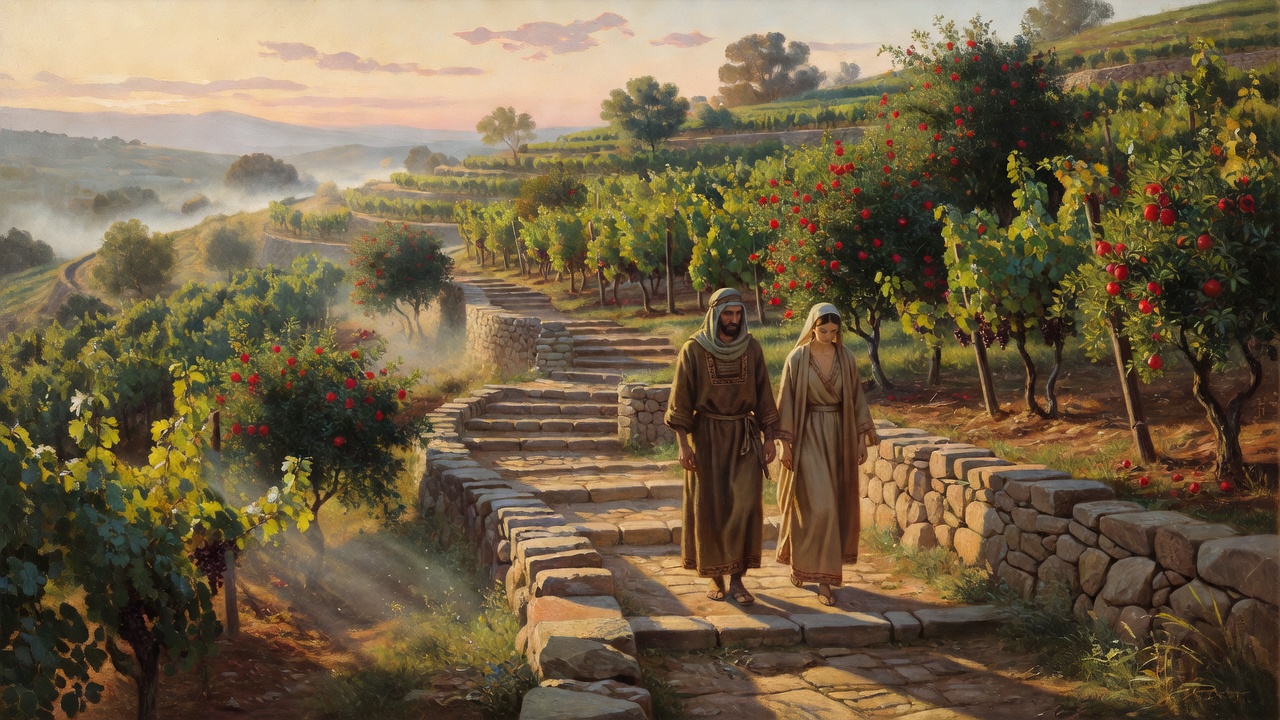
- El capítulo concluye con una invitación al campo durante el despertar de la primavera. Los amantes salen a observar los brotes de las vides, la floración de los granados y el aroma de las mandrágoras, reflejando la estrecha relación en la poesía hebrea antigua entre la intimidad romántica y la naturaleza.Fuentes: el propio texto bíblico
Notas escritas con ayuda de IA a partir de fuentes abiertas (Theographic Bible Metadata, CC BY-SA 4.0; Easton’s Bible Dictionary, dominio público) y revisadas antes de publicarse.
Lugares de este capítulo
- Bath-rabbim · Hoy: in Tell Hesban · 31.801, 35.809 · versículo 4
- Damascus · 33.511, 36.306 · versículo 4
- Lebanon · 33.540, 35.584 · versículo 4
- Mount Carmel · 32.672, 35.023 · versículo 5
Solo aparecen lugares identificados con alta confianza (90 % o más según las fuentes académicas reunidas por OpenBible). Mapa de la época: DARE (Digital Atlas of the Roman Empire), CC BY 4.0; mapa actual: © colaboradores de OpenStreetMap; lugares: OpenBible.info (CC BY 4.0).
Créditos y licencia de esta traducción
Paipel
The Holy Bible in the Chuukese language of the Federated States of Micronesia
copyright © 1984, 1989, 1991, 2001 Liebenzel Mission
Language: Chuukese
Translation by: Liebenzell Mission
Old Testament © 1989, 2001 Liebenzel Mission
New Testament © 1984, 1991 Liebenzel Mission
This translation is made available to you under the terms of the
Creative Commons Attribution-No Derivatives license 4.0.
You may share and redistribute this Bible translation or extracts from it in any format, provided that:
You include the above copyright and source information.
You do not make any derivative works that change any of the actual words or punctuation of the Scriptures.
Pictures included with Scriptures and other documents on this site are licensed just for use with those Scriptures and documents.
For other uses, please contact the respective copyright owners.
2024-01-24
Fuente: http://ebible.org/chk/ · eBible.org