1 Corintios 15
Handr Taara · Toca un versículo para ver sus referencias cruzadas.
Krstos k'irotse b́tuutsok'o
1Eshe ando t eshuwotso! itsh tdanits doo shishi aap'o itsh gawiwo geefe, doo shishy aap'onwere it dek'tsonat kup'dek'at bíyats it needirwoniye. 2Taa itsh tdaniitso doo shishi aap'o kup'ide'er desh it dek'ink'ere bín kashiyank'te, maniyere okoonmó it amantso datsmec'roone.
3Taa t dek'ts shintso jamoniyere bogo itsh beshire, itsh tbeshits keewonwere S'ayin mas'aafotse guut'etsok'on Krstos no morrosh k'irre, 4duukere, S'ayin mas'aafotse guut'etsok'onowere keezl aawots k'irotse tuure etke. 5Bí P'et'rossh be'ere, ilowere tatse git woshetswotssh be'ere, 6Úts bal ashuwotsiyere bogts b́shuuts shoydek't sha'iruwotssh iknoto be'ere, boyitse ayuwots andish b́borfetsosh fa'ane, ik ikuwotsmó k'irrne. 7Maniye hakonowere Yak'obsh be'ere, wosheets jamwotssho be'ere.
8Jami s'uwaatsnowere shabetsok'o wottsosh taash ando be'ere. 9Taa Ik'i moo gishtso twottsotse wosheets jamwotsitse dashonat wosheka err s'eegeyo taash geyirawo taane. 10Ernmó taa and twottso wotat tdaatseyir Ik'i s'aatonee, taashowere imets s'aato shuwalon ooreratse, dabnuwor k'oshuwotsiyere bogo finon mawure, erenmó han k'alirwo taanton fa'a Ik'i s'aatoni bako taanaliye. 11Eshe taan wotowa boon wotowa nodaniyrwo haniye, itwere itamantso haniye.
Ashuwots k'irotse tuwo
12Krstos k'irotse b́ tuutsk'owa no daniyiri wotiyalmó ititsere ik ikuwots aawk'oneya k'irots tuwo aaliye boetiri? 13K'irotse tuwo aali wotiyal Krstos k'irotse tuuratse etee, 14Krstos k'irotse tuuratse wotiyal no daniruwoni wotowa it imnetiyo k'awuntso deshatse etee, 15Ik'o Krstosi k'irotse tizre etaat daniruwots kootets Ik'i gawwotsi woterone etee, eshe k'irts ashuwots k'irotse tuwatsno wotiyal Ik'o Krstosi k'irotse tuzatse etee. 16K'irts ashuwots k'irotse tuwatsno wotiyal Krstos k'irotse tuwatse etee. 17Krstos k'irotse tuuratse wotiyal it imnetiyo k'awuntso deshatse etee, andoru morrotsa it beyiri etee, 18Krstosn amanat k'irtswots t'afrnee etee, 19Krstosi nojangir datsanatsi be mec'rosha wotiyal ash jamoniyere bogo noosh shiyanetk nowotoniye.
20Ernmó Krstos k'irtswotssh k'irotse tuwon k'aabo wotat arikon k'irotse tuure. 21K'iro b́ waa ik asho atse tuutson b́ wottsok'o k'irotse tuwonu b́ weet ik asho atse tuutsone. 22Adam atse tuutson ash jamo b́k'iriruowok'o mank'o Krstos atse tuutson ash jamo kasho daatsituwe. 23Man b́wotituwere ik ikosh b́ tar tarone, Krstos k'irotse tuwooke shintsoniye, ilowere Krstos b́woor bík wottsuwots k'irotse tuwitune. 24Maniyere hakowere bíalguronat alona ang jamo t'afir mengsto Ik'o Nihosh beshide b́ ímet aawo dúri s'uwoniye b́ wotiti. 25Ik'o b́ balangar jamwotsi bí ali shirots b́ woshfetsosh Krstos b́ naasho geyiyituwe. 26Da'eyar s'uwatse t'afitu t'elato k'ironiye. 27«Ik'o jam keewo bí ali shirots woshk'rere» ettso guut'ere, maniye daneke, ernmó «Jam keewo bí ali shirots wotere» bíetor jam keewo bí ali shirots woshts Ik'o nihono dabaatse 28Jam keewo Krstos ali shirots b́ wotiyakon Ik'o niho jámo b́jámon b́ wotituwok'o naayo b́ tookon jám keewo bí ali shirots woshtso Ik'o niho shirots wotitwe.
29Eshe k'irts ashuwots tuwatsno wotiyal k'irts ashuwots jangosh guupeyiru jamwots eebi bo'ot'oni? k'irts ashuwots b́ jamon k'irotse tuuratsno wotiyal ashuwots boshegro eegosha etniya bo gupeyiri? 30Noo nowotiyaloru aaw aawon t'up' er tawootse nobeyir eegoshe? 31T eshuwotso! taa aaw aawuon k'iro taan b́ datsiri, hanowere t keewir doonzo Iyesus Krstos jangosh itatse t detsts it'o arik b́wottsotsne. 32Ash asaabiyok'on taa Efesonn dini s'ootswotsnton t kaare eeg orshoshe? K'irtswots k'irotse tuuratsno wotiyal «Yaats nok'iritwotse woore moone, úyone» eteetsok'oyiye.
33Dáshek'ayere, «Woteraw tooho sheeng doyoniye bí awashifoni.» 34It nibo maants aanoore, morro fink'ayere, ititsere ik ikuwots Ik' danawwots fa'ane. Hano ti etiri it jitsitwok'wa etaatniye.
K'irotse tuuts atso
35Asho iko «K'irts ashuwots aawk'oneya botuwit? k'irotse bo tuwor bodetset atso awuk'one?» err aato falitwe, 36Nee dogono n shokiru mááyo b́ k'irrawo boc'r beyo falatse, 37Nee n shokor Geshi shooko wee k'osh mááyi shooko s'uzi n shooketi bako ili bos'et miti gindoniyaliye. 38Ik'onmó shook mansh b́ shuntsok'o miti gindo b́ imeti, ik ik shookosh k'osh k'osh miti gindo b́ imeti.
39Meets jamo ik naaraliye, ash meetso ik naare, gizi meetso k'osh naare, Kafuwots meetso k'osh naare, Mus' meets k'osh naare.
40Mank'o daritsi atso fa'ee, datsatsi atsonu fa'ee, ernmó daratsi atsi mango ik naare, datsatsi atsi mangonu k'osh naare. 41Aawi mango ik naare, Ashitsi mangonuwere k'osh naare, K'enuwots mangonu k'osh naare, ik k'eeno k'osh k'eenoniyere k'osh mango detsfe.
42K'irotse tuwit ashuwots jango haniye bíari, t'afitu k'irts atso wotat shooketso k'irawu beetk atso wotar tuwituwe. 43Ketoon shooketso mangon tuwitwe, maawon shooketso kúp'on tuwituwe, 44Meetsi ats wotat shooketso shayiri atso wotar tuwituwe. Meetsi atso b́ beyok' shayiri atsonuwere fa'ee. 45Mansh, «Shints asho Adam kashets azeetso b́ woti» ett guut'ere, iltso Adam Krstosmó kash imet shayiro b́ woti. 46Ernmó shintso b́ waa meetsone bako shayironaliye, shayiron wottso b́waa meetson wottsoniyere ile. 47Shints asho Adam bí azee shawatse b́ wottsosh datsatsike, gitl ashonmó b́waa daratsnee. 48Datsats wottswots datsatse azeets ashok'one, daaratse wottsuwots daaratse waats ashok'one. 49Datsatsi asho aro noartsok'o daratsi asho aronowere aritwone.
50Eshuwotso! itsh tkeewirwo haniye, meetsonat s'atson Ik'i mengsto naaratse, mank'owere k'irr t'afit atso t'afrawu kashets atso naaratse.
51Eshe! mist'iri iko itsh keewirwe. Noo noúnetswor k'irratsone. Ernmó no únets wonetuwone. 52Nowoneetwonwere s'uwatse ezbedo fugewor ááwi k'iluowok'o iknotone. Ezbedo fugetuwe, k'irts ashuwotswere t'afraw kashetswotsi wotar tuwitune, noowere wonetuwone, 53T'afituhan t'afrawo k'irituhanwere k'irrawo tahdek'o bísh geyituwe. 54T'afituwaan t'afrawo k'iritwanwere k'irrawo tah b́dek'or «K'iro da'ewon k'oot'ewtsere!» ett guut'etso s'eenetwe. 55Mank'owere,
«K'irono! bín nkoshetuwo aawoke b́fa'oni?
K'irono! ash bín n t'afit ango ewuke?» etetuwe.
56K'iro bín b́koshet ango morre, morri angonuwere neme. 57Ernmó nodoonz Iyesus Krstos weeron da'o noosh imetuwosh Ik'osh údo wotowe!
58Eshe mansha shuneets eshuwotso! kup'ar need'ore, ik keewonor shek'ek'ayere, doonzo finosh it shaatso datsmec'r b́woterawok'o dande'er, it eed'irawo jam aawo doonzo fino finosh kup'ore.
¿Sabías que…?
La resurrección de los muertos
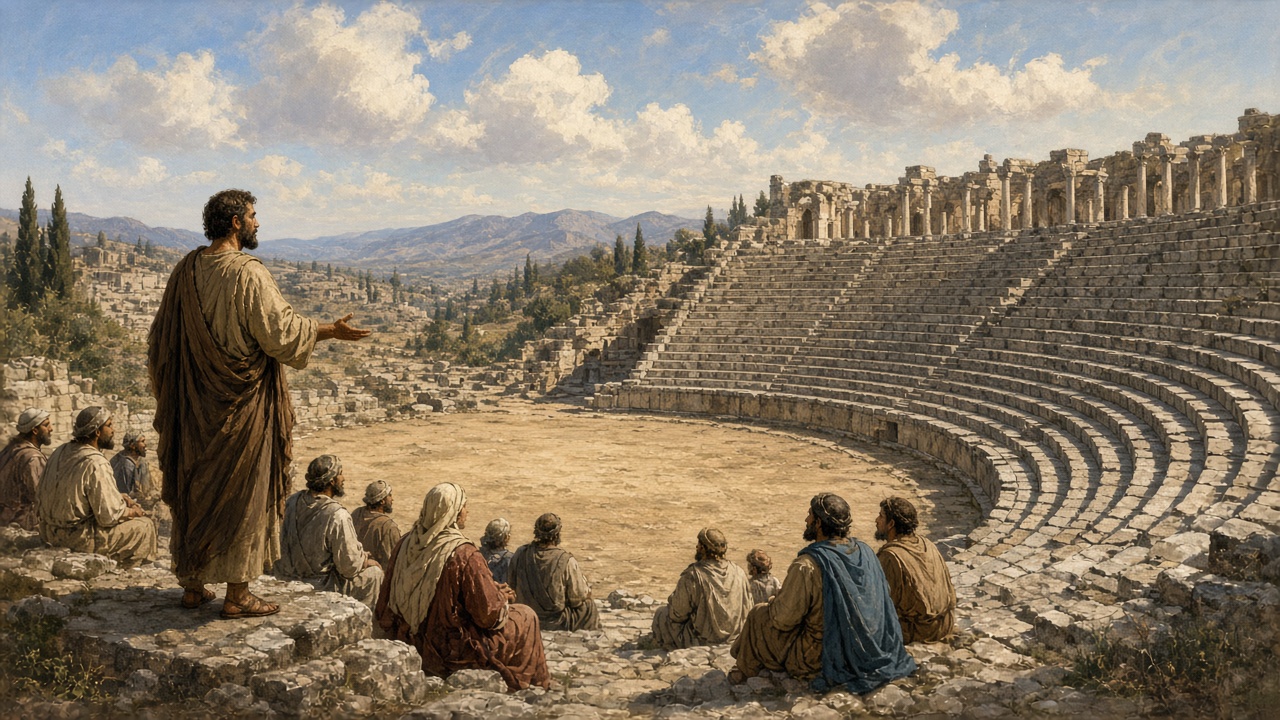
- Cuando este capítulo pregunta qué se ganó al luchar con fieras en Éfeso, nombra una ciudad que el Easton's Bible Dictionary llama capital del Asia proconsular, conocida por un teatro a cielo abierto —el más grande del mundo, capaz de albergar a 50.000 espectadores— donde se presentaban luchas de fieras y de hombres contra fieras.Fuentes: Ephesus · el propio texto bíblico
- El Easton's Bible Dictionary explica que Adán, palabra babilónica que significa rojo y el nombre común de hombre en hebreo y en asirio, fue el primer hombre, formado del polvo de la tierra, y por eso recibió ese nombre. Este capítulo retoma esa imagen: la muerte vino por medio de un hombre, el primer hombre era del polvo, y el último Adán es espíritu vivificante.Fuentes: Adam · el propio texto bíblico
- El Easton's Bible Dictionary (1897) identifica al Jacobo a quien Cristo se apareció después de la resurrección, como registra este capítulo, como hermano o pariente cercano de Jesús, también llamado Jacobo el Menor, y dice que después encabezó la iglesia en Jerusalén.Fuentes: James (Brother of Jesus) · el propio texto bíblico
Notas escritas con ayuda de IA a partir de fuentes abiertas (Theographic Bible Metadata, CC BY-SA 4.0; Easton’s Bible Dictionary, dominio público) y revisadas antes de publicarse.
Lugares de este capítulo
- Ephesus · 37.939, 27.341 · versículo 32
Solo aparecen lugares identificados con alta confianza (90 % o más según las fuentes académicas reunidas por OpenBible). Mapa de la época: DARE (Digital Atlas of the Roman Empire), CC BY 4.0; mapa actual: © colaboradores de OpenStreetMap; lugares: OpenBible.info (CC BY 4.0).
Créditos y licencia de esta traducción
Handr Taara
The New Testament in the Borna Language of Ethiopia (Handr Taara)
copyright © 2018 The Word for the World International
Language: Borni (Borna)
Contributor: The Word for the World Southern Africa
Handr Taara
The New Testament in Borna in Latin version
The Word for the World
This translation is made available to you under the terms of the
Creative Commons Attribution license 4.0.
You may share and redistribute this Bible translation or extracts from it in any format, provided that:
You include the above copyright and source information.
If you make any changes to the text, you must indicate that you did so in a way that makes it clear that the original licensor is not necessarily endorsing your changes.
Pictures included with Scriptures and other documents on this site are licensed just for use with those Scriptures and documents.
For other uses, please contact the respective copyright owners.
Note that in addition to the rules above, revising and adapting God's Word involves a great responsibility to be true to God's Word. See Revelation 22:18-19.
2023-04-08
Fuente: http://ebible.org/bwo/ · eBible.org