Génesis 49
I tnalù dwata · Toca un versículo para ver sus referencias cruzadas.
I kfati na kalbang ku Dyékob
28Na dad sfalò lwe dad ngà Dyékob, mbaling ale i sfalò lwe dad lumbuk di bel Israél. Na mni Dyékob di Dwata fye banlén ale kafye, i kafye i gablà di kat man satu dale, na én gman i màla di dale.
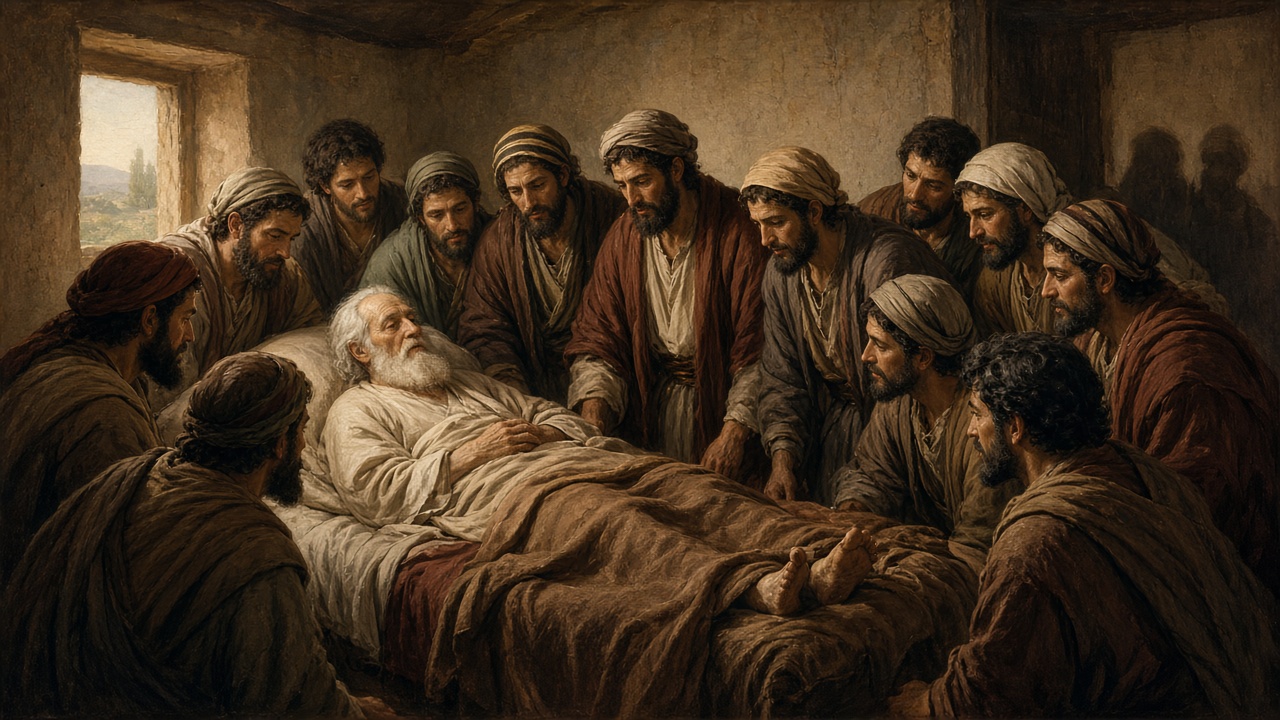
29Kafnge én, nun kated Dyékob i dad ngaan, manan, “Fan agu mlalò i dad gutambulgu i tamati. Na ku mati agu, lbangyu agu di gulambang i dad gutambulgu di ilib ditù di tanà nfun Ifron di muna, i mnè di Hiti, 30ditù di Makféla gsen di gusut i duh, mdadong di banwe Mamri di Kanaan. Na ilib na tanà ani bnayad Abraham mdà di Ifron, du nimoan gulambang. 31Ditù gulambang ku Abraham na Sara, na balù dad tuagu Isaak na Rébéka, na déén gulambanggu i yaangu Liya. 32I tanà na ilib ani, dunan tagbayad di dad to mnè di Hiti.” 33Di kafnge Dyékob kmated ani di dad ngaan, lê milè na fles nan mati.
¿Sabías que…?
Últimas bendiciones a las doce tribus de Israel
- Las palabras de Jacob juegan con el significado de los nombres de sus hijos. Judá (en hebreo Yehudah) proviene de las palabras de Lea, "Ahora alabaré" (odeh), y Jacob dice que los hermanos de Judá lo alabarán. El nombre de Dan hace eco del "Dios me ha juzgado" (dananni) de su madre Bilha; Jacob dice que Dan juzgará a su pueblo, o le hará justicia, y el Easton's Bible Dictionary (1897) sugiere que esto probablemente alude a Sansón, un juez posterior de la tribu de Dan.Fuentes: Judah (patriarch) · Dan · el propio texto bíblico
- El capítulo llama bendición a cada discurso, aunque algunos son severos. Rubén, primogénito de Jacob y Lea, cuyo nombre significa "¡He aquí un hijo!", oye que ya no sobresaldrá, porque profanó el lecho de su padre. Simeón y Leví, que se vengaron con violencia de Hamor y de los siquemitas, oyen su ira maldecida y la promesa de que serán dispersados en Jacob y esparcidos en Israel; donde la Authorized Version decía que derribaron un muro, la Revised Version dice que desjarretaron un buey, tal como este capítulo afirma que desjarretan bueyes.Fuentes: Reuben · Simeon · Levi (patriarch) · el propio texto bíblico
- Jacob pide entonces que lo sepulten con sus padres en la cueva del campo de Efrón el hitita, que Abraham compró como sepulcro de la familia. Macpela, nombre entendido como "porción" o "cueva doble", estaba en la ladera de un monte al este de Hebrón, frente a Mamre, en la tierra de Canaán. Abraham y Sara, Isaac y Rebeca, y Lea ya estaban sepultados allí.Fuentes: Machpelah · Ephron · Mamre · el propio texto bíblico
Notas escritas con ayuda de IA a partir de fuentes abiertas (Theographic Bible Metadata, CC BY-SA 4.0; Easton’s Bible Dictionary, dominio público) y revisadas antes de publicarse.
Lugares de este capítulo
- Shiloh · Hoy: Khirbet Seilun · 32.056, 35.290 · versículo 10
- Sidon · Hoy: Sandikli archaeological site in Sidon · 33.561, 35.372 · versículo 13
- Canaan · 32.767, 35.333 · versículo 30
- Machpelah · Hoy: Cave of the Patriarchs · 31.525, 35.111 · versículo 30
Solo aparecen lugares identificados con alta confianza (90 % o más según las fuentes académicas reunidas por OpenBible). Mapa de la época: DARE (Digital Atlas of the Roman Empire), CC BY 4.0; mapa actual: © colaboradores de OpenStreetMap; lugares: OpenBible.info (CC BY 4.0).
Créditos y licencia de esta traducción
I tnalù dwata
New Testament in Blaan, Sarangani
copyright © 1998 Wycliffe Bible Translators, Inc.
Language: Sarangani Blaan (Blaan, Sarangani)
Translation by: Wycliffe Bible Translators
Contributor: Wycliffe Bible Translators, Inc.
Copyright Information
© 1998, Wycliffe Bible Translators, Inc. All rights reserved.
This translation text is made available to you under the
terms of the Creative Commons License: Attribution-Noncommercial-No Derivative Works.
( http://creativecommons.org/licenses/by-nc-nd/3.0/ )
In addition, you have permission to port the text to different file formats, as long as you
do not change any of the text or punctuation of the Bible.
You may share, copy, distribute, transmit, and extract portions
or quotations from this work, provided that you include the above copyright
information:
You must give Attribution to the work.
You do not sell this work for a profit.
You do not make any derivative works that change any of the actual words or punctuation of the Scriptures.
Permissions beyond the scope of this license may be
available if you contact
us with your request.
The New Testament
in Blaan, Sarangani
© 1998, Wycliffe Bible Translators, Inc. All rights reserved.
This translation is made available to you under the terms of the
Creative Commons Attribution-Noncommercial-No Derivatives license 4.0.
You may share and redistribute this Bible translation or extracts from it in any format, provided that:
You include the above copyright and source information.
You do not sell this work for a profit.
You do not change any of the words or punctuation of the Scriptures.
Pictures included with Scriptures and other documents on this site are licensed just for use with those Scriptures and documents.
For other uses, please contact the respective copyright owners.
2015-03-17
Fuente: http://ebible.org/bps/ · eBible.org