Génesis 28
I tnalù dwata · Toca un versículo para ver sus referencias cruzadas.
I kafdà Isaak Dyékob salu ditù di faan
1Kaklinge Isaak i gman Rébéka fngén Dyékob, na dnasalan du banlé kenen kafye na flaloan kenen, manan, “Nang ge mwè yaanam i libun mdà di banwe Kanaan ani. 2Bay baling ge fatlagad, na mdà ge nan salu ditù di banwe Mésofotamya, di gumnè i mà i yéam Bétuél. Ditù gumweam yaanam. Na i nweam yaanam di dad ngà libun Laban i lagi yéam. 3Na blé moon Dwata i too mtulus i kafye di ge, na banlén ge moon dee dad ngà, du mgimò ge mà i dee bung dad to. 4Na blén moon kafye di ge, na di dad belam i salngad kafye fakangan ku Abraham i fuam, du fye kadang di satu duh, gamu sa mfun i banwe i flo gumneito ani, i banwe gablé Dwata ku Abraham.” 5Kafngen talù, fdaan Dyékob salu di Mésofotamya ditù di ku Laban tingà Bétuél i to mdà di banwe Aramaya. Na Laban ani lagi Rébéka, i yê Dyékob na Isaw.
6Na gadè Isaw i kdasal Isaak ku Dyékob, du fye blé Dwata kafye di kenen, na fsalun ditù di Mésofotamya, du fye gamwè yaanan ditù. Na gadean di kdasalan kenen fnangan ku Dyékob mwè yaan i libun mdà di Kanaan. 7Na lêman gadè Isaw nimen Dyékob i knayè i maan na yéan, na tamdà nan salu di Mésofotamya. 8Ani glabat Isaw di maan i laan lehew i dad libun fdu di Kanaan. 9Taman salu kenen ditù di faan Ismaél tingà Abraham, na mwè fa satu yaanan dnagit ku Mahalat twali Nébayot i tingà Ismaél.
I kna Dyékob ditù di Bétél
10Na tamdà Dyékob di banwe Bérsiba na salu ditù di banwe Haran. 11Na kakelan ditù di satu banwe, na ftud du takifu nan. Milè kenen na tamdanan di batu. 12Na kamna kenen, i knan ani teenan i bong yaut. Na yaut ani gafdak di tanà kel di tah i langit, na déén gumyak na gumnaul i dee kasaligan Dwata. 13Na teenan Dwata i Amu, tadag di tah i yaut na talù, manan, “Agu sa Dwata i Amu, Dwata i fuam Abraham na Dwata i maam Isaak. Blégu ge na i dad belam kadang i tanà gumileam ani. 14Dee kadang i belam salngad i kfung di tanà du là gse. Na satu duh mbel gamu ditù di gusut i duh, na di gusdaf i duh, ditù di gufdu i sabnal, na ditù di gufdu i balat. Na fagu di ge, na i dad belam blégu kafye di kdee dad to di klamang banwe. 15Na samnagin agu ge, na nifatta ge, balù nè i gusalum. Na fasfulêta ge dini di tanà ani. Làta ge tnagak kel di kagdohò i fakanggu di ge ani.”
16Na di kukat Dyékob manan di nawan, manan, “Too glut, dini Dwata i Amu di gusablàgu ani, bay di kakelgu làgu gadè dini kenen.” 17Na likò kenen, na manan, “Tay, gamlikò i gumnègu ani. Ani i too glut gumnè Dwata na ani i gufusuk salu di langit.”
18Na di kaflafusan, too flafus mték Dyékob na nwean i batu gutamdananan na fdakan du nimoan gufaldam i gnagun ani. Na kafnge én nkokan fngalo, du ilè ani i gumangamfù di Dwata. 19Na dnagitan i banwe ani Bétél, du i muna dagit i banwe ani dunan Lus.
20Kafnge én, makang Dyékob di Dwata, na manan, “Ku samnagin ge deg na nifatam agu di kagugu, na banlém agu knaan na klaweh 21kel di kulêgu di gumnè i màgu di landè gaslokgu, dnilègu ge i too Dwatagu. 22Na i batu fdakgu gine du nimògu gufaldam i gnagugu ani, nimògu kadang gumangamfù di ge, na blégu di ge satu duh kadang i gasfalò i kdee di dad gablém deg.”
Kafnge én, fadlug Dyékob salu ditù di gumnè i faan, di banwe Haran. Na di banwe ani, toon mlo mimò déén. Klon mnè déén nun fat yaanan, én lwe dad ngà i faan, dnagit ku Liya na Rakél. Kafnge én, dee dad ngaan, na too dee nfunan. Kakubu i lwe falò fali i klon di Haran, man Dwata di ku Dyékob, “Samfulê ge di ge banwe Kanaan, na samnagin agu ge.” Taman mdà Dyékob, na i magin kenen i dad yaanan, i dad ngaan, i dad saligan, na i kdee dad lmanafan, na nebela fa i dademe dad nfunan.
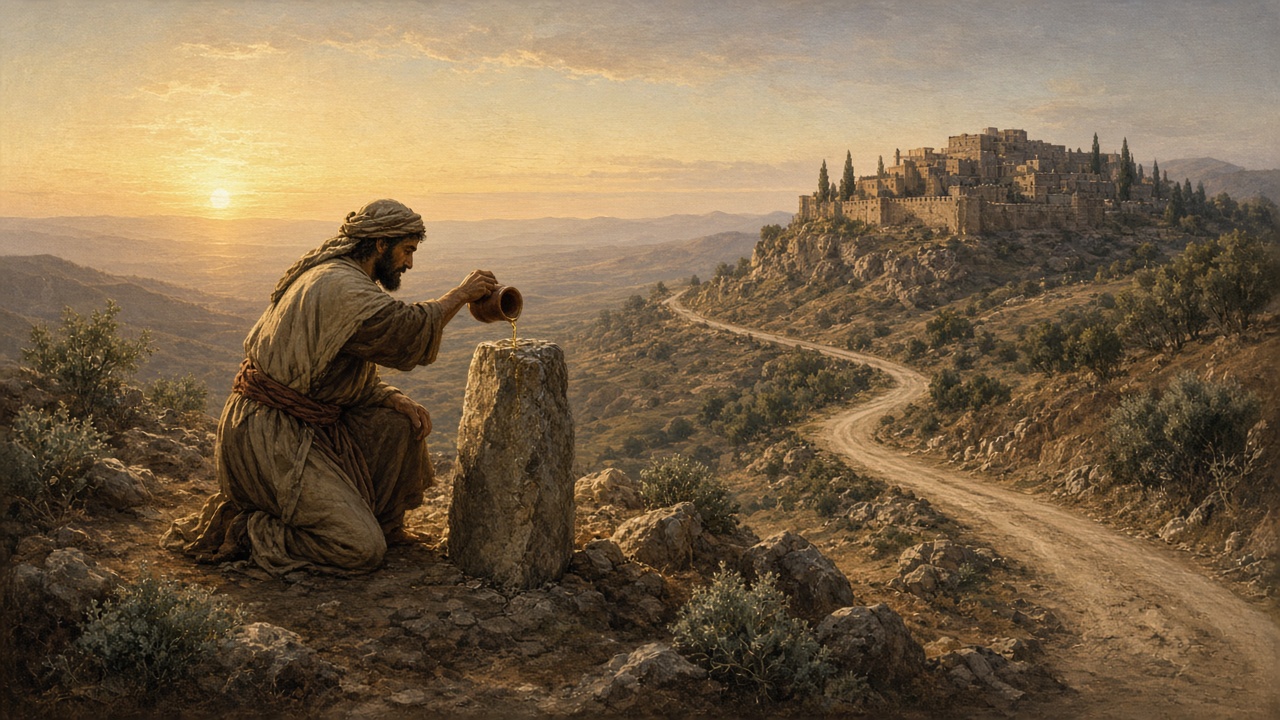
¿Sabías que…?
El viaje de Jacob y el sueño en Betel
- Isaac envió a Jacob desde Beerseba a Padan-aram para que tomara esposa entre las hijas de Labán, hermano de su madre Rebeca, y no entre las mujeres cananeas. Padan-aram, llamada la llanura de Aram, se considera comúnmente el distrito mesopotámico alrededor de Harán, donde vivía Labán; Harán, también llamada la ciudad de Nacor, fue donde Abraham permaneció después de salir de Ur hasta que murió su padre Taré.Fuentes: el propio texto bíblico · Paddan-aram · Haran · Laban
- El lugar donde Jacob soñó, levantó como columna la piedra que había puesto bajo su cabeza y derramó aceite sobre ella era la ciudad real cananea de Luz; él la renombró Betel. El Easton's Bible Dictionary (1897) sitúa Betel en la Palestina central, a unas diez millas al norte de Jerusalén, y señala que el nombre se dio al principio, al parecer, a un santuario en las cercanías de Luz, y no se dio a la ciudad misma hasta después de que la tribu de Efraín la conquistara.Fuentes: el propio texto bíblico · Luz · Bethel (of Palestine)
- Cuando Esaú supo que Isaac había bendecido a Jacob y le había ordenado no casarse con una mujer cananea, fue a Ismael y se casó con Mahalat, hermana de Nebaiot e hija de Ismael, hijo de Abraham, además de las esposas que ya tenía. El Easton's Bible Dictionary (1897) también la llama Basemat y señala que las tres esposas de Esaú reciben nombres distintos en la genealogía edomita de Génesis 36 de los que se dan en el relato de Génesis 26 y 28.Fuentes: el propio texto bíblico · Bashemath
Notas escritas con ayuda de IA a partir de fuentes abiertas (Theographic Bible Metadata, CC BY-SA 4.0; Easton’s Bible Dictionary, dominio público) y revisadas antes de publicarse.
Lugares de este capítulo
- Canaan · 32.767, 35.333 · versículos 1, 6, 8
- Haran · Hoy: Harran · 36.864, 39.033 · versículo 10
- Luz · Hoy: Beitin · 31.923, 35.241 · versículo 19
Solo aparecen lugares identificados con alta confianza (90 % o más según las fuentes académicas reunidas por OpenBible). Mapa de la época: DARE (Digital Atlas of the Roman Empire), CC BY 4.0; mapa actual: © colaboradores de OpenStreetMap; lugares: OpenBible.info (CC BY 4.0).
Créditos y licencia de esta traducción
I tnalù dwata
New Testament in Blaan, Sarangani
copyright © 1998 Wycliffe Bible Translators, Inc.
Language: Sarangani Blaan (Blaan, Sarangani)
Translation by: Wycliffe Bible Translators
Contributor: Wycliffe Bible Translators, Inc.
Copyright Information
© 1998, Wycliffe Bible Translators, Inc. All rights reserved.
This translation text is made available to you under the
terms of the Creative Commons License: Attribution-Noncommercial-No Derivative Works.
( http://creativecommons.org/licenses/by-nc-nd/3.0/ )
In addition, you have permission to port the text to different file formats, as long as you
do not change any of the text or punctuation of the Bible.
You may share, copy, distribute, transmit, and extract portions
or quotations from this work, provided that you include the above copyright
information:
You must give Attribution to the work.
You do not sell this work for a profit.
You do not make any derivative works that change any of the actual words or punctuation of the Scriptures.
Permissions beyond the scope of this license may be
available if you contact
us with your request.
The New Testament
in Blaan, Sarangani
© 1998, Wycliffe Bible Translators, Inc. All rights reserved.
This translation is made available to you under the terms of the
Creative Commons Attribution-Noncommercial-No Derivatives license 4.0.
You may share and redistribute this Bible translation or extracts from it in any format, provided that:
You include the above copyright and source information.
You do not sell this work for a profit.
You do not change any of the words or punctuation of the Scriptures.
Pictures included with Scriptures and other documents on this site are licensed just for use with those Scriptures and documents.
For other uses, please contact the respective copyright owners.
2015-03-17
Fuente: http://ebible.org/bps/ · eBible.org