Génesis 25
I tnalù dwata · Toca un versículo para ver sus referencias cruzadas.
Dyékob na Isaw
19Na ani i santulen gablà ku Isaak i tingà Abraham. 20Na tafat falò fali Isaak di kagwean i yaanan Rébéka, i tingà Bétuél. Bétuél ani, na Laban i flanek Rébéka, mnè ale di Aramaya di Mésofotamya.
21Na Rébéka là mngà, taman dmasal Isaak di Dwata i Amu gablà ani. Na linge Amun Dwata i kafnin, taman Rébéka mbaling maltien. 22Na fingin i kaltienan ani, na di là ale fa sut lyalon i kgal kalyak di lam i tienan. Taman snalekan di nawan, “Tan kè ku ani mgimò di deg?” Taman snalekan di Dwata.
23Na man Dwata i Amu di kenen, “Fingin i tingaam na mbaling ale kadang gutambul i lwe bung dad to. Na dad lwe bung to ani, là satu nawala, sduen ale, taman stani ale. Na kadang satu duh, i satu bung dad to ani nun enegla mdatah di eneg i satu. Na i tingaam twege glifan kadang di twalin.”
24Na kakel i bang i ksut dad ngaan, tasut i tingaan fingin slame lagi. 25I muna sut too fulè na i lawehan too nun bulan, taman dnagitla kenen Isaw, du too nbul. 26Kafnge én, di ksut i twalin, nagotan i takad i twegen, taman dnagitla kenen Dyékob, du dagitan ani fan salngad di satu talù takad. Na di ksutla tanam falò fali Isaak.
27Na talamnok i fingin ani na tasawang lagi ale nan. Na Isaw kenen tambaling kenen fulung dmulak, na lamngab di lam i dlag. Kabay Dyékob kenen fafanak mdadong di slung i gumnèla. 28Na bong nawa Isaak ku Isaw, du too mayè kmaan i dad lmanaf di bnas i gwè Isaw. Kabay bong nawa Rébéka baling ku Dyékob.
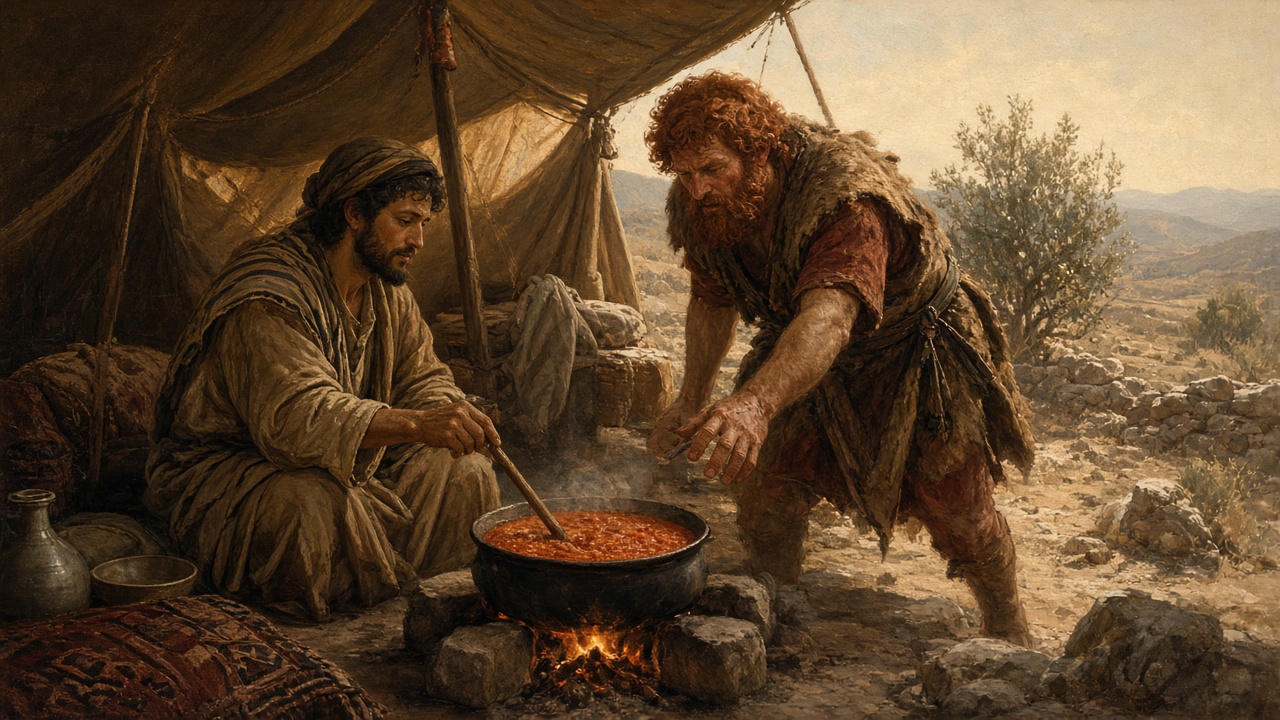
29Satu duh, smabew Dyékob i dad blangol fulè, du nimoan uten. Kel Isaw mdà di gumlokan, too kenen bitil. 30Taman manan di ku Dyékob, “Tò, gasilam agu banlé i fulè sabew én, du fan agu mati i kbitilgu.” (Én duenan satu dagit Isaw dunan Idom, gumtatekan fulè.)
31Na tmimel Dyékob, manan, “Làta ge sa banlé silang ku banlém agu untung i dnawatam kadang di kfati màta, du ge tingaan twege.”
32Man Isaw, “Hae, fye sa. Balù deg i tingaan twege, tan i gukmamugu i untung én ku mati agu di kbitilgu ani.”
33Man Dyékob, “Silanggu blé ge ku funa ge smafà na blém di deg i untung tagak màta di ge di kfatin kadang satu duh.” Taman smafà Isaw i blén kadang kun i untung mdà di maan di kfatin.
34Kafnge én, banlé Dyékob Isaw fan gagin di sabew blangol. Kmaan na minum kenen, na kafnge én mdà.
Taman laan knabas i untung tagak i maan kenen, én baling knabasan i sulê kakaan.
¿Sabías que…?
Los herederos de Abraham y los hermanos gemelos
- Cetura, cuyo nombre el Easton's Bible Dictionary (1897) explica como “incienso”, aparece aquí como otra esposa de Abraham. Ese diccionario dice que probablemente se casó con ella después de la muerte de Sara, aunque se desconoce su nacionalidad, y señala que 1 Crónicas la llama concubina. Ella le dio seis hijos, entre ellos Jocsán y Madián, padre de los madianitas; mientras Abraham aún vivía, dio regalos a los hijos de sus concubinas y los alejó de Isaac, enviándolos a la tierra de oriente.Fuentes: Keturah · Midian · el propio texto bíblico
- Isaac e Ismael juntos enterraron a Abraham en la cueva de Macpela, cerca de Mamre, en el campo que Abraham había comprado a Efrón el hitita, donde Sara ya había sido enterrada. El Easton's Bible Dictionary (1897) explica Macpela como “porción” o “cueva doble”, situada en la ladera de un monte al este de Hebrón y frente a Mamre, un lugar llamado las encinas —o, en un margen, los terebintos— de Mamre.Fuentes: Machpelah · Mamre · el propio texto bíblico
- Esaú, el gemelo primogénito de Rebeca, nació rojizo y cubierto de pelo como un abrigo de piel. El Easton's Bible Dictionary (1897) vincula el otro nombre, Edom, “rojo”, con el guiso rojo de lentejas por el que vendió el derecho de primogenitura, y explica a Jacob como “el que sigue los talones de otro” o “suplantador”, en consonancia con el relato de que Jacob nació agarrado al talón de Esaú. Esaú creció como un cazador hábil y hombre del campo, mientras que Jacob era un hombre tranquilo que se quedaba en casa.Fuentes: Esau (Edom) · Jacob (Israel) · el propio texto bíblico
Notas escritas con ayuda de IA a partir de fuentes abiertas (Theographic Bible Metadata, CC BY-SA 4.0; Easton’s Bible Dictionary, dominio público) y revisadas antes de publicarse.
Lugares de este capítulo
- East · Hoy: region around Amman · 31.955, 35.934 · versículo 6
- Machpelah · Hoy: Cave of the Patriarchs · 31.525, 35.111 · versículo 9
- Negeb · 31.245, 34.841 · versículo 11
- Assyria · 36.359, 43.153 · versículo 18
- Egypt · 30.129, 31.308 · versículo 18
Solo aparecen lugares identificados con alta confianza (90 % o más según las fuentes académicas reunidas por OpenBible). Mapa de la época: DARE (Digital Atlas of the Roman Empire), CC BY 4.0; mapa actual: © colaboradores de OpenStreetMap; lugares: OpenBible.info (CC BY 4.0).
Créditos y licencia de esta traducción
I tnalù dwata
New Testament in Blaan, Sarangani
copyright © 1998 Wycliffe Bible Translators, Inc.
Language: Sarangani Blaan (Blaan, Sarangani)
Translation by: Wycliffe Bible Translators
Contributor: Wycliffe Bible Translators, Inc.
Copyright Information
© 1998, Wycliffe Bible Translators, Inc. All rights reserved.
This translation text is made available to you under the
terms of the Creative Commons License: Attribution-Noncommercial-No Derivative Works.
( http://creativecommons.org/licenses/by-nc-nd/3.0/ )
In addition, you have permission to port the text to different file formats, as long as you
do not change any of the text or punctuation of the Bible.
You may share, copy, distribute, transmit, and extract portions
or quotations from this work, provided that you include the above copyright
information:
You must give Attribution to the work.
You do not sell this work for a profit.
You do not make any derivative works that change any of the actual words or punctuation of the Scriptures.
Permissions beyond the scope of this license may be
available if you contact
us with your request.
The New Testament
in Blaan, Sarangani
© 1998, Wycliffe Bible Translators, Inc. All rights reserved.
This translation is made available to you under the terms of the
Creative Commons Attribution-Noncommercial-No Derivatives license 4.0.
You may share and redistribute this Bible translation or extracts from it in any format, provided that:
You include the above copyright and source information.
You do not sell this work for a profit.
You do not change any of the words or punctuation of the Scriptures.
Pictures included with Scriptures and other documents on this site are licensed just for use with those Scriptures and documents.
For other uses, please contact the respective copyright owners.
2015-03-17
Fuente: http://ebible.org/bps/ · eBible.org