Éxodo 19
I tnalù dwata · Toca un versículo para ver sus referencias cruzadas.
Bulul Sinay
1Di tnanin duh, di gatlu bulen mdà di kagalwà i dad bel Israél di Idyif, lêman ale mdà. Di kdàla di banwe Rifidim, fadlug ale magu. Kafnge én, kel ale di banwe gulandè to dnagit Sinay, na flo ale mnè déén smalu di bulul. 3Na kafngela nimò ani, mnagad Mosis di bulul, du stulen di Dwata. Di knagadan di bulul, tlo kenen Dwata i Amu, na manan, “Ani tulenam di dad bel Dyékob, i dnagit dad bel Israél. 4Manam di dale, manam, ‘Tateenyu i mgimògu di dad to Idyif, na lêyu teen ku tan i bong gnagangu, di kebegu gamu di deg, gambet i kebe i malbang anuk di bnas i imfisan di fafakan. 5Na ku tooyu agu nimen, na satu nawayu di kimenyu i dad flalògu gamu, mbaling gamu dad togu too mabtas. Balù mfun agu i klamang banwe, bay gamu i dad to mgalékgu, 6i dad to alò deg mfun dun. Na mimò agu gamu dad gal bà di deg, i dad to mangamfù di dagu!’ Na Mosis, ani i tulenam di dad bel Israél.”
7Taman masol Mosis na fatlon i dad tua di dad to, na tulenan i kdee i gman Dwata i Amu, i kdee dekan kenen. 8Na kaklinge i dad to kdee gman Dwata, salngan ale tmimel, manla, “Nimòmi i kdee i gman Amuito Dwata.” Kafnge én, tulen Mosis di Dwata i Amu, i timel i dad bel Israél.
9Na lêman talù Dwata i Amu di ku Mosis, manan, “Kadang salu agu di ge, fagu di too mgat labun, du fye mlinge i dad to dagu stulen di ge, du fye toola ge fnaglut na nimen i galam man dale.” Kafnge én, tulen Mosis di Dwata i Amu i gman i dad to.
10Na talù Dwata i Amu di ku Mosis, manan, “Salu ge di dad to na tulenam dale toola nlaneb i ktola di duh ani, na lê fayah, na toom ale fafuk i klawehla, du mangamfù ale di deg. 11Too ale fatlagad di lwe duh, du di gatlun duh agu, Dwata i Amu, fdanà, mdà di langit, di bulul Sinay, du fye teen agu i kdee dad to. 12Na nimoam ilè glibut di bulul, i gufanakla magu, du fye là mlafà i dad to i ilè ani. Na manam di dale nang mnagad di bulul, ku demen nang mlafà i ilè i gufanakla, du ku simto mlafà ilè ani, to én, too fnati. 13Hae, ku nun mlafà ilè i gufanakla magu, tnudà kenen batu kel di kfatin, ku demen fnanà, du fnanggu ku nun magot kenen. Salngad kibòyu to, ku demen lmanaf, too ale fnati ku nlafàla ilè i gufanakla. Kabay di kfuni i few, fakay ale mnagad di bulul.”
14Di kafnge talù Dwata di ku Mosis, lêman masol Mosis du fafatlagadan i dad to mangamfù di Dwata. Ani flaloan dale, nlanebla i ktola, na nfukla i klawehla. 15Kafnge én, manan di dad to, “Fatlagad gamu, du fye gatlagad gamu di satu fayah. Na nangyu sansatu i lawehyu di yaanyu mdà ani, kel di duh i kfangamfùyu Dwata.”
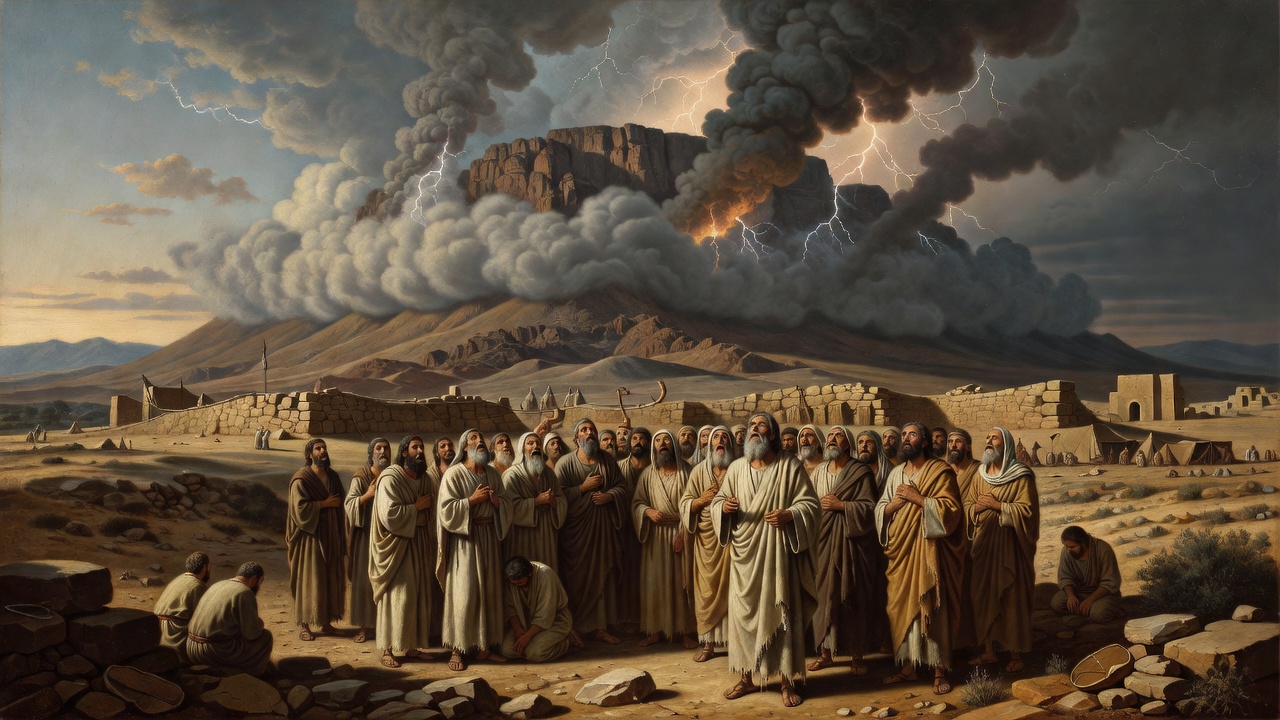
16Na di flafus i gatlun duh, kmilet na smilà, na too mgat labun maglimun i tah i bulul, na là mlo linge i dad to i too bong uni i féw. Taman i kdee dad to déén, kankal ale di bong klikòla. 17Kafnge én, nebe Mosis i dad to ditù, du fye smitong ale Dwata, na tadag ale di gugdak i bulul. 18I klamang bulul maglimun i buk, du fdanà Dwata i Amu di lam i lifoh. Myak i buk gambet i buk mdà di bong fnuluk, na i klamang bulul too mingok, 19na i uni i féw too matnù. Na kafnge én, talù Mosis, na tmimel Dwata gagin i kilet.
¿Sabías que…?
Israel en el monte Sinaí
- En el tercer mes después de salir de Egipto, los israelitas partieron de Refidim, entraron en el desierto de Sinaí y acamparon frente al monte. El Easton's Bible Dictionary (1897) identifica ese distrito montañoso como Sinaí, llamado también Horeb, explica el nombre como de Sin, el dios de la luna, y dice que permanecieron acampados cerca de un año tras un viaje de unas 150 millas desde el mar Rojo, incluyendo todos los recodos del camino.Fuentes: el propio texto bíblico · Mount Sinai · Sinai
- El Easton's Bible Dictionary (1897) sitúa Refidim, la estación que acababan de dejar, en el Wady Feiran, cerca de su unión con el Wady esh-Sheikh. Allí no se halló agua, y el pueblo estaba dispuesto a apedrear a Moisés; por orden de Dios, él golpeó la roca en Horeb, y los amalecitas que después atacaron el campamento fueron derrotados por completo.Fuentes: el propio texto bíblico · Rephidim
- El Easton's Bible Dictionary (1897) dice que los últimos veintidós capítulos de Éxodo, todo Levítico y Números 1-11 registran lo que ocurrió mientras Israel estaba acampado en esa región. Aarón, a quien Moisés recibe la orden de llevar consigo, era su hermano mayor, nacido en Egipto tres años antes que él, y había sido enviado para cooperar con él en llevar a cabo el éxodo.Fuentes: el propio texto bíblico · Mount Sinai · Aaron
Notas escritas con ayuda de IA a partir de fuentes abiertas (Theographic Bible Metadata, CC BY-SA 4.0; Easton’s Bible Dictionary, dominio público) y revisadas antes de publicarse.
Lugares de este capítulo
- Egypt · 30.129, 31.308 · versículos 1, 4
- Wilderness of Sinai · Hoy: about 50 km around Jebel Musa · 28.540, 33.973 · versículos 1, 2
Solo aparecen lugares identificados con alta confianza (90 % o más según las fuentes académicas reunidas por OpenBible). Mapa de la época: DARE (Digital Atlas of the Roman Empire), CC BY 4.0; mapa actual: © colaboradores de OpenStreetMap; lugares: OpenBible.info (CC BY 4.0).
Créditos y licencia de esta traducción
I tnalù dwata
New Testament in Blaan, Sarangani
copyright © 1998 Wycliffe Bible Translators, Inc.
Language: Sarangani Blaan (Blaan, Sarangani)
Translation by: Wycliffe Bible Translators
Contributor: Wycliffe Bible Translators, Inc.
Copyright Information
© 1998, Wycliffe Bible Translators, Inc. All rights reserved.
This translation text is made available to you under the
terms of the Creative Commons License: Attribution-Noncommercial-No Derivative Works.
( http://creativecommons.org/licenses/by-nc-nd/3.0/ )
In addition, you have permission to port the text to different file formats, as long as you
do not change any of the text or punctuation of the Bible.
You may share, copy, distribute, transmit, and extract portions
or quotations from this work, provided that you include the above copyright
information:
You must give Attribution to the work.
You do not sell this work for a profit.
You do not make any derivative works that change any of the actual words or punctuation of the Scriptures.
Permissions beyond the scope of this license may be
available if you contact
us with your request.
The New Testament
in Blaan, Sarangani
© 1998, Wycliffe Bible Translators, Inc. All rights reserved.
This translation is made available to you under the terms of the
Creative Commons Attribution-Noncommercial-No Derivatives license 4.0.
You may share and redistribute this Bible translation or extracts from it in any format, provided that:
You include the above copyright and source information.
You do not sell this work for a profit.
You do not change any of the words or punctuation of the Scriptures.
Pictures included with Scriptures and other documents on this site are licensed just for use with those Scriptures and documents.
For other uses, please contact the respective copyright owners.
2015-03-17
Fuente: http://ebible.org/bps/ · eBible.org