Hechos 24
I Falami Kasafnè (New Testament) · Toca un versículo para ver sus referencias cruzadas.
I ktifùla ku Pol di kanfe Gubirnador Filik
1Na kafnge lime butang, ta salu Ananayas, i ulu dad ganlal di kafaglut i dad Dyu ditù di Sisarya, na faginan dademe dad tua gal mebe dad Dyu na Tirtulu, i abugadu. Na tadag ale di kanfe i gubirnador, du tulenla di kenen i manla dad salà Pol. 2Ta fatlo i gubirnador Pol, na kanto kel déé, ta tambù Tirtulu tmifù ku Pol, manan, “Too mgafè Gubirnador, ta mlo nan nun bong kgilih i mgimòam gamfye di banweto. 3Là fanak gami dmilè ani balù nèan, na too gami fasalamat di ge. 4Bay ani, là fantahàgu i talùgu du tà ge ganggà, bay lo yé fnigu di ge, ku mfakay, begam gami falninge là mlo. 5Teenmi Pol, kenen i mebe samuk du banlétan i dad Dyu mimò samuk di klamang banwe. Na kenen i ulu di fantoo i dad to di Nasarét. 6Na kayèan fagsik i Gumnè Gumangamfù di Dwata, taman, ta kanfèmi kenen, du kayèmi nukum glalò di uldinmi. 7Bay kel Kernél Lisyas, na nladan di gami. 8Na dekan i kdee tmifù di kenen salu di ge. Ku toom kenen snalek, glabatam i kdee tifùmi kenen.” 9Na nagin dad Dyu déé i tifùla ku Pol, na manla slame glut i kdee manan ayé.
I ktalù Pol di kanfe Gubirnador Filik
10Na kafnge ayé, sninyas i gubirnador Pol du ftalùan. Na man Pol, “Gadègu ta dee falim mukum di banwe ani, taman, too agu lehew msen i ktogu di kanfem. 11Ku toom snalek i dad to, gadèam na là fa gafatan sfalò lwe butang, i ta kgatùgu di Dyérusalém du mangamfù agu di Dwata. 12I dad to tmifù do, teenla na là mbet agu sbalew di Gumnè Gumangamfù di Dwata, na là banlétgu i dad to di dad gumnè gustifun i dad Dyu ku demen balù nèan di syudad ayé. 13Na landè gfitela di ge ku yé gugmadèam dun na glut i tifùla do. 14Bay di kaglutan, yé tulen-gu di ge na mangamfù agu di Dwata, dunan i fnangamfù dad gutambulmi fagu di klalògu i Dalan Amu, i manla satu fantoo là glut. Na lêgu fantoo i kdee dad uldin blé Dwata fagu di ku Mosis na i kdee dademe dad tugad Dwata. 15Na salngad i dad to ani, yé fanden-gu di Dwata na nun du ntékan i kdee dad to mati, fye ku demen sasè. 16Na yé duenam man, toogu fan-geye i ktogu du fye landè gumaslen-gu di kanfe i Dwata na lê man di dad to.
17“Dee faligu là ditù di Dyérusalém, kafnge ayé, ta lê agu ditù du nun nebegu filak tabeng di dademegu Dyu i mnè di klimah, na nun dad dsù blégu di Dwata ditù. 18Di kitela do di Bong Gumnè Gumangamfù di Dwata, sanagu fnge flaneb glalò di uldin Dwata fagu di ku Mosis. Là dee gami ditù, na là mimò gami samuk. 19Bay nun dad Dyu mdà di Asya ditù. Dale moon i gablà smalu di ge na tmulen i salàgu, ku nun sa. 20Ku demen i dad to ani i ftulenam i salàgu di kaftadagla do di kanfe i dad mdatah ganlal. 21Lo yé duenla malbut di do du ta falbonggu talùgu, na man-gu dale ani, ‘Yé duenyu mukum do du fantoogu na nték i dad mati.’ ”
22Na Filik, toon gadè gablà di Dalan i Amuto, taman, fafanakan i kasfala, manan, “Silanggu nukum i to ani ku ta kel Kernél Lisyas.” 23Na yé flaun di satu kapitan i dad sundalu, bnantayla Pol, bay falohla kenen mimò i knayèan, na falohla i dademen lmauy kenen du fye banléla kenen i dad kalnidùan.
24Na kafnge dad file du, ta lê kel Filik, na magin i yaanan Drusila, i satu Dyu. Fngén Pol, na falningen i ktulenan gablà di kaftoo ku Dyisas Krayst. 25Na di lam Pol tmulen gablà di katluh, na i kadnan nawa, na i Du Kukum, ta likò Filik, na manan, “Ta gablà ayé. Fakay ge mdà. Na ku lê nun gugaslenggu, lêta ge fngé.” 26Bay di kaglutan, yé kayè nawan ku banlé Pol kenen filak du fye falwàan. Na yé duenam man, galan fngé Pol du stulen ale.
27Na kanto mlius i lwe fali, yé tamlas ku Filik dunan Porsyu Fistu. Bay là falwà Filik Pol di blanggù du yé kayèan ku lehew i dad Dyu mdà di nimòan.
¿Sabías que…?
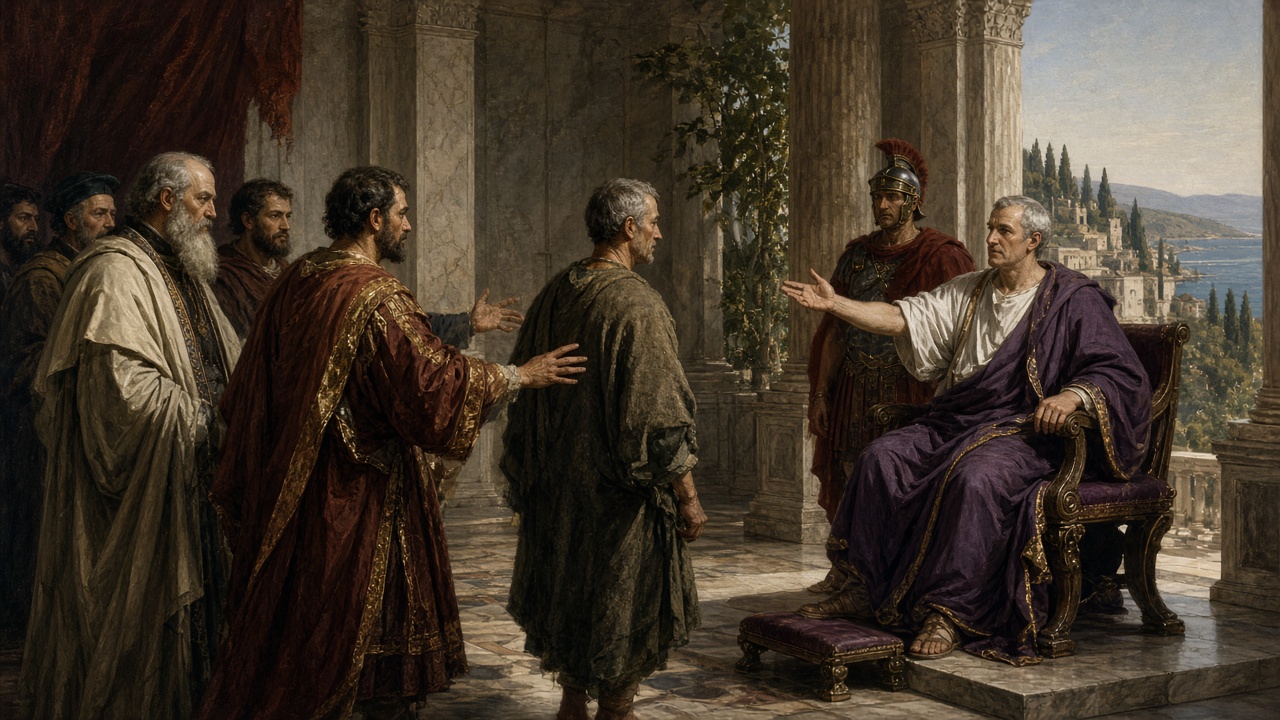
Pablo ante Félix
- El sumo sacerdote Ananías bajó con algunos ancianos y un abogado llamado Tértulo, a quien el Diccionario Bíblico de Easton describe como un abogado romano empleado por los judíos para exponer su causa contra Pablo ante Félix. Tértulo elogió al gobernador y luego dijo que Pablo era una peste que provocaba disensión entre los judíos por todo el mundo, cabecilla de la secta de los nazarenos y un hombre que había intentado profanar el templo. El diccionario relaciona ese elogio inicial con la limpieza que Félix hizo del país, al expulsar a bandidos e impostores.Fuentes: el propio texto bíblico · Tertullus · Felix
- Félix, que estaba bien informado acerca del Camino, aplazó la audiencia y mantuvo a Pablo bajo guarda, aunque le permitió cierta libertad y dejó que sus amigos atendieran sus necesidades. El relato dice que esperaba que Pablo le ofreciera un soborno y por eso lo mandaba llamar con frecuencia; el Diccionario Bíblico de Easton también afirma que al parecer esperaba un soborno y, por ello, tuvo varias entrevistas con él. Después de dos años lo sucedió Porcio Festo —el Diccionario Bíblico de Easton (1897) fecha ese nombramiento en el año 60 d. C.— y, queriendo hacer un favor a los judíos, Félix dejó a Pablo en prisión.Fuentes: el propio texto bíblico · Felix · Portius Festus
- Unos días después, Félix regresó con su esposa Drusila, que era judía, y escuchó a Pablo hablar de la fe en Cristo Jesús y de la justicia, el dominio propio y el juicio venidero; Félix se asustó y lo despidió. El Diccionario Bíblico de Easton (1897) identifica a Drusila como la tercera y la más joven hija de Herodes Agripa I y dice que Félix la indujo a dejar a su esposo, Azizus, rey de Emesa. La misma entrada dice que ella y su hijo perecieron en la erupción del monte Vesubio en el año 79 d. C.Fuentes: el propio texto bíblico · Drusilla
Notas escritas con ayuda de IA a partir de fuentes abiertas (Theographic Bible Metadata, CC BY-SA 4.0; Easton’s Bible Dictionary, dominio público) y revisadas antes de publicarse.
Lugares de este capítulo
- Caesarea · Hoy: Caesarea Maritima · 32.500, 34.892 · versículo 1
- Jerusalem · 31.777, 35.234 · versículos 11, 17
- Asia · 38.400, 28.300 · versículo 18
Solo aparecen lugares identificados con alta confianza (90 % o más según las fuentes académicas reunidas por OpenBible). Mapa de la época: DARE (Digital Atlas of the Roman Empire), CC BY 4.0; mapa actual: © colaboradores de OpenStreetMap; lugares: OpenBible.info (CC BY 4.0).
Créditos y licencia de esta traducción
I Falami Kasafnè (New Testament)
New Testament in Blaan, Koronadal
copyright © 1995 Wycliffe Bible Translators, Inc.
Language: Koronadal Blaan (Blaan, Koronadal)
Translation by: Wycliffe Bible Translators, Inc.
Copyright Information
© 1995, Wycliffe Bible Translators, Inc. All rights reserved.
This translation text is made available to you under the
terms of the Creative Commons License: Attribution-Noncommercial-No Derivative Works.
( http://creativecommons.org/licenses/by-nc-nd/3.0/ )
In addition, you have permission to port the text to different file formats, as long as you
do not change any of the text or punctuation of the Bible.
You may share, copy, distribute, transmit, and extract portions
or quotations from this work, provided that you include the above copyright
information:
You must give Attribution to the work.
You do not sell this work for a profit.
You do not make any derivative works that change any of the actual words or punctuation of the Scriptures.
Permissions beyond the scope of this license may be
available if you contact
us with your request.
The New Testament
in Blaan, Koronadal
© 1995, Wycliffe Bible Translators, Inc. All rights reserved.
This translation is made available to you under the terms of the
Creative Commons Attribution-Noncommercial-No Derivatives license 4.0.
You may share and redistribute this Bible translation or extracts from it in any format, provided that:
You include the above copyright and source information.
You do not sell this work for a profit.
You do not change any of the words or punctuation of the Scriptures.
Pictures included with Scriptures and other documents on this site are licensed just for use with those Scriptures and documents.
For other uses, please contact the respective copyright owners.
2014-08-06
Fuente: http://ebible.org/bpr/ · eBible.org