Lucas 6
I 'utz laj tzij re i dios · Toca un versículo para ver sus referencias cruzadas.
I Jesus rajaw i uxlambal ʼij
1Xoʼon panok, chupam jun uxlambal ʼij, i Jesus ca bin cuʼ u tijoxelab chupam juban ticon. I u tijoxelab xe oc chu chʼupic u wach i trígo, y xqui bar piqui ʼab ca quesbej re u solot; teʼuri xqui tijo. 2Are ʼuri ʼo jujun chique aj Fariséo xqui bij che i Jesus:
—¿Wuchac qui ʼan yix i chac-le? N-ʼus taj quix chacun pa uxlambal ʼij, cu bij i ʼatbal tzij tzʼibtal can rumal i mam Moises —xe cha.
3I Jesus xu laʼ u wach chique:
—¿Xataba n-iwetaʼam ti yix wach xu ʼan i mam David ujer are xqui tij numic cuʼ i rachiʼil? 4Xoc ire pa rachoch i Dios, y xu chap i caxlanwa chi sujtal can chuwach i Dios. Teʼuri, xu tijo, xak xu ya chique i rachiʼil. Queje xu ʼan ire ile, tupu n-ta re che. Man cu bij i ujer ʼatbal tzij chi xui i sacerdóte que tijaw i caxlanwa-le. (Queje ile xu bij i Jesus chique).
5Xak xu bij:
—Yin chi in Achi aj Chicaj xak quin rajawij puwi i uxlambal ʼij —xu bij chique.
I rutzirsaxic i achi chakijnak u ʼab
6Xu rik chic jun uxlambal ʼij, i Jesus xoc pa molbalʼib y xoc chic chu cʼutic chique i winak. Chila ʼo wi jun achi siquirnak u ʼab wikabim, chakijnak chic. 7Xak chila je ʼo wi jujun tijonel re i ʼatbal tzij, xak jujun aj Fariséo winak. Ique que tijin chu takexic i Jesus, we crutzirsaj i achi-le pa uxlambal ʼij. Cacaj ique quiqui tzucuj u mac. 8Ire retaʼam wach quiqui chʼob piqui cʼux; xu bij che i achi chi chakijnak u ʼab:
—Chat walijok, y chat tacʼal chakawach —xu bij che.
Are ʼuri i achi xwalijic y xtaqʼuiʼic. 9Teʼuri i Jesus xu bij chic chique i que tzucuw u mac:
—ʼO jun tzij cwaj quin tzʼonoj chiwe. I ujer ʼatbal tzij, ¿wach cu bij chake, qui bij yix? Chupam i uxlambal ʼij, ¿ʼutz nawi we caka ʼan jun utzil chomal, o xa caka ʼan i n-ʼus taj? ¿ʼUtz caka to jun chi ya ca camic? ¿O xa caka ya che chi ca camic? (Queje ile xu bij i Jesus chique.)
10Cʼula xe u takej, teʼuri xu bij che i achi:
—Cha sucʼba i a ʼab —coʼono.
I achi xu sucʼba u ʼab, y xutziric. 11Xui-ri, i juban lic xpe coywal; xe oc chu chʼobic chiquiwach, “¿Wach caka ʼan che i achi-le?” xe cha.
Wach u chayic i cablajuj tijoxelab
12Che tak i ʼij-le, i Jesus xel bi che jun jyub chu tzʼonoxic che i Dios. Xu chʼij jun aʼab ca tijin chu tzʼonoxic che. 13Are xpe u sakiric, xe u siqʼuij u tijoxelab ruʼ. Teʼuri xe u cha cablajuj chiquixol, chi xu ya can piqui bi, je apostelab. (Queʼel pa ka chʼawbal, je u takon.) 14Are i qui bi i cablajuj-le are iri: jun, ma Simon, chi xak ma Pédro ca bix che rumal i Jesus. Xak ʼo i ma Andres, chi ratz u chaʼ i ma Pédro. Xak je ʼo i ma Jacóbo, i ma Wan, i ma Felípe, i ma Bartolome. 15Xak je ʼo i ma Matéo, i ma Tomas; xak i ma Jacóbo chi u cʼojol i ma Alféo; xak ʼo chic jun ma Simon, chi re i partído cananísta. 16Xak ʼo i ma Júdas chi catz qui chaʼ quib ruʼ i ma Jacóbo. Xak ʼo i ma Júdas Iscarióte chi xoʼon panok xu cʼayij i Jesus. (Ile je are i cablajuj apostelab je chatal rumal i Jesus.)
I Jesus xe u nawsaj je uqʼuial winak
17Teʼuri i Jesus xe kaj li tzam jyub cuʼ u tijoxelab, y xe qʼuiji che jun uwataʼaj. Je qʼui chic i u tijoxelab xe moltaj cuʼ, xak je qʼui i winak xe cʼun cuʼ, chi je aj ronojel i jyub Judéa, xak xe cʼun i je aj pa tinimit Jerusalen, xak xe cʼun i je aj pa queb tinimit, Tíro y Sidon chi ʼo pa cósta. Naj je petnak wi. Ique je upon-nak chu tayic u tzij i Jesus, xak chu cunaxic i cʼax ʼo chique. 18Xak niʼpa i ʼo itzel tew chique, xak xe utzirsax na. 19Conojel i winak cacaj quiqui yin pan i Jesus, man i choʼab ʼo ruʼ ire que u cunaj iwabib.
Pachin ca pe ni ʼutz piquiwi, xak pachin ca pe ni cʼax piquiwi
20Are ʼuri i Jesus xe u takej i u tijoxelab. Xu bij chique:
—ʼUtz iwe yix, ix nibaʼ, man ix ʼo chic puʼab i Dios; ire cu ʼat tzij piwi.
21ʼUtz iwe yix, chi woʼor quix numic, man quix nojsax na.
ʼUtz iwe yix chi woʼor quix oʼic, man quix tzen na.
22ʼUtz iwe yix we i winak tzel quix quilo xa wumal yin chi in Achi aj Chicaj, xak we quix quesaj chiquixol, xak we quix qui yoʼya, xak we tzel quiqui ta i bi yix, xa wumal yin. 23Chix quicot ʼuri, ¡chix sacʼlin chicaj! man yix qui chʼac ni nim laj i sipon chila chicaj. Mi bisoj we queje quiqui ʼan ique ile chiwe, man xak queje xqui ʼan i catit qui mam chique i je ajbil u tzij i Dios ujer.
24Xui-ri, ¡toʼ i wach yix ix beyomab! quix tijin ruʼ i ʼutz chuwach i jyub taʼaj, xui-ri, ya ca qʼuisic.
25Toʼ i wach yix chi woʼor ix nojnak, man coʼon panok qui tij numic.
Toʼ i wach yix chi quix tzen woʼor man coʼon panok quix oʼ na rumal i bis.
26Toʼ i wach yix we conojel i winak quiqui bij ix ʼutz laj winak. Xak queje xqui bij i catit qui mam chique i je aj tʼoronel ujer (ique chi toʼ xqui ʼan che quib pacha je ajbil u tzij i Dios).
(Queje ile xu bij i Jesus chique.)
ʼO u chac cʼax que ka na i aj chʼoʼoj chikij
27I Jesus xak xu bij chique:
—Yix chi quix tijin chu tayic in tzij, cwaj quin bij iri chiwe: Cʼax che i na i aj chʼoʼoj chiwij; chi ʼana i ʼutz chique i tzel quix quilo. 28Chi tzʼonoj i ʼutz re i Dios piquiwi i que tzʼonow i cʼax piwi yix. Chi tzʼonoj che i Dios piquiwi i quix qui yoʼya. 29We ʼo jun cat u chʼay che juperaj a palaj, cha sujuj i juperaj chic che. We ʼo jun cu maj a chaquet, xak cha ya che we cresaj bi a camix. 30We ʼo jun cu tzʼonoj chawe wach i rajwaxic che, cha ya che; xak we ʼo jun cu maj ubitak awe, ma tzʼonoj chic che. 31Pacha i cawaj yet chi quiqui ʼan i winak chawe, xak queje cha ʼana yet chique.
32Yix, we xui cʼax que i na ique chi xak cʼax quix qui naʼo, mi chʼob ʼuri we ix ʼutz chuwach i Dios rumal. Xak i ajmaquib queje quiqui ʼan ile. 33Xak, we xui qui ʼan i ʼutz chique i que ʼanaw i ʼutz chiwe yix, mi chʼob ʼuri we ix ʼutz chuwach i Dios rumal. Xak i ajmaquib queje quiqui ʼan ile. 34Xak we ʼo i qui ya pa chaʼim xa rumal ca jach na chic chiwe, mi chʼob yix ʼuri quix ʼel ʼutz chuwach i Dios rumal. Xak queje i ajmaquib que chiʼman chiquiwach je ajmaquib, man quetaʼam ca jach na chic chique. 35Xui-ri yix, cʼax che i na i je aj chʼoʼoj chiwij; chi ʼana i ʼutz chique; xak we ʼo qui ya pa chaʼim, miwoyʼej u qʼuexel. We qui ʼan niʼpa tak ile, nim i sipon qui rik na ʼuri, xak quix ʼelok ix racʼal i Dios chi ʼAtz u ʼIj. Lic ix racʼal ni ire, man xak queje cu ʼan ire, aj ʼanol ʼutz chique i je mal, xak chique i n-quiqui tioxij ta che. 36Chi ʼana che iwib ʼo i cʼaxnabal i cʼux, xak jun ruʼ i Ta chicaj chi xak ʼo i cʼaxnabal u cʼux.
Ma ʼat tzij chirij jun chic, wach u ʼanom
37Mi ʼat tzij piquiwi iwachiʼil, wach qui ʼanom, man xak n-cu ʼat ti tzij i Dios piwi yix; xak mi coj qui mac iwachiʼil, man n-cocsax ta i mac yix rumal i Dios. We ʼo i qui ʼanom qui mac chiwe, chi cuyu, man xak ca cuytaj na i mac yix. 38Che i to niʼpa i ʼo rajwaxic chique, man i Dios xak cu ya na chiwe yix wach i rajwaxic chiwe. Ire qʼui cu ya na chiwe we qʼui i yom yix; lic cu nojsaj i coxtal yix, lic cu chʼaychʼa, xak cu laʼpuj, y mas cu ya puwi, tzubub cu ʼan che. (Queje ile xu bij i Jesus chique.)
39Teʼuri xu bij chic jun tijojbal tzij chique. Xu bij:
—¿ʼO tak wa jun mawach cu binsaj rach mawach? N-taj; we queje ile quiqui ʼano, che queb que tzak bi pa jul. 40Jun, we are u tijoxel jun chic, n-nim ti u ʼij ire chuwach u tijonel. Xui-ri, i tijoxel, we xutzin u nawsaxic rib che, queʼel na ʼuri pacha u tijonel.
41Ma takej jun ral tzʼil ʼo chupam u baʼwach awachiʼil, y awe yet n-ca na taj ʼo jun nim laj ʼet chupam. 42Y yet, we n-ca coj ti retalil che i ʼet ʼo pa baʼwach, ¿wuchac ʼuri ca bij che awachiʼil: “Cuyu in mac, wachalal, cha ya a baʼwach chwe, cwesaj i tzʼil ʼo chupam” cat cha? Yet ¡n-katzij ti ca ʼano! Nabe chawesaj ni ʼet ʼo pa baʼwach yet, teʼuri cat tzun na chi relsaxic i tzʼil ʼo chupam u baʼwach awachiʼil.
Jun cheʼ, ca ʼalijin che u wach we ʼutz laj cheʼ
43Jun ʼutz laj cheʼ n-tu wach cu yaʼo chi n-ʼus taj; xak i n-ʼus ta laj cheʼ, n-tu wach ʼutz cu yaʼo. 44ʼIs ca ʼalijin che u wach, we ʼutz laj cheʼ o we n-ʼus taj. Xak queje jun qʼuix: are cu ya u wach, n-cu wachij ti inum; xak queje jun qʼuix rixcʼak sacʼ, n-cu wachij ti tapal 6.44. 45Jun achi we ʼutz, ʼutz i cu bij, man xui i ʼutz ʼo pu cʼux. Xak queje jun achi we n-ʼus taj, xui i n-ʼus taj cu bij, man n-ʼus ti ʼo pu cʼux. Queje ile queʼelok man ruʼ i ka chiʼ caka bij wach i ʼo pa ka cʼux.
I tijojbal tzij re i queb cubibal ja
46Yix ¿wuchac qui bij chwe, “Lic at Kajwal,” quix cha, xui-ri n-qui coj taj wach quin bij chiwe? 47Jun, we ca cʼun wuʼ y cu coj retalil che in tzij, xak cu ʼan pacha i quin bij, yin quin bij na chiwe wach ca majaw ire. 48Ire queje pacha jun aj ʼanol ja chi ʼutz laj cubibal xu coj che i rachoch. Nabe, naj xu wor u pam ulew cʼa xe u rika ni abaj; teʼuri xu coj i cubibal ja puwi abaj. Xoʼon panok, xnimar i ya, y xu ya li u choʼab che i ja. Xui-ri, i ya n-xtiqui ta chu bokic i ja man cul puwi abaj. 49Xui-ri, jun, we u tom in tzij, péro n-xcojon ta che, ire pacha jun aj ʼanol ja chi n-xu coj ti u cubibal i rachoch. Ire toʼ xu cuba i rachoch chuwach ulew, n-tu cubibal xu yijba. Xoʼon panok, are xnimar i ya, xu ya li u choʼab che i ja; are ʼuri xtzak i ja pulew, y xsach u wach. (Queje i tijojbal tzij ile xu bij i Jesus chique.)
¿Sabías que…?
El sábado, los Doce y la llanura
- En un sábado, mientras Jesús pasaba por los sembrados, sus discípulos arrancaban espigas, las restregaban entre las manos y se las comían, y algunos fariseos dijeron que eso era ilícito. Jesús recordó que David y sus compañeros, con hambre, comieron el pan consagrado de la casa de Dios, lícito solo para los sacerdotes, y dijo que el Hijo del Hombre es Señor del sábado. En otro sábado, restauró en la sinagoga la mano derecha atrofiada de un hombre, mientras los escribas y fariseos lo observaban buscando un motivo para acusarlo; una cronología fecha ambos episodios en el año 28 d. C.Fuentes: el propio texto bíblico · Corn on the Sabbath · Healing a Withered Hand
- Después de pasar la noche en oración en el monte, Jesús llamó a sus discípulos y eligió a doce, a quienes designó apóstoles. Entre ellos estaban Simón, a quien llamó Pedro, y Andrés, hermano de Pedro, pescadores de Betsaida, en la costa occidental del mar de Galilea, y Mateo, recaudador de impuestos en Capernaúm, antes conocido como Leví.Fuentes: el propio texto bíblico · Simon Peter · Andrew · Matthew
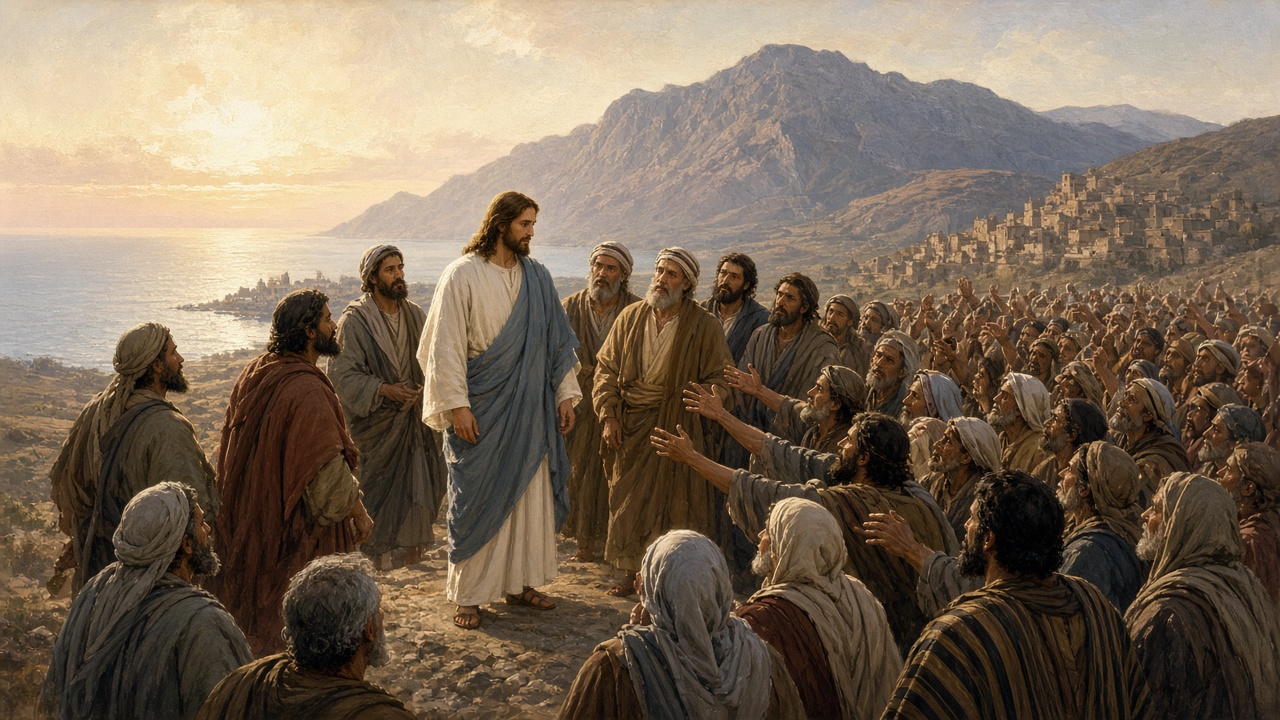
- Jesús bajó con ellos y se detuvo en un lugar llano, donde se había reunido gente de Judea, de Jerusalén y de la costa de Tiro y Sidón para oírlo y ser sanada. Tiro y Sidón eran antiguas ciudades fenicias del Mediterráneo; Sidón, la más antigua, quedaba a unas veinticinco millas al norte de Tiro. Una cronología fecha esta enseñanza en el año 28 d. C. y la titula Sermón del Monte, aunque el relato sitúa a Jesús en terreno llano después de bajar del monte.Fuentes: el propio texto bíblico · Tyre · Sidon · Sermon on the Mount
Notas escritas con ayuda de IA a partir de fuentes abiertas (Theographic Bible Metadata, CC BY-SA 4.0; Easton’s Bible Dictionary, dominio público) y revisadas antes de publicarse.
Lugares de este capítulo
- Jerusalem · 31.777, 35.234 · versículo 17
- Judea · Hoy: Judea 1 · 31.777, 35.234 · versículo 17
- Sidon · Hoy: Sandikli archaeological site in Sidon · 33.561, 35.372 · versículo 17
- Tyre · 33.271, 35.196 · versículo 17
Solo aparecen lugares identificados con alta confianza (90 % o más según las fuentes académicas reunidas por OpenBible). Mapa de la época: DARE (Digital Atlas of the Roman Empire), CC BY 4.0; mapa actual: © colaboradores de OpenStreetMap; lugares: OpenBible.info (CC BY 4.0).
Créditos y licencia de esta traducción
I 'utz laj tzij re i dios
New Testament in Achi (I 'utz laj tzij re i dios)
copyright © 2009 Wycliffe Bible Translators, Inc.
Language: Achi
Dialect: Cubulco
Translation by: Wycliffe Bible Translators, Inc.
Achi, Cubulco
Achi' is a Mayan language very
closely related to K'iche' (Quiché in the older orthography). It is spoken by the
Achi people, primarily in the area of Baja Verapaz in Guatemala. There are two Achi'
dialects. Cubulco Achi' is spoken by approximately 48,000 people in the Cubulco area
west of Rabinal area. Rabinal Achi' is spoken by approximately 37,000 people in the
Rabinal area.
El Nuevo Testamento
en el idioma Achí de Cubulco de
Guatemala
Ediciones anteriores
Segunda edición
©2009, Wycliffe Bible
Translators
Primera edición
Publicado por
©1984, Sociedad Bíblica
Internacional
Copyright Information
© 2009, Wycliffe Inc. All rights reserved.
This translation text is made available to you under the terms of the Creative
Commons License: Attribution-Noncommercial-No Derivative Works. ( http://creativecommons.org/licenses/by-nc-nd/3.0/ ) In addition, you have
permission to port the text to different file formats, as long as you do not change
any of the text or punctuation of the Bible.
You may share, copy, distribute, transmit, and extract portions or quotations from
this work, provided that you include the above copyright information:
You must give Attribution to the work.
You do not sell this work for a profit.
You do not make any derivative works that change any of the actual words or
punctuation of the Scriptures.
Permissions beyond the scope of this license may be available if you contact us
with your request. If you want to revise a translation, use a translation in an
adaptation, or use a translation commercially, we will consider your request.
NT:segunda edición
The New Testament
in Achi
© 2009, Wycliffe Inc. All rights reserved.
This translation is made available to you under the terms of the
Creative Commons Attribution-Noncommercial-No Derivatives license 4.0.
You may share and redistribute this Bible translation or extracts from it in any format, provided that:
You include the above copyright and source information.
You do not sell this work for a profit.
You do not change any of the words or punctuation of the Scriptures.
Pictures included with Scriptures and other documents on this site are licensed just for use with those Scriptures and documents.
For other uses, please contact the respective copyright owners.
2013-01-05
Fuente: http://ebible.org/acr-acc/ · eBible.org