Hechos 20
I 'utz laj tzij re i dios · Toca un versículo para ver sus referencias cruzadas.
U ʼenam i ma Páblo pa Macedónia xak pa Grécia
1Are xuxlan i chʼokowic, i ma Páblo xe u siqʼuij i creyent ruʼ, yabal re qui nojbal. Teʼuri xe u tzʼulej, xe u ʼijla canok, y xa ʼe pa Macedónia. 2Xe u solij i tak tinimit re i jyub-le, y xu ya u cowil qui cʼux i creyent ruʼ tak u tzij. Teʼuri xa ʼe pa Grécia. 3Chila xoʼon wi oxib icʼ; teʼuri xu yijba rib, ʼenam-re pa Síria. Are ya ca ʼan te pa bárco, xretamaj chi i aj Israel winak qui yijbam wach u chapic quiqui ʼan che. Rumal-i, xu chʼobo n-ca ʼe ta pa bárco, y xtzalijic; xu maj chubi u be pa jyub Macedónia. 4Je ʼo jujun creyent xcachiʼilaj bic: jun chique are i ma Sópater, aj Beréa; queb chic je aj Tesalónica, je are i ma Aristárco, i ma Segúndo; jun chic are i ma Gáyo, aj Dérbe; xak ʼo i a-Timotéo; xak je ʼo i ma Tíquico y ma Trófimo chi je aj pa jyub Asia. 5Xui-ri, ique xe nabej bic, xe ʼe cʼa pa tinimit Tróas; chila xoj coyʼej wi. 6Yoj xkoyʼej i ricʼawic i nimaʼij chi ca tijaw wi i caxlanwa n-ta cunbal che. Teʼuri xoj ʼan pa bárco y xoj el pa Filípos. Che i joʼob ʼij, xe ʼe ka maja pa Tróas pa oj coyʼem wi; chila xoj qʼuiji wi wukub ʼij.
I qʼuisbal chic cʼutunic xu ʼan i ma Páblo pa tinimit Tróas
7Che i nabe ʼij re i seman, xka mol kib cuʼ i creyent chu tijawic ka wa. Teʼuri i ma Páblo xoc chu cʼutic chique i je moltajnak. Lic xnajtin chu cʼutic chique, man ʼo tan chic u viáje chucab ʼij. Rumal-i cʼa tiqʼuil aʼab ca tijin chi tzij. 8I cuárto pa ka molom wi kib ʼo cʼa pa oxleja; chila qʼui i ʼaʼ tzijtalic. 9ʼO jun ala cul pa wantana, a-Eutico u bi. Ire craj chic waram, man i ma Páblo xnajtin chi chʼaʼatic, y ya naj chic chaʼab. Are u ʼonquil i ala-le lic xoc li u waram y xak teʼet xtzak li cʼa pulew. Are xqui yaco, ya camnak chic. 10Teʼuri i ma Páblo xkaj lok, xjupi chirij, y xu tzʼulej. Xu bij chique i creyent:
—Mi xij iwib; ire cʼaslic —xu bij.
11Teʼuri xel chubic y xu tij wa cuʼ i creyent. Are xrelej, xoc chic che u cʼutunic chique cʼa che u sakirbal. Teʼuri xa ʼec. 12I ala chi tzaknak pa wantana, xqui cʼam bi chi rachoch, cʼaslic; conojel xcubi qui cʼux man xcʼasi chic.
U ʼenam i ma Páblo pa Miléto chu nakaj i Efeso
13Teʼuri xoj ʼe yoj pa bárco cʼa pa tinimit Ason, man i ma Páblo xu chʼobo chi ʼutz coj nabej bi yoj; xui-ri ire n-xicʼaw ta chuwi ya, xa xu ya vuélta che akan y xu bij chi caka rik kib chila pa Ason. Queje ile xka yijba chakawach. 14Are xka rik kib chila ruʼ ire, xa ʼan bi kuʼ pa bárco, y xoj ʼe junam pa tinimit Mitiléne. 15Teʼuri xoj ʼec, y chucab ʼij xoj icʼaw chuwach i tinimit Quío. Cʼa che chic jun ʼij xoj upon pa tinimit Sámos, chi ʼo chu chiʼ i mar. Xoj uxlan jubiʼ pa tinimit Trogílio, y chucab ʼij xoj upon pa tinimit Miléto. 16Queje ile xka ʼano, man i ma Páblo craj uponic weʼ pa Jerusalen, man craj ca ʼe rila i nimaʼij Pentecostes chila. Rumal-i, n-xraj ta ʼenam pa Efeso, y n-xraj ta xu bay mas rib pa jyub Asia. Rumal-i queje ile xka ʼano.
U tzij i ma Páblo chique i je aj cʼamol u tzam i jutzobaj creyent pa Efeso
17I ma Páblo, are ʼo pa Miléto, xu tak qui siqʼuixic i aj cʼamol u tzam chique i creyent pa tinimit Efeso. 18Are xe cʼun ruʼ, xu bij chique:
—Yix lic iwilom wach in cʼaslemal chiwach; lic iwilom wach in ʼanom chu jekbal lok iwuʼ yix waral pa Asia. 19Lic xin ya wib chu ʼonquil u chac i Kajwal; n-xin ʼan ta nim che wib chiwach. Queje ile xin ʼano, tupu ʼolic xin oʼ rumal u qʼuial cʼax xpe pin wi cumal i aj Israel chi xcaj in chapic. 20Xui-ri, n-xin xij ta wib chu bixquil chiwe niʼpa i tzij rajwaxic chiwe, xak n-xin mayij tu cʼutic chiwe wach i ʼutz qui ʼano. Queje ile xin ʼano are i molom iwib, xak queje xin ʼan chi tak iwachoch. 21Lic xin ʼalijinsaj chiwe chi ʼo u chac qui jalwachij i cʼaslemal chuwach i Dios, xak qui cuba i cʼux che i Kajwal Jesucrísto. Queje ile xin cʼut chique i aj Israel winak xak chique i ne te aj Israel. 22Woʼor ʼut, quin ʼe Jerusalen, man i u Tewal i Dios quin u tak bi chila. Quin ʼec, tupu n-wetaʼam taj wach quin cʼulmaj chila. 23Xui-ri, wetaʼam ipa quin ʼe wi pa tak tinimit, quin tij uyej; ʼolic quin qui min pa cárcel. Ile wetaʼam, man i u Tewal i Dios ca bin chwe. 24Niʼpa ile n-quin cʼachir ta rumal, xak mi ne che in cʼaslemal. N-ta we che, we xin camic, o we in cʼaslic. Are i ʼo we che, are we quin quicotic quin qʼuis u ʼonquil in chac chi u yom i Kajwal Jesus chinkul; i in chac-i are u paxsaxic u tzijol i cʼaxnabal u cʼux i Dios chique conojel.
25Woʼor wetaʼam chi mi jun chiwe cril chic in wach. In cʼutum chiwe iwonojel wach usucʼ i ʼatbal tzij re i Dios pakawi. 26Rumal-i, woʼor cwaj quin bij chiwe: we ʼo jun chiwe yix ca sachic, n-in mac ta chic yin. 27In bim chic ronojel wach u chʼobom i Dios; lic n-ta wuwam u wach chiwe. 28Chiwila iwib yix, xak che iwila i jutzobaj creyent, man i u Tewal i Dios u yom u chajixic chikul. Che i chajij pacha quiqui ʼan i je aj chajil chij. Queje ile chi ʼana che i jutzobaj re i Kajwal, man ire je u loʼom ruʼ u quiqʼuel. 29Che iwila, man wetaʼam, are quin ʼe yin, que cʼun juban chic chu quichersaxic i jutzobaj; quiqui ʼan na pacha quiqui ʼan utiw chiquixol jutzobaj chij. 30Chixol yix mísmo ʼo ni que walij chu tʼoric i jutzobaj creyent, cʼambal bi qui wach. 31Chi ʼana cwent ʼu iwib; cha cʼun chi cʼux chi yin oxib junab u wach, chi paʼij, chi chaʼab, xin oʼic xix in pixbaj chi jujunal.
32Woʼor, wachalal, quix in ya can puʼab i Dios chi quix u chajij; chi chʼobo i u tzij man are ile ca ʼalijinsaw i cʼaxnabal u cʼux i Dios chiwe. I tzij-le cu cowirsaj u cubibal i cʼux, xak quix u to chu rikic i ʼutz chi cu ya i Dios piquiwi conojel i je re ire. 33N-in rayim tu wach u mer jun chic, xak ni u ʼuʼ. 34Are in ʼanom, in chacun-nak ruʼ in ʼab, chʼacbal re niʼpa i rajwaxic chwe, xak chique niʼpa i que chacun wuʼ. Lic iwetaʼam yix ile. 35Ile lic ʼax in cʼutum wi chiwe chi ʼo u chac coj chacunic, chʼacbal-re wach caka tobej-que i nibaʼib. Cha cʼun chaka cʼux wach xu bij i Kajwal Jesucrísto. Xu bij: “Jun winak, mas ca quicotic we ca sipanic, chuwach i jun chi cu cʼam i sipon.” Queje ile xu bij Kajwal —xu bij i ma Páblo chique.
36Are xrelej u bixquil ile, xe xuqui junam, y xqui tzʼonoj che i Dios. 37Conojel xe oʼic; xqui tzʼulej i ma Páblo, y xqui tzʼubaj. 38Lic que bisonic, man xu bij chique chi n-caquil ta chic u wach. Teʼuri xcachiʼilaj bic cʼa ruʼ i bárco.
¿Sabías que…?
Despedida camino a Jerusalén
- Al salir de Troas, Pablo envió a sus compañeros por delante en el barco y caminó hasta Assos por el camino romano. Assos era un puerto de la Asia proconsular, en Misia, en la costa norte del golfo de Adramitio; el trayecto a pie era de unas 20 millas, el de mar de unas 30, y la isla de Lesbos quedaba a unas 7 millas de la costa.Fuentes: el propio texto bíblico · Assos
- Pablo pasó de largo frente a Éfeso para no demorarse en la provincia de Asia —la provincia romana del oeste de Asia Menor, cuya capital era Éfeso—, porque esperaba, si era posible, llegar a Jerusalén para el día de Pentecostés. Se detuvo en Mileto, un puerto y la antigua capital de Jonia, a unas 36 millas al sur de Éfeso, y mandó llamar a los ancianos de la iglesia de Éfeso.Fuentes: el propio texto bíblico · Asia · Miletus
- Siete hombres viajaban con él: Sópater de Berea, Aristarco y Segundo de Tesalónica, Gayo de Derbe, Timoteo, y Tíquico y Trófimo de Asia. Aristarco, de Tesalónica, más tarde compartió el encarcelamiento de Pablo en Roma, y Trófimo, efesio, lo acompañó en esta parte del viaje y estuvo con él en Jerusalén.Fuentes: el propio texto bíblico · Aristarchus · Trophimus
Notas escritas con ayuda de IA a partir de fuentes abiertas (Theographic Bible Metadata, CC BY-SA 4.0; Easton’s Bible Dictionary, dominio público) y revisadas antes de publicarse.
Lugares de este capítulo
- Macedonia · 41.600, 22.540 · versículos 1, 3, 6
- Greece · 37.972, 23.727 · versículo 2
- Syria · Hoy: Syria 2 · 33.511, 36.306 · versículo 3
- Asia · 38.400, 28.300 · versículos 4, 16, 18
- Berea · Hoy: Veria · 40.518, 22.200 · versículo 4
- Thessalonica · Hoy: Thessaloniki · 40.638, 22.946 · versículo 4
- Troas · Hoy: Alexandria Troas · 39.752, 26.159 · versículos 5, 6
- Philippi · 41.012, 24.285 · versículo 6
- Assos · 39.491, 26.337 · versículos 13, 14
- Mitylene · Hoy: ancient theater at Mitylene · 39.110, 26.547 · versículo 14
- Chios · 38.373, 26.137 · versículo 15
- Miletus · 37.531, 27.276 · versículos 15, 17
- Samos · 37.750, 26.833 · versículo 15
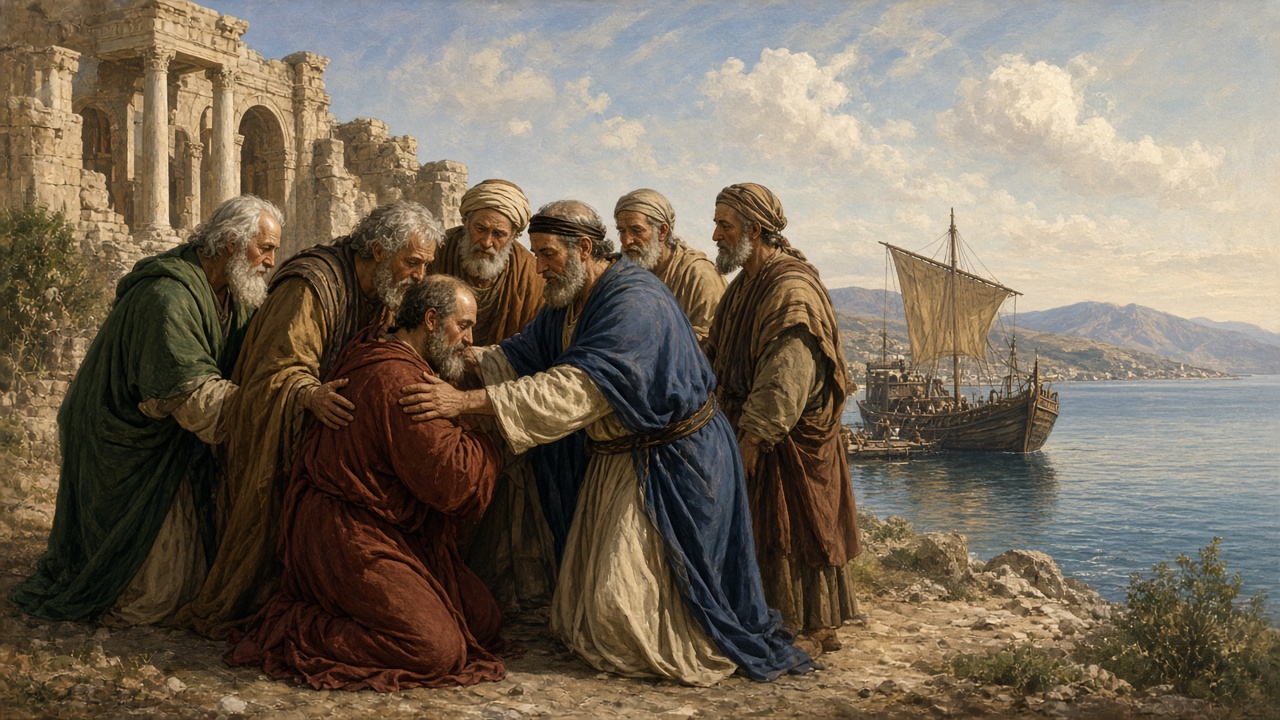
- Trogyllium · Hoy: Cape Mycale · 37.659, 27.003 · versículo 15
- Ephesus · 37.939, 27.341 · versículos 16, 17
- Jerusalem · 31.777, 35.234 · versículos 16, 22
Solo aparecen lugares identificados con alta confianza (90 % o más según las fuentes académicas reunidas por OpenBible). Mapa de la época: DARE (Digital Atlas of the Roman Empire), CC BY 4.0; mapa actual: © colaboradores de OpenStreetMap; lugares: OpenBible.info (CC BY 4.0).
Créditos y licencia de esta traducción
I 'utz laj tzij re i dios
New Testament in Achi (I 'utz laj tzij re i dios)
copyright © 2009 Wycliffe Bible Translators, Inc.
Language: Achi
Dialect: Cubulco
Translation by: Wycliffe Bible Translators, Inc.
Achi, Cubulco
Achi' is a Mayan language very
closely related to K'iche' (Quiché in the older orthography). It is spoken by the
Achi people, primarily in the area of Baja Verapaz in Guatemala. There are two Achi'
dialects. Cubulco Achi' is spoken by approximately 48,000 people in the Cubulco area
west of Rabinal area. Rabinal Achi' is spoken by approximately 37,000 people in the
Rabinal area.
El Nuevo Testamento
en el idioma Achí de Cubulco de
Guatemala
Ediciones anteriores
Segunda edición
©2009, Wycliffe Bible
Translators
Primera edición
Publicado por
©1984, Sociedad Bíblica
Internacional
Copyright Information
© 2009, Wycliffe Inc. All rights reserved.
This translation text is made available to you under the terms of the Creative
Commons License: Attribution-Noncommercial-No Derivative Works. ( http://creativecommons.org/licenses/by-nc-nd/3.0/ ) In addition, you have
permission to port the text to different file formats, as long as you do not change
any of the text or punctuation of the Bible.
You may share, copy, distribute, transmit, and extract portions or quotations from
this work, provided that you include the above copyright information:
You must give Attribution to the work.
You do not sell this work for a profit.
You do not make any derivative works that change any of the actual words or
punctuation of the Scriptures.
Permissions beyond the scope of this license may be available if you contact us
with your request. If you want to revise a translation, use a translation in an
adaptation, or use a translation commercially, we will consider your request.
NT:segunda edición
The New Testament
in Achi
© 2009, Wycliffe Inc. All rights reserved.
This translation is made available to you under the terms of the
Creative Commons Attribution-Noncommercial-No Derivatives license 4.0.
You may share and redistribute this Bible translation or extracts from it in any format, provided that:
You include the above copyright and source information.
You do not sell this work for a profit.
You do not change any of the words or punctuation of the Scriptures.
Pictures included with Scriptures and other documents on this site are licensed just for use with those Scriptures and documents.
For other uses, please contact the respective copyright owners.
2013-01-05
Fuente: http://ebible.org/acr-acc/ · eBible.org