Isaiah 64
YAUBADA YANA VONA'AWAUFAUFA 'IVAUNA · Tap a verse to see its cross-references.
4Tutuya basenadiotoga i maiga 'asiau,
kebu tamu yaubada tulina 'omu yama Yaubada bani'odi,
yaubadanina tulina kebu tamu aitoi i da 'iseni 'alo bonana i da nogai.
We'e 'omu yama Yaubada, tomotoganidi i vetumagana 'waimuye, 'aisedi 'u 'i'ivaisedi.
5Egavo ma yadi sosoana sauluva 'atumaidi i 'i'idewadiga,
wata yamu sauluva tonovidi i vevetutuyamedi,
'omu 'u lulu'uma'umaiedi.
We'e 'ima, tutuya manamanawena 'a kwayega sauluva sakoidi 'a 'i'idewadi,
begaidi 'u nunuasakoyema.
'Ana fata 'ita'ita'i 'a na veluagai?
6Yama sauluva sakoidi 'waidiega, matatabuma 'a veyoke matamuye.
Igodi 'a vevewavawava nuanuama yama sauluva i na tonova matamuye,
siwe naninidi matatabuna 'waimuye 'wa da vo bani'odi kaleko dibulakata yokeyoke-otogina.
Yada sakonanidi i eva-vuvueda, 'wa da vo bani'odi welavi lukudi 'adalidi kaukau i da lubewevuvueni.
7Siwe kebu tamu aitoi 'waimuye i da velu'ui,
'alo i da wai 'aivaita faifaina
begaidi 'u vedumwe'ubu'ubusema.
Yama sauluva sakoidi 'u tauyedi i na 'ivesakoima.
8'Auvea, 'omu 'ima tamama.
'Ima bani'odi fwayafwaya dekudekuna,
'omu bani'odi nau 'ana to'abi,
nimamuyega 'u 'idewama 'a souyema.
9Kebu 'u na toke 'u na nuasakoyema,
kebu yama sauluva sakoidi 'u na nuave'avinidi
fai matatabuma yamu tomotoga,
begaidi ma yamu 'isanuakalikali 'u da 'i'isave'avinima.
Did you know?
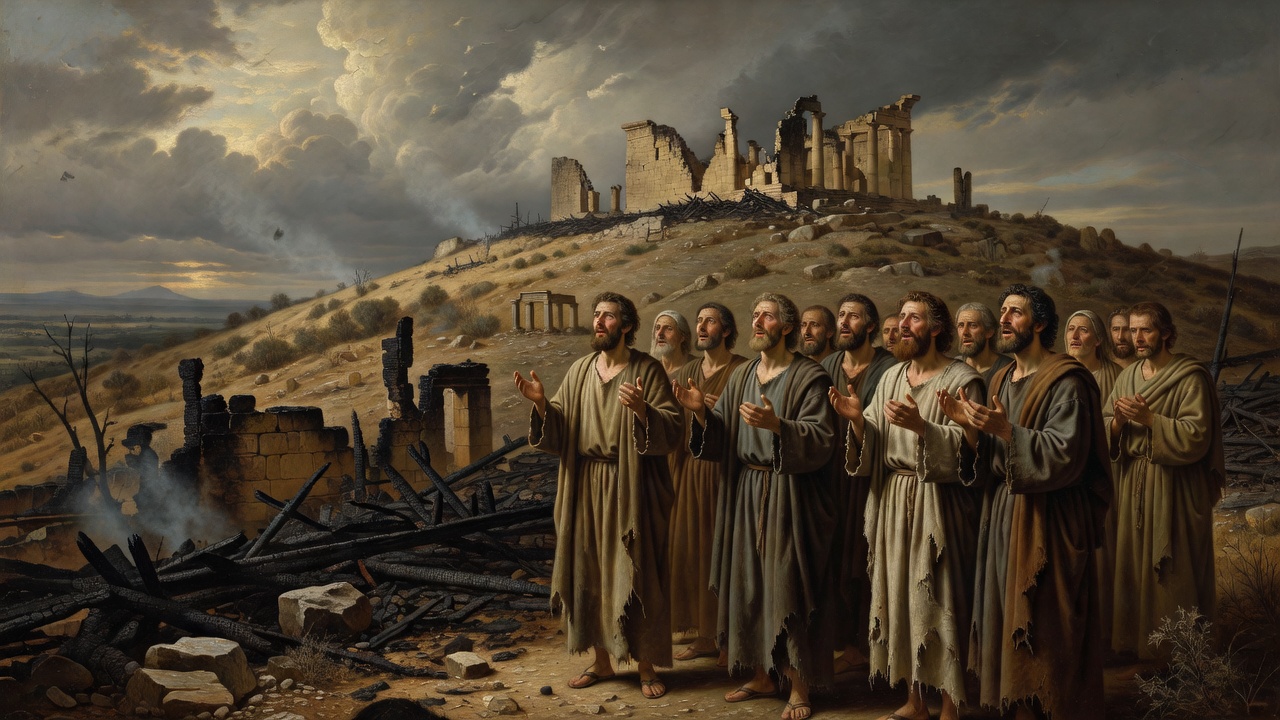
A Prayer for Mercy Amid Ruin
- The passage opens with a plea for God to rend the heavens and descend with world-shaking power, like fire that kindles brushwood. Yet it contrasts this desire for divine presence with a confession of human unworthiness, comparing people to withering leaves swept away by their own iniquities.Sources: the Bible text itself
- In Isaiah 64, the community appeals to God as a Father and craftsman, declaring, "we are the clay, and You are the potter." This imagery emphasizes human frailty and total dependence on God, pleading for divine mercy despite their acknowledged guilt.Sources: the Bible text itself
- The chapter laments the destruction of sacred spaces, describing Zion and Jerusalem as desolate wastelands. It specifically mourns the burning and ruin of the holy temple where past generations had offered praise.Sources: the Bible text itself · Zion · Jerusalem
Notes written with AI assistance from open sources (Theographic Bible Metadata, CC BY-SA 4.0; Easton’s Bible Dictionary, public domain) and reviewed before publishing.
Places in this chapter
Only places identified with high confidence are shown (90% or more according to the scholarly sources compiled by OpenBible). Period map: DARE (Digital Atlas of the Roman Empire), CC BY 4.0; modern map: © OpenStreetMap contributors; places: OpenBible.info (CC BY 4.0).
Credits and license for this translation
YAUBADA YANA VONA'AWAUFAUFA 'IVAUNA
The New Testament in the Iamalele dialect of the Ubuvala Language of Papua New Guinea
Nupela Testamen long tokples Ubuvala long Niugini
copyright © 1984, 1988, 2025 Wycliffe Bible Translators, Inc. and SIL Papua New Guinea
Language: Ubuvala (Iamalele)
Dialect: Iamalele
Translation by: SIL PNG
Contributor: Wycliffe Bible Translators
This translation is made available to you under the terms of the
Creative Commons Attribution-Noncommercial-No Derivatives license 4.0.
You may share and redistribute this Bible translation or extracts from it in any format, provided that:
You include the above copyright and source information.
You do not sell this work for a profit.
You do not change any of the words or punctuation of the Scriptures.
Pictures included with Scriptures and other documents on this site are licensed just for use with those Scriptures and documents.
For other uses, please contact the respective copyright owners.
2026-09-30
Source: http://png.bible/yml/ · eBible.org