Deuteronomy 4
YAUBADA YANA VONA'AWAUFAUFA 'IVAUNA · Tap a verse to see its cross-references.

About this book
About Deuteronomy
- Easton's Bible Dictionary (1897) explains that the Greek name Deuteronomion, the second law, gave us Deuteronomy: a second statement of laws already promulgated. It says the division of the Pentateuch into five books was probably first made by the Greek translators, whom the Vulgate follows. Jews name the book from its opening Hebrew words, 'Elle haddabharim, These are the words.Sources: Easton: Deuteronomy
- Easton's Bible Dictionary (1897) presents Deuteronomy as chiefly three discourses delivered by Moses a short time before his death, spoken to all Israel in the eleventh month of the last year of their wanderings in the wilderness. It says the story of his death and burial was written by some other hand, probably that of Joshua, who succeeded him as leader of Israel.Sources: Easton: Deuteronomy · Joshua
- The discourses of Deuteronomy are set in the plains of Moab, east of the Jordan and opposite Jericho, Israel's last encampment before entering Canaan, a region then held by the Amorites. East of the Jordan the Israelites had defeated Sihon, king of the Amorites, whose country ran from the Arnon to the Jabbok, and Og, king of Bashan, whose kingdom was given to Reuben, Gad, and half the tribe of Manasseh.Sources: Easton: Deuteronomy · Moab · Sihon · Og
- Easton's Bible Dictionary (1897) describes three discourses: the first (1-4:40) recapitulates forty years in the wilderness, exhorts obedience to the divine ordinances, and warns against forsaking the God of their fathers; the second (5-26:19), the body of the book, restates the law given at Mount Sinai and instructs Israel for life in Canaan; the third (chapters 27-30) sets out blessings for the obedient and the curse on the rebellious, urging faithfulness to the covenant.Sources: Easton: Deuteronomy
- Easton's Bible Dictionary (1897) adds three appendices after the addresses: a song which God had commanded Moses to write (32:1-47), blessings pronounced on the separate tribes (chapter 33), and the story of his death (32:48-52) and burial (chapter 34). In Hebrew manuscripts the Pentateuch forms one scroll; Jews divided this book into eleven parshioth, and the English Bible contains thirty-four chapters.Sources: Easton: Deuteronomy
Notes written with AI assistance from open sources (Theographic Bible Metadata, CC BY-SA 4.0; Easton’s Bible Dictionary, public domain) and reviewed before publishing.
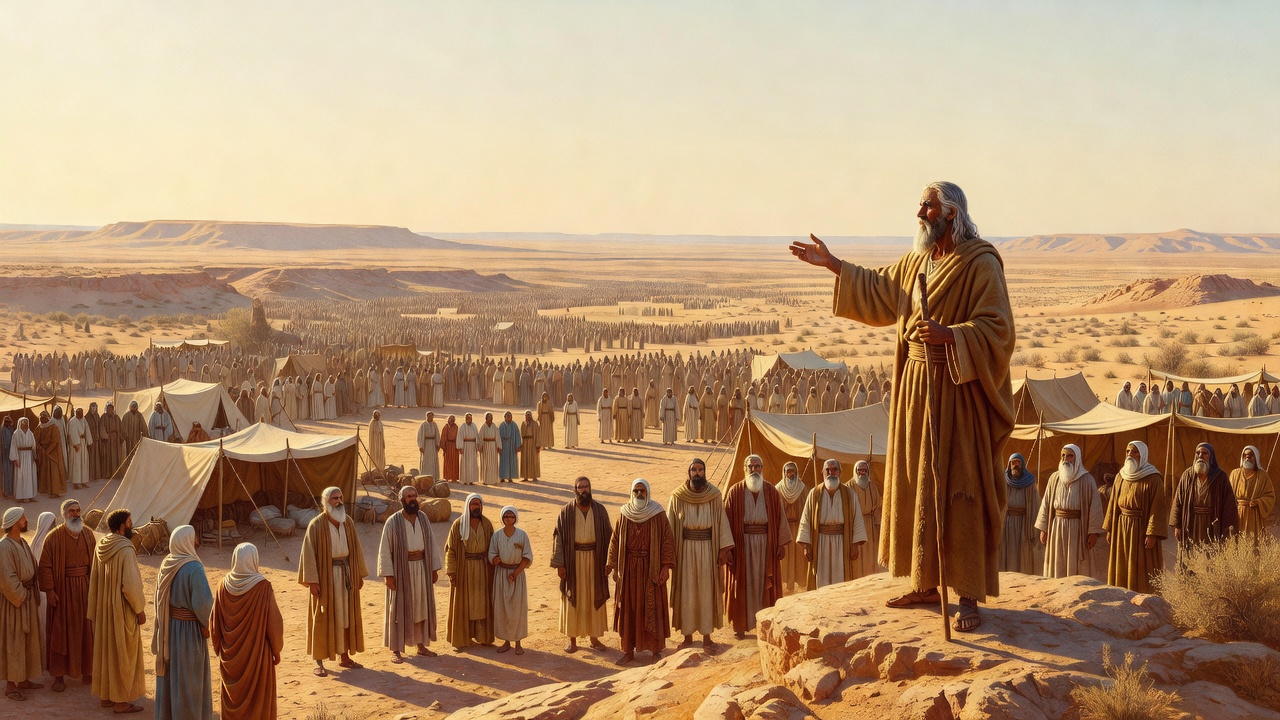
Mosese me Isileli i vonedi bega i na vematayakayaka
1Wata Mosese me Isileli i vonedi i vo, 'Omi me Isileli, 'wa ve'wada a na vonemi. Veimea wata awave'eda'eda 'asiau a vevemiga 'wa na nogaidi 'wa na vematayakeyakedi bega ma yawaimi 'wa na miamia, nika 'ami fata 'wa na luku 'awalawanina 'Auvea tubudavo yadi Yaubada i velevelemiga, 'wa na 'ewai 'wa na vetoniwakeni. 2Veimeanidi a lu'ivoneyedi kebu 'wa na 'imoso'i wata kebu 'wa na 'ewayavulagi 'waidiega. 'Auvea yami Yaubada yana veimea 'wa na nogaidi 'wa na vematayakeyakedimo.
6Veimeanidi 'asa'aiana 'wa na vematayakeyakedi nika mali tomotoga yami nuamageta wata yami nuanua tonovidi i na 'isa'inanai. Tutuyanina veimeanidi i na nogaidi i na vo, Mogitana, me Isileli 'adi 'aila'a bwaikina, tomotoganidi yadi nuamageta wata yadi nuanua tonovidi.’
7'Auvea yada Yaubada lilivadeye, tutuyanina ta na velu'ui 'waineye bonada i noganogai. Kebu tamu 'aila'a bwaikina 'alo siaina yana yaubadavo bani'odi. 8'Asiau veimeanidi a lulu'ivoneyedi matatabuna tonovidi wata 'atumaidi, kebu tamu 'aila'a bwaikina 'alo siaina yana veimea wata ve'etoboda bani'odiga.
32'Auvea yada Yaubada yana toketokena bwaikina 'wainega i vagavaimi Itifitayega 'wa souyemi, 'eba nuavogana wata 'eba nua'ewa bwaikidi i 'idewadi matamie. Me Itifita 'waidie i lugavia faifaimi bega veviga bwaikina i veledi. I vagavaimi, 'omi yana tomotogavo, wata 'Oya Sainai 'waineye 'wa nogai, taunina i veifufu 'ai 'ala'alata nagenega siwe bola ma yawaimi 'wa miamiani. Kebu tamu tutuya nani de'e bani'odi i da souyeni, kebu'a'ava. Nuami i na vilai i na nago 'idewavau 'waineye, tutuyanina Yaubada tomogo kumekumetana i 'idewai i maiga 'asiau 'wa na 'iseni, wata fwayafwaya matatabuna 'waineamo 'wa na lauala, kebu tamu nani de'e bani'odi 'wa na veluagaiga.
39'Wa na nuave'avini wata 'wa na vetumaganeni tutuya matatabuna, kebu nuami i na fani, 'Auvea yami Yaubada abama nageneye i miamia wata fwayafwaya 'waineye. Kebu tamu yaubada i da miamia. 40Yana veimea wata yana awave'eda'eda 'asiau a velevelemiga, matatabuna 'wa na ve'ililibuyedi bega 'omi wata tubumiavo yami mia i na ve'atumai wata yami tutuya i na vemanawe fwayafwayanina 'Auvea yami Yaubada i velevelemi 'asiau wata tutuya matatabuna faifaina.”
Did you know?
A Call to Obedience and the Cities of Refuge
- Moses reminded Israel that at Mount Horeb they heard God's voice from the fire but saw no visible form. This absence of a physical appearance served as the primary foundation for the strict prohibition against making any carved image or idol of God.Sources: the Bible text itself · Horeb
- The text cites the incident at Baal-peor, where Israelites who followed the Moabite deity were destroyed. Moses pointed out that those who remained faithful survived, using this recent event as a clear warning against idolatry.Sources: the Bible text itself · Baal · Baal-peor
- After defeating the Amorite kings Sihon and Og, Moses designated three cities of refuge east of the Jordan: Bezer, Ramoth, and Golan. These locations provided asylum for individuals who caused an unintentional, non-malicious death.Sources: the Bible text itself · Sihon · Og · Golan
Notes written with AI assistance from open sources (Theographic Bible Metadata, CC BY-SA 4.0; Easton’s Bible Dictionary, public domain) and reviewed before publishing.
Places in this chapter
- Peor · Today: within 1 km of Khirbet Ayun Musa · 31.777, 35.738 · verse 3
- Mount Horeb · Today: Jebel Musa · 28.540, 33.973 · verses 10, 15
- Jordan · Today: Jordan River · 31.761, 35.558 · verses 14, 21, 22, 26, 41, 46, 47, 49
- Egypt · 30.129, 31.308 · verses 20, 34, 37, 45, 46
- Bashan · 32.781, 35.935 · verses 43, 47
- Gilead · Today: Gilead 1 · 32.187, 35.692 · verse 43
- Ramoth · Today: Tall er Rumeith · 32.500, 36.015 · verse 43
- Mount Hermon · 33.400, 35.850 · verse 48
- Valley of the Arnon · Today: Wadi Mujib · 31.466, 35.573 · verse 48
- Arabah · 30.417, 35.151 · verse 49
- Salt Sea · Today: Dead Sea · 31.500, 35.500 · verse 49
Only places identified with high confidence are shown (90% or more according to the scholarly sources compiled by OpenBible). Period map: DARE (Digital Atlas of the Roman Empire), CC BY 4.0; modern map: © OpenStreetMap contributors; places: OpenBible.info (CC BY 4.0).
Credits and license for this translation
YAUBADA YANA VONA'AWAUFAUFA 'IVAUNA
The New Testament in the Iamalele dialect of the Ubuvala Language of Papua New Guinea
Nupela Testamen long tokples Ubuvala long Niugini
copyright © 1984, 1988, 2025 Wycliffe Bible Translators, Inc. and SIL Papua New Guinea
Language: Ubuvala (Iamalele)
Dialect: Iamalele
Translation by: SIL PNG
Contributor: Wycliffe Bible Translators
This translation is made available to you under the terms of the
Creative Commons Attribution-Noncommercial-No Derivatives license 4.0.
You may share and redistribute this Bible translation or extracts from it in any format, provided that:
You include the above copyright and source information.
You do not sell this work for a profit.
You do not change any of the words or punctuation of the Scriptures.
Pictures included with Scriptures and other documents on this site are licensed just for use with those Scriptures and documents.
For other uses, please contact the respective copyright owners.
2026-09-30
Source: http://png.bible/yml/ · eBible.org