1 Kings 2
YAUBADA YANA VONA'AWAUFAUFA 'IVAUNA · Tap a verse to see its cross-references.

About this book
About 1 Kings
- Easton's Bible Dictionary (1897) treats the authorship of the books of Kings as uncertain. A tradition that Jeremiah wrote them is, in Easton's view, supported by passages almost identical with parts of Jeremiah and by events Jeremiah knew personally, yet Easton thinks it more probable that Ezra, after the Captivity, compiled the books from earlier documents, perhaps written by David, Solomon, Nathan, Gad, and Iddo. Easton dates the composition between 561 B.C., when Jehoiachin was released from captivity by Evil-merodach, and 538 B.C., the decree of Cyrus.Sources: Easton: Kings, The Books of
- Easton says these books contain the annals of the kingdom from Solomon's accession until Nebuchadnezzar and the Babylonians subdued it, a period he estimates at about 453 years. 1 Kings opens while David is dying: Adonijah, his fourth son, who had become heir-apparent to the throne after the deaths of Amnon and Absalom, has himself proclaimed king, but Nathan and Bathsheba persuade David to enthrone Solomon at once. Solomon, David's son by Bathsheba, whose history is recorded in 1 Kings 1-11, came to the throne, Easton suggests, at about sixteen or eighteen.Sources: Easton: Kings, The Books of · Adonijah · Solomon
- In the Hebrew Scriptures the two books of Kings originally formed one book; the Septuagint first divided them and, with the Vulgate, numbers them as the third and fourth books of Kings, the books of Samuel being the first and second. Easton notes that Chronicles gives greater prominence to the priestly or Levitical office, while Kings gives greater prominence to the royal office, and that in the threefold division of the Scriptures by the Jews these books are ranked among the Prophets. The narrative points to earlier sources: the book of the acts of Solomon and the chronicles of the kings of Judah and of Israel.Sources: Easton: Kings, The Books of
- After Solomon's death the ten tribes revolted and invited Jeroboam, son of Nebat, to be their king; Easton calls him the first king of those tribes and dates his reign from 976 to 945 B.C. He had fled to Egypt under the protection of Shishak I, and later moved his residence from Shechem, his first capital, to Tirzah, which remained the chief residence of Israel's kings until Omri bought the hill of Shomeron from Shemer for two talents of silver and built Samaria. The later narrative includes Ahab, Omri's son and the seventh king of Israel, whose wife was Jezebel: to the calf worship introduced by Jeroboam he added the worship of Baal, and he was severely admonished by the prophet Elijah.Sources: Jeroboam · Tirzah · Samaria · Ahab
Notes written with AI assistance from open sources (Theographic Bible Metadata, CC BY-SA 4.0; Easton’s Bible Dictionary, public domain) and reviewed before publishing.
Kini Devida yawaina i 'a'ava
10Kini Devida me Isileli i veveimeyedi malamala 40 nagedie mulieta yawaina i 'a'ava i ve'ufai Ielusalema. Tutuyanina i veveimea, malamala 7 i miamia 'atamana Ebiloni, mulieta malamala 33 nagedie i mia Ielusalema 'waineye. 12Mulieta natuna Solomoni i ve-kini tamana tutulina, me Isileli i veveimeyedi we'e Yaubada yana veimea i kiavetoketokei.
Did you know?
Solomon Establishes His Kingdom
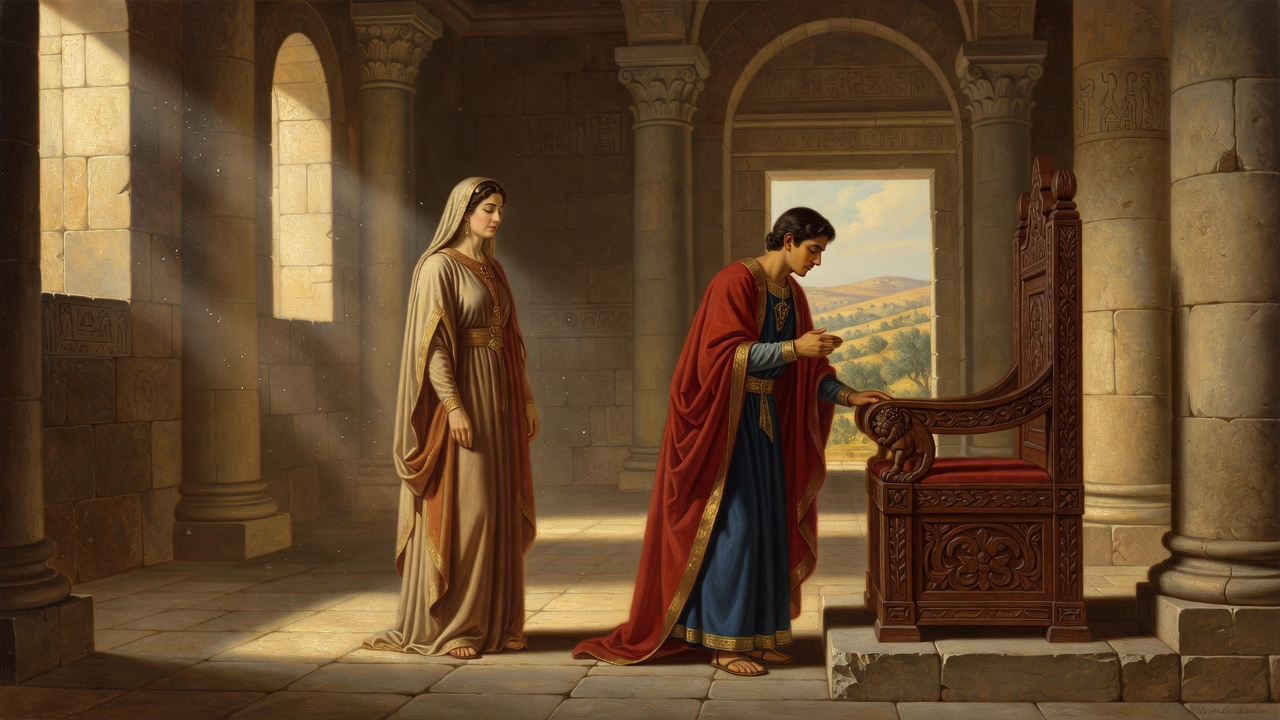
- David died after reigning for forty years—seven in Hebron and thirty-three in Jerusalem—and was buried in the City of David. Before his death, he urged Solomon to observe the Law of Moses and gave specific instructions regarding figures from his reign, including Joab, the sons of Barzillai, and Shimei.Sources: the Bible text itself · Hebron · Jerusalem · David
- Adonijah, David's fourth son, asked Bathsheba to plead with Solomon so that he might marry Abishag the Shunammite, who had attended the late king. In ancient royal succession, requesting a late monarch's wife was treated as an aspiration to the throne, prompting Solomon to order Adonijah's execution.Sources: the Bible text itself · Abishag · Adonijah · Bathsheba
- Solomon consolidated his rule by removing leaders who had supported Adonijah, banishing the high priest Abiathar to Anathoth and executing Joab at the altar. Benaiah son of Jehoiada was then appointed commander over the army in place of Joab, while Zadok replaced Abiathar in the priesthood.Sources: the Bible text itself · Abiathar · Benaiah · Joab
Notes written with AI assistance from open sources (Theographic Bible Metadata, CC BY-SA 4.0; Easton’s Bible Dictionary, public domain) and reviewed before publishing.
Places in this chapter
- Gilead · Today: Gilead 1 · 32.187, 35.692 · verse 7
- Jordan · Today: Jordan River · 31.761, 35.558 · verse 8
- City of David · 31.774, 35.236 · verse 10
- Hebron · Today: Tel Rumeida · 31.525, 35.102 · verse 11
- Jerusalem · 31.777, 35.234 · verses 11, 36, 38, 40, 41
- Shunem · Today: Sulam · 32.606, 35.334 · verses 17, 21
- Shiloh · Today: Khirbet Seilun · 32.056, 35.290 · verse 27
- Kidron · Today: Kidron River · 31.780, 35.240 · verse 37
Only places identified with high confidence are shown (90% or more according to the scholarly sources compiled by OpenBible). Period map: DARE (Digital Atlas of the Roman Empire), CC BY 4.0; modern map: © OpenStreetMap contributors; places: OpenBible.info (CC BY 4.0).
Credits and license for this translation
YAUBADA YANA VONA'AWAUFAUFA 'IVAUNA
The New Testament in the Iamalele dialect of the Ubuvala Language of Papua New Guinea
Nupela Testamen long tokples Ubuvala long Niugini
copyright © 1984, 1988, 2025 Wycliffe Bible Translators, Inc. and SIL Papua New Guinea
Language: Ubuvala (Iamalele)
Dialect: Iamalele
Translation by: SIL PNG
Contributor: Wycliffe Bible Translators
This translation is made available to you under the terms of the
Creative Commons Attribution-Noncommercial-No Derivatives license 4.0.
You may share and redistribute this Bible translation or extracts from it in any format, provided that:
You include the above copyright and source information.
You do not sell this work for a profit.
You do not change any of the words or punctuation of the Scriptures.
Pictures included with Scriptures and other documents on this site are licensed just for use with those Scriptures and documents.
For other uses, please contact the respective copyright owners.
2026-09-30
Source: http://png.bible/yml/ · eBible.org