Genesis 16
Buki Tabu Beyabeyana · Tap a verse to see its cross-references.
Ega Isimeli ikabi
1Abelem me wainena Sele simiyamiya Kenani koina bolime sanaulu. Na Sele nige natuna yabo ikakabi na ana topaisowa panpanna sinena yabo imiyamiya esana Ega, Itipita sinena. Kabo Sele iwalo Abelem koina iba, “Yaubada ikausiyau kani nige yakakabi. Na kulau yagu topaisowa panpanna sinena mekamkava wakeno, na tem isiuma yo ikabi, kabo melumelune yakawa-natu-wan.” Mwa Abelem italam. Kabo Sele ana topaisowa panpanna Ega ilawan Abelem koina besiele wainena yaboyoi. 4Abelem mekanakava Ega sikenokeno mwa isiuma. Saugana Ega ikatai isiuma, nige ana yakasisi yaboyoi Sele koina yo Sele iyamala ginauli bwagabwaga Ega manna mena. 5Mwa Sele iwalolau Abelem koina iba, “Kowa am pwanoli bwaite. Yagu topaisowa yaeyawa koliwo na sauganane isiuma mwa igite-lobiyegau. Yaubada iboma ikatai yaiya idudulai yo yaiya nigele.” 6Abelem Sele kainana iyamaisa iba, “Na iya am topaisowa panpanna imiyamiya am loina koina. Uginauli koina besiele tawae am nuwatu.” Kabo Sele Ega ikalomagigilan yo paisowa polopolowena iwolena koina me ana munamunai mwa Ega Sele iyabubu-gabaen.
7Ega iyabubu ilalau Sulu kana kamwasa koina bwaimwa dedei leleyanna yo iyawatagili waila doelu yabo koina sabi kaiyawasi kabo Yaubada ana anelose iyawatagili koina. 8Mwa iba, “Ega, Sele ana topaisowa panpanna, toweya kulaomaya yo toweya kulalau?” Kabo kainana iyamaisa iba, “Yagu keduluma Sele yayabubu-gabaen.” 9Kabo anelosene iba, “Kupileyoi kulau am keduluma koina na kumiyamiya ana loina yaulina mena. 10Bwaliga kani tubumwao sidebalala nige sowasowana tomo yabo iyasili woli. 11Na kusiumako mwa kani ukwabi natum tauna na esana kupei Isimeli, kaiwena am valam Yaubada ibenalanako. 12Na iboma iloinayan besiele yakayakan sokasokana, ikalekaleya tomo meuloili kolili, yo tomo meuloili sikalekaleya koina mwa kani nige mekanakavao totounao simimiya-namwanamwa.” Anelosene ana walo iyemwawasi kabo Ega ilogabaen. 13Kabo Ega me ana nuwapwanopwano yo walo bwaite iwalowen iba, “Gubesi na Yaubadane iya igitagitaiyau yau yagitaiyako?” Kabo Yaubada esana ipei ‘Yaubada kowa ugitagitaiyau.’ 14Bwaite iya kaiwena mwa tomo wailane doelune esana sipei ‘Yaubada meyawasina igiteyau wailana.’ Na wailane iyaele yanuwa bwaine Keidesi yo Belid luwaluwalili mena. 15Kabo Ega ipileyoi imiyamiya Abelem koina kanasiga ikabi kabo Abelem melumelune esana ipei Isimeli. 16Sauganane Abelem ana bolime eiti sikisi (86) kabo Ega Isimeli ikabi.
Did you know?
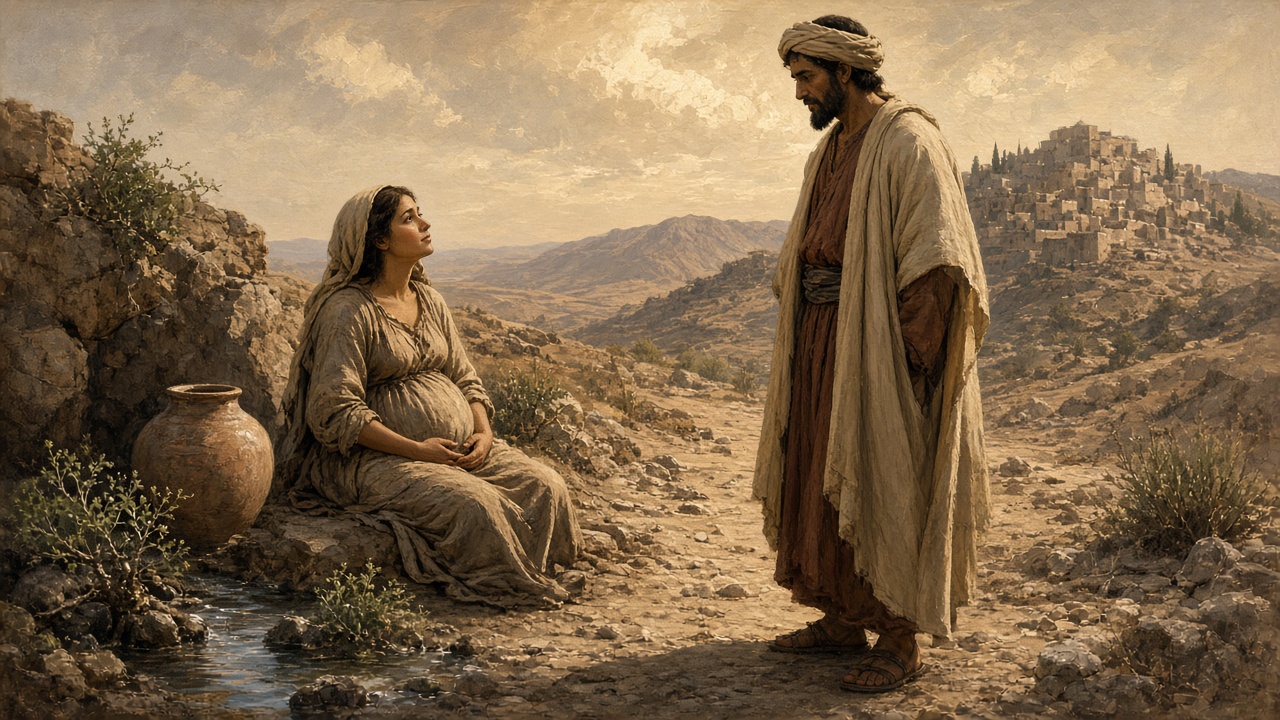
Hagar’s Flight and the Birth of Ishmael
- Hagar, an Egyptian maidservant of Sarai, bears a name understood to mean “flight,” or, according to others, “stranger.” After Abram had lived in Canaan for ten years, Sarai gave her to him as a secondary wife, hoping to build a family through her.Sources: Hagar · the Bible text itself
- When Sarai treated her harshly, Hagar fled along the road to Shur, through the desert that lay between her and Egypt, apparently intending to return to her relatives. The angel of the LORD found her by a spring of water there. Shur, meaning “wall,” was a wilderness on Egypt’s north-eastern border, probably named for frontier fortifications running from Pelusium to Heliopolis.Sources: the Bible text itself · Hagar · Shur
- Hagar called the LORD who spoke to her “the God who sees me,” and the well was named Beer-lahai-roi, “the well of the visible God,” between Kadesh and Bered, a town in the south of Palestine in the desert of Shur. She returned to Abram’s tent, and his eldest son, Ishmael, was born at Mamre when Abram was eighty-six; Abram gave him the name the angel had announced, because the LORD had heard her affliction.Sources: the Bible text itself · Hagar · Bered · Ishmael (Son of Hagar)
Notes written with AI assistance from open sources (Theographic Bible Metadata, CC BY-SA 4.0; Easton’s Bible Dictionary, public domain) and reviewed before publishing.
Places in this chapter
- Canaan · 32.767, 35.333 · verse 3
Only places identified with high confidence are shown (90% or more according to the scholarly sources compiled by OpenBible). Period map: DARE (Digital Atlas of the Roman Empire), CC BY 4.0; modern map: © OpenStreetMap contributors; places: OpenBible.info (CC BY 4.0).
Credits and license for this translation
Buki Tabu Beyabeyana
Portions of the Old Testament in the Tubetube dialect of the Bwanabwana language of Papua New Guinea
Hap Olpela Testamen long tokples Tubetube long Niugini
copyright © 2019 Wycliffe Switzerland
Language: Tubetube (Bwanabwana) (Bwanabwana)
Dialect: Tubetube
This translation is made available to you under the terms of the
Creative Commons Attribution-Noncommercial-No Derivatives license 4.0.
You may share and redistribute this Bible translation or extracts from it in any format, provided that:
You include the above copyright and source information.
You do not sell this work for a profit.
You do not change any of the words or punctuation of the Scriptures.
Pictures included with Scriptures and other documents on this site are licensed just for use with those Scriptures and documents.
For other uses, please contact the respective copyright owners.
2022-08-18
Source: http://png.bible/tteo/ · eBible.org