Genesis 46
Godón Buk · Tap a verse to see its cross-references.
Zeikob Tóba Olmalkolpükü we Bupadórr Izipt
1Zeikob tóba blaman elklaza tómbapónórr, we wamórr Berrsyiba wirri basirrdü. Wa ola lar bamngulürr ⌊alta⌋ kwitüdü, tóba ab Aesakón God we iliónürr.
2Ene irrüb, Zeikob nuszan kla esenórr. God oyaka bóktanórr, da we ngilianórr wagó, “Zeikob, Zeikob!”
“Ó, ka inamüla,” wa bóktan we yalkomólórr.
3“Ka Godla, marü aban God. Ma gumgu Izipt tótókóm; ka sab marü olmalbobatalab zitül wirri ninünümo ola. 4Ka küób sab mankü wamo Izipt, akó ka sab marü olmalbobatal sakono ini tüpdü. Zosep sab marüka asi yarile, ma nóma nurrótoko.”
5Zeikob Berrsyiba wirri basirr amgatórr. Oya simanal olmala tibiób ab Zeikob, tibiób kari olmal, akó kol osab bimurrat kla kwitüdü yamselóp, parraoa ne kla zirrtapónóp. 6I tibiób ngabyón lar akó tibiób blaman elklaza, Keinanóm ne kla bumigóp, we imarruóp, da Izipt we bazebórr. Zeikob tóba blaman olmalbobatalpükü wamórr: 7tóba blaman simanal olmal, ópal olmal, akó bobatal.
8Zeikobón olmalbobatalab ngi módógako, Izipt nidi ogobórr, Zeikob akó tóba simanal olmal akó bobatal. Ibü ngi módógako:
Tóba ngaen siman olom, ngi Rruben,
9akó oya simanal olmal:
Anok, Palu, Ezrron, akó Karrmi.
10Simion akó tóba simanal olmal:
Zemuel, Zamin, Oad, Zakin, Zoarr, akó Syaol, Keinan koldógab nótó tómtómólórr.
11Libae akó tóba simanal olmal:
Gerrson, Koat, akó Merrarri.
12Zuda akó tóba simanal olmal:
Syela, Perrez, akó Zerra. (Zudan nis siman olom nisa Keinanóm ola nurrótókrri, ngi Err akó Onan.)
Perrezón simam olom nis idi namülnürri:
Ezrron akó Amul.
13Isakarr akó tóba simanal olmal:
Tola, Pua, Zasub, akó Syimrron.
14Zebulun akó tóba simanal olmal:
Serred, Elon, akó Zale-el.
15Ini olmal Zeikob Liakagab nósenóp Mesopotamia bwóbdü. Daenan ta ola osenórr, darrpanan óp olom. Liakagab blaman oya 33 ngarkwat olmalbobatal kwarilürr.
16Gad akó tóba simanal olmal:
Zepon, Agi, Suni, Ezbon, Erri, Arrod, akó Arreli.
17Asyerr akó tóba simanal olmal:
Imna, Isba, Isbi, Berria,
akó ibü óp bólbót Serra.
Berrian siman olom nis:
Eberr akó Malkiel.
18Ini ne 16 olmalbobatal Zeikob Zilpakagab nósenóp. Zilpa Lian leba zaget kol warilürr, Leiban noan okyanórr.
19Zeikobón solo kol Rreizel nis olom nis nósenórr:
ngi Zosep akó Benzamin. 20Iziptüm Zosep nis siman olom nis nósenórr, Manase akó Iprra-im, Asenatkagab, Potiperran óp olom, prrist nótó yarilürr Eliopolis wirri basirrdü.
21Benzaminün simanal olmal idi kwarilürr:
Bela, Bekerr, Asbel, Gerra, Na-aman, E-i, Rros, Mupim, Upim, akó Arrd.
22Ini ne 14 olmalbobatal Zeikob Rreizelkagab nósenóp.
23Dan tóba darrpanan siman olompükü:
ngi Usyim.
24Naptali akó tóba simanal olmal:
Zaziel, Guni, Zezerr, akó Syilem.
25Ini ne 7 olmalbobatal Zeikob Bilakagab nósenóp. Bila Rreizelón leba zaget kol warilürr, Leiban noan okyanórr.
26Da blaman Zeikobón ne olmalbobatala ogobórr Izipt kóta 66 kwarilürr. Oya simanal olmalab kol ngarkwat koke ipüdóp. 27Zosep nis olom nis nósenórr Iziptüm. Zeikob tóba olmalbobatalpükü Izipt nóma togobórr, ibü pam ngarkwat kóta 70 emrranórr.
Zeikob Tóba Olmalbobatalpükü Izipt Abzilürr
28Zeikob Zudan singül kwata we zirrapónórr, Zosepón amtinüm ibü basenóm tótókóm Gosyen tüpdü. I nóma babzilürr, 29Zosep tóba ⌊osab amorrat klamdó⌋ kasilürr, da we wamórr Gosyen tóba ab asenóm. osab amorrat kla|alt="chariot" src="CO00756B.TIF" size="span" copy="David C. Cook" ref="46:29" I nóma baserri, Zosep tóba ab we amiógürr akó yón yarilürr. I barrkyanbóka yónüm we bairri. 30Zeikob we bóktanórr tóba olomdó wagó, “Ka marü gaodó kuri mósena, kürü büdüla ki tam. Ini ngürrdü, ka marü ilküpi kuri mósena akó ka umul kuri baina ma arrólóla.”
31Da Zosep tóba zonaretaldó we bóktanórr akó tóba aban kolpamdó wagó, “Ka kubó wamo parraodó, oya azazilüm kagó, kürü zonaretal akó kürü aban pamkolpama, Keinan tüpdü nidi ngyabenónóp, kuri togobe. 32Ka kubó parrao izazilo igó, e ⌊sip⌋ ngabkan pamakla akó e sip a ⌊gout⌋ akó ⌊kaupükü⌋ kuri tübarrmüna akó blaman yabü ne elklazako. 33Kubó parraoa yabü nóma ngibaune akó nóma nümtirre wagó, ‘Yabü zaget ia laróga?’ 34e kubó izazilamke igó, ‘Wirri pam, ki wata sip ngabkan pamakla kibiób ngyaben tonarrdó, kibü abalbobatalazan ngyabenónóp.’ Ini bóktandógab, wa sab igósidi yabü Gosyen tüp nókyerre ngyabenóm. Zitülkus módóga, Izipt pamkolpamab ilküpdü, blaman sip ngabkan pam ngazirr kla kwarilürr. Koke ok nyónónóp tibiób minggüpanandó ngyabenóm.”
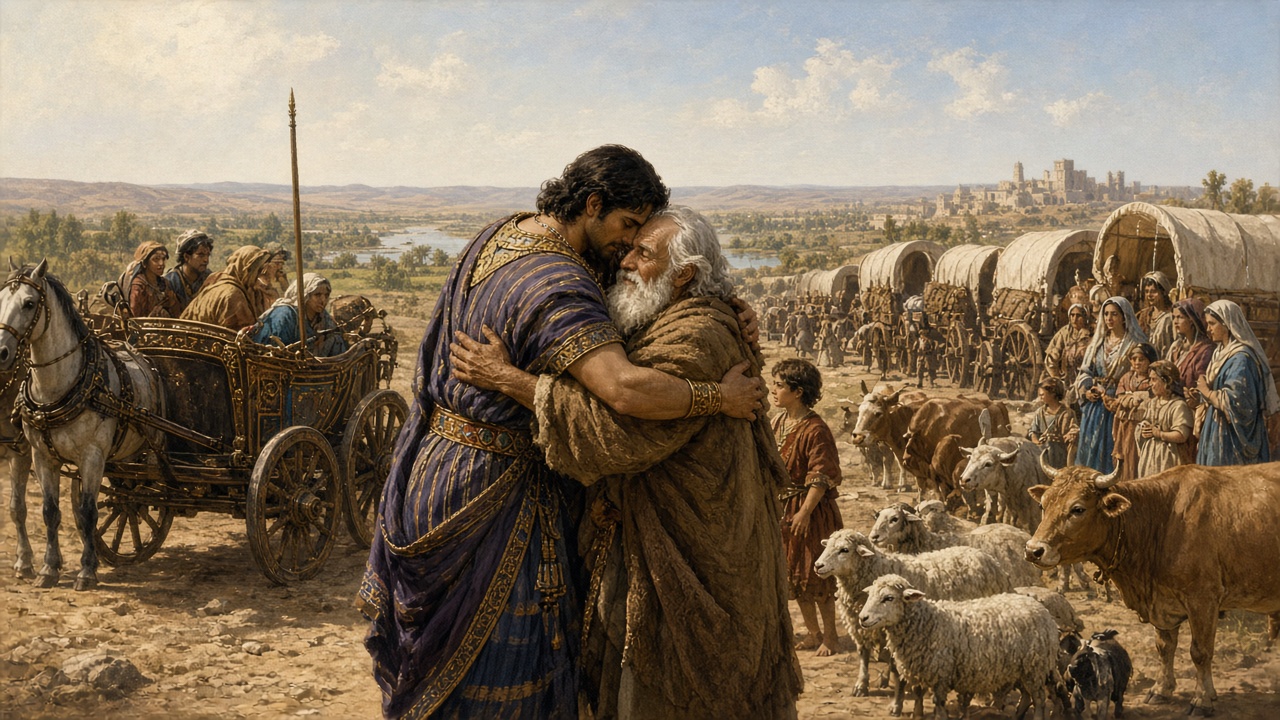
Did you know?
Israel Goes Down to Egypt
- As Israel set out for Egypt with all that he had, he stopped at Beersheba and offered sacrifices to the God of his father Isaac. Beersheba, meaning well of the oath or well of seven, was a well Abraham dug and named after a compact with Abimelech; when Isaac reopened it, he gave it the same name. It was a favorite dwelling of both patriarchs, and there that night God spoke to Jacob in a vision, telling him not to fear going down to Egypt, for he would make him a great nation there.Sources: the Bible text itself · Beersheba
- Jacob sent Judah ahead to Joseph for directions to Goshen, an Egyptian district east of the Nile, apparently near the royal residence, where the family remained until the Exodus. Easton's Bible Dictionary (1897) calls it the best of the land, now a desert, and also the land of Rameses. Joseph told his brothers to say they had raised livestock from youth, so they might settle there, because shepherds were detestable to the Egyptians; that dictionary suggests Pharaoh was probably Apopi, last of the Hyksos, who welcomed these Asiatic shepherds, while native Egyptians abhorred them, though some argue Joseph arrived later, under Thothmes III, after the Hyksos were expelled.Sources: the Bible text itself · Goshen · Pharaoh (of Joseph)
- The chapter counts sixty-six of Jacob's direct descendants who came to Egypt, not counting the wives of his sons, and seventy when Joseph's two sons already born in Egypt are included. Leah's sons and her daughter Dinah are named in that tally, although Easton's Bible Dictionary (1897) says Leah herself had died in Canaan before the journey and was buried in the cave of Machpelah; Rachel had died earlier giving birth to Benjamin and was buried on the way to Ephrath, that is, Bethlehem. Manasseh and Ephraim were born to Joseph in Egypt by Asenath, daughter of Potiphera, priest of On, a center of sun-worship that the Septuagint and Vulgate call Heliopolis.Sources: the Bible text itself · Leah · Rachel · On
Notes written with AI assistance from open sources (Theographic Bible Metadata, CC BY-SA 4.0; Easton’s Bible Dictionary, public domain) and reviewed before publishing.
Places in this chapter
- Egypt · 30.129, 31.308 · verses 1, 3, 4, 5, 6, 7, 8, 20, 26, 27
- Canaan · 32.767, 35.333 · verses 6, 12, 31
- Heliopolis · Today: Ain Shams · 30.129, 31.308 · verse 20
- Goshen · Today: Goshen 1 · 30.799, 31.834 · verses 28, 29, 34
Only places identified with high confidence are shown (90% or more according to the scholarly sources compiled by OpenBible). Period map: DARE (Digital Atlas of the Roman Empire), CC BY 4.0; modern map: © OpenStreetMap contributors; places: OpenBible.info (CC BY 4.0).
Credits and license for this translation
Godón Buk
Portions of the Holy Bible in the Gizrra language of Western Province, Papua New Guinea
Buk Baibel long tokples Gizrra long Niugini
copyright © 2019 Wycliffe Bible Translators, Inc.
Language: Gizrra
Translation by: Wycliffe Bible Translators, Inc.
This translation is made available to you under the terms of the
Creative Commons Attribution-Noncommercial-No Derivatives license 4.0.
You may share and redistribute this Bible translation or extracts from it in any format, provided that:
You include the above copyright and source information.
You do not sell this work for a profit.
You do not change any of the words or punctuation of the Scriptures.
Pictures included with Scriptures and other documents on this site are licensed just for use with those Scriptures and documents.
For other uses, please contact the respective copyright owners.
2024-07-01
Source: http://png.bible/tof/ · eBible.org