Malachi 1
Versión Biblia Libre · Tap a verse to see its cross-references.
About this book
About Malachi
- Easton's Bible Dictionary (1897) presents Malachi, a name meaning "messenger" or "angel," as the last of the minor prophets and the writer of the last book of the Old Testament canon. Nothing is known of him beyond what is contained in his book of prophecies.Sources: Easton: Malachi · Malachi
- Some have supposed that the name is simply a title for a messenger of Jehovah, not a proper name. Easton's Bible Dictionary (1897) concludes, however, that there is reason to regard Malachi as the prophet's ordinary name.Sources: Easton: Malachi · Malachi
- Easton's Bible Dictionary (1897) dates the prophecies to about 420 B.C., after Nehemiah's second return from Persia, or possibly before that return. Because Ezra does not mention him and he does not mention the restoration of the temple, the dictionary infers that he prophesied after Haggai and Zechariah.Sources: Easton: Malachi
- Easton's Bible Dictionary (1897) treats Malachi as a contemporary of Nehemiah, comparing Malachi 2:8 with Nehemiah 13:15 and Malachi 2:10-16 with Nehemiah 13:23. It also notes that the temple services were still in existence, citing Malachi 1:10, 3:1 and 3:10.Sources: Easton: Malachi
Notes written with AI assistance from open sources (Theographic Bible Metadata, CC BY-SA 4.0; Easton’s Bible Dictionary, public domain) and reviewed before publishing.
El amor del Señor por Israel
1Una profecía: Este mensaje vino del Señor respecto a Israel, a través de Malaquías.
2Yo te he amado, dice el Señor.
Pero tú preguntas: “¿Cómo nos has amado?”
¿Acaso no era Esaú el hermano de José? responde el Señor. Pero yo amé a José 3y desprecié a Esaú. He destruido las montañas de Esaú y transformé su heredad en un desierto para chacales.
4El pueblo de Edom podrá decir: “Hemos sido golpeados hasta el polvo, pero reconstruiremos las ruinas”.
Pero esto es lo que dice el Señor Todopoderoso: Aunque lo intenten y construyan, yo los volveré a destruir. Serán llamados tierra de maldad, y el pueblo de los que enojan al Señor para siempre. 5Tú verás esta destrucción con tus propios ojos, y dirás: “El Señor es grande, incluso más allá de los límites de Israel”.
Las ofrendas indignas
6Un hijo honra a su padre, y un siervo respeta a su amo. Si yo soy su padre, ¿dónde está mi honra? Si soy su amo, ¿dónde está el respeto que me merezco? dice el Señor Todopoderoso entre tus sacerdotes que han mostrado desprecio por mi.
Pero tú preguntas: “¿Cómo hemos mostrado desprecio por ti?”
7Presentando ofrendas contaminadas en mi altar.
Entonces ustedes preguntan: “¿Cómo te hemos contaminado?”
Diciendo: la mesa del Señor no merece respeto.
8Cuando presentan un animal ciego como sacrificio, ¿está mal? O cuando ofrecen animals tullidos o enfermos, ¿no está mal? ¿Presentarían tales ofrendas a un gobernante? ¿Se agradaría él con ustedes? ¿Sería amable y les mostraría su favor? Pregunta el Señor Todopoderoso.
9¿Por qué, entonces, no tratan de agradar a Dios, y piden su misericordia? Pero cuando traen tales ofrendas, ¿por qué debería él mostrarles su favor? Pregunta el Señor Todopoderoso. 10Desearía que uno de ustedes cerrara las puertas del Templo, y así cesen sus hogueras sin sentido sobre mi altar! No estoy agradado con ustedes, dice el Señor Todopoderoso, y no aceptaré ofrendas de parte de ustedes.
11Me siento honrado por las naciones desde el extremo más oriental, hasta el extremo más occidental. En todas partes la gente me trae ofrendas de incienso y sacrificios puros. Soy honrado entre las naciones, dice el Señor Todopoderoso.
12Pero ustedes me deshonran cuando dicen que la mesa del Señor no merece respeto, y que su comida puede ser tratada con desprecio. 13Ustedes dicen: “¡Esto es demasiada molestia!” y huelen la comida con repulsión, dice el Señor Todopoderoso. Pero cuando ustedes me traen como sacrificio animales que son robados, o están lisiados o enfermos, ¿debería yo aceptar tales ofrendas? Pregunta el Señor. 14Malditos son los que engañan y juran traer un carnero como sacrificio, y luego traen un animal imperfecto ante el Señor. ¡Porque yo soy un Rey grande, dice el Señor Todopoderoso, y soy respetado entre las naciones!
Did you know?
Honoring God and Defective Offerings
- The name Malachi means messenger or angel. While some have suggested it was a title rather than a proper name, scholars and traditions widely treat it as the prophet's personal name, placing his ministry during the period of Nehemiah, after Haggai and Zechariah.Sources: Malachi
- The opening dispute recalls the twin brothers Jacob and Esau, the ancestors of Israel and Edom. The text contrasts God's covenant love for Israel with the judgment and desolation coming upon the mountainous region of Edom.Sources: Esau (Edom) · Jacob (Israel) · Edom · the Bible text itself
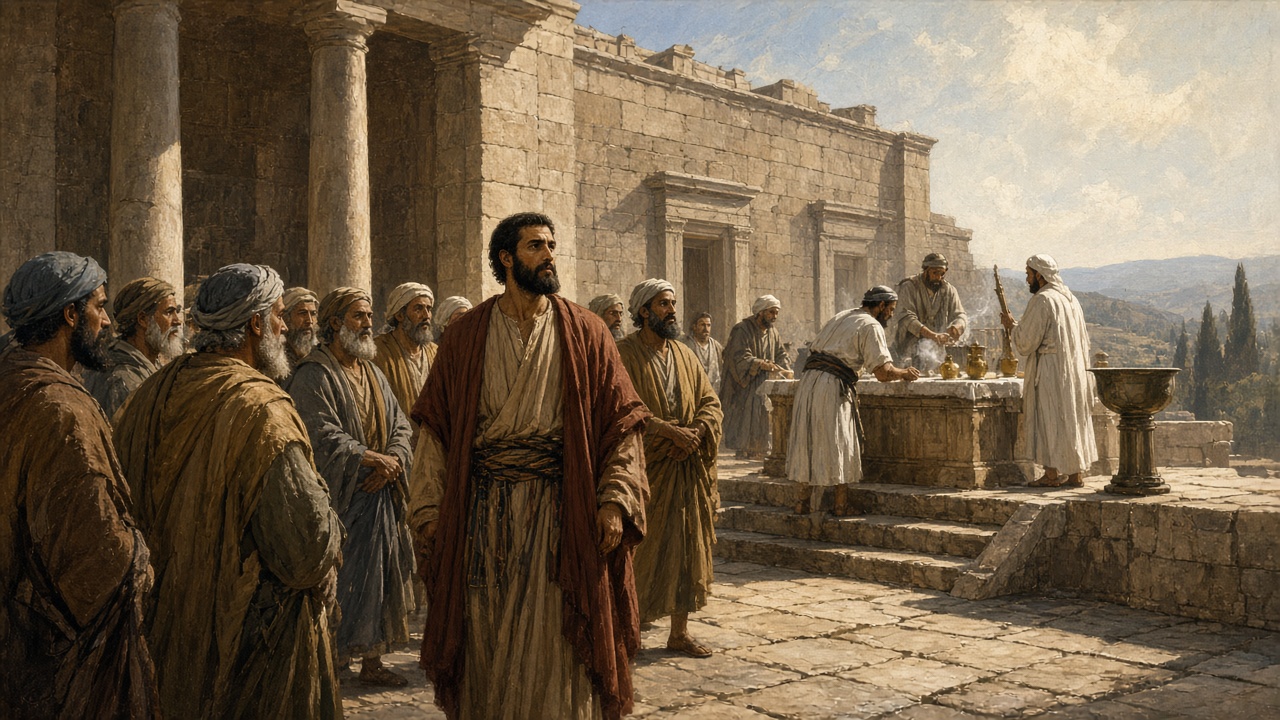
- The priests are rebuked for offering blind, lame, and diseased animals on the altar rather than unblemished livestock. Malachi exposes their disrespect by asking whether a civil governor would accept such inferior gifts.Sources: the Bible text itself
Notes written with AI assistance from open sources (Theographic Bible Metadata, CC BY-SA 4.0; Easton’s Bible Dictionary, public domain) and reviewed before publishing.
Places in this chapter
- Edom · 30.746, 35.604 · verse 4
Only places identified with high confidence are shown (90% or more according to the scholarly sources compiled by OpenBible). Period map: DARE (Digital Atlas of the Roman Empire), CC BY 4.0; modern map: © OpenStreetMap contributors; places: OpenBible.info (CC BY 4.0).
Credits and license for this translation
Versión Biblia Libre
The Holy Bible in Spanish, Free Bible Version
Versión Biblia Libre, Nuevo Testamento
copyright © 2018-2020 Jonathan Gallagher y Shelly Barrios de Avila
Language: Español (Spanish)
Translation by: Jonathan Gallagher y Shelly Barrios de Avila
Contributor: Gustavo Sanabria y Rebekah Põldaas
This translation is made available to you under the terms of the
Creative Commons Attribution Share-Alike license 4.0.
You have permission to share and redistribute this Bible translation in any format and to make reasonable revisions and adaptations of this translation, provided that:
You include the above copyright and source information.
If you make any changes to the text, you must indicate that you did so in a way that makes it clear that the original licensor is not necessarily endorsing your changes.
If you redistribute this text, you must distribute your contributions under the same license as the original.
Pictures included with Scriptures and other documents on this site are licensed just for use with those Scriptures and documents.
For other uses, please contact the respective copyright owners.
Note that in addition to the rules above, revising and adapting God's Word involves a great responsibility to be true to God's Word. See Revelation 22:18-19.
2026-10-02
Section headings adapted from the Berean Standard Bible (public domain); they are not part of this translation’s text.
Source: http://ebible.org/spavbl/ · eBible.org