Joshua 18
Versión Biblia Libre · Tap a verse to see its cross-references.
Repartición del resto de la tierra
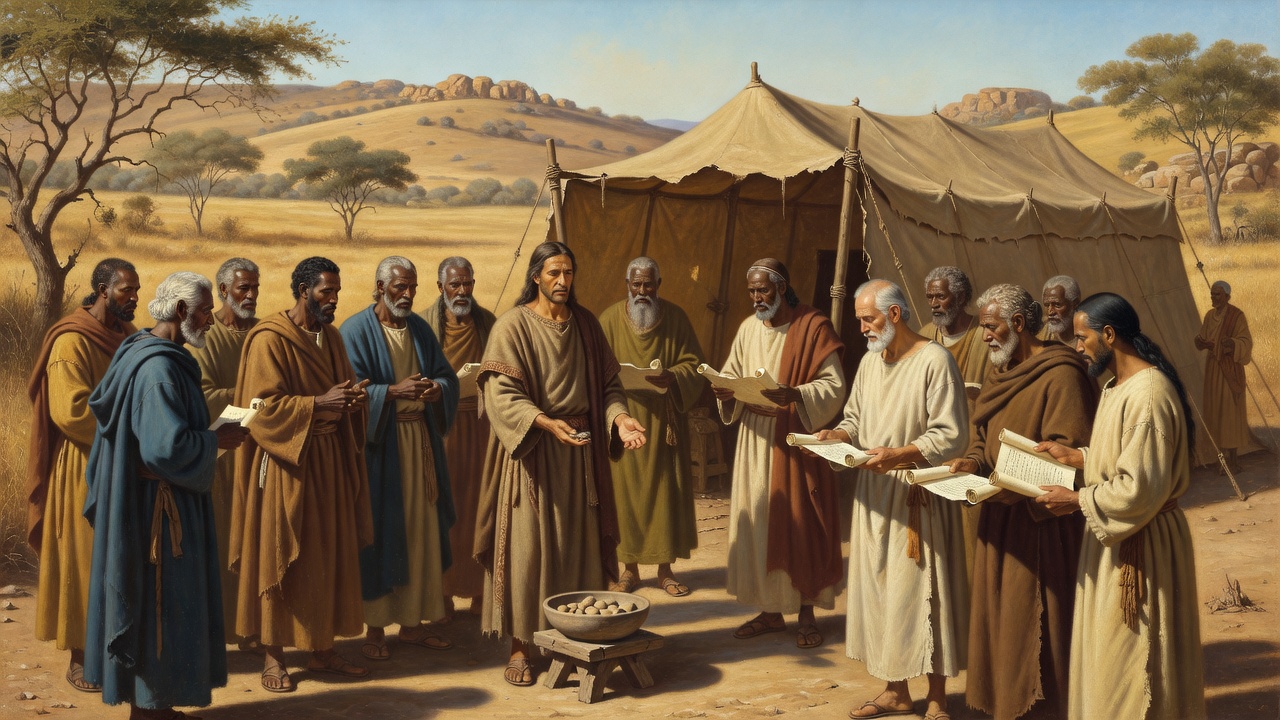
1La tierra había sido sometida y estaba ante ellos. Los israelitas se reunieron en Silo e instalaron el Tabernáculo de Reunión. 2Sin embargo, siete de las tribus israelitas no habían recibido sus asignaciones de tierras. 3Entonces Josué les preguntó a los israelitas: “¿Hasta cuándo seguirán siendo reacios a ir a tomar posesión de la tierra que el Señor le dio a sus antepasados? 4Elijan a tres hombres de cada tribu y los enviaré a explorar la tierra. Luego podrán escribir una descripción sobre la distribución de la tierra y traérmela. 5Deben dividir la tierra en siete partes, hasta el límite de la tierra de Judá en el sur y la de José en el norte. 6Una vez que hayas escrito la descripción de la tierra, dividiéndola en siete partes, me la traerás aquí y yo te echaré suertes en presencia del Señor, nuestro Dios.
7“Pero los levitas no reciben una parte, pues su función como sacerdotes del Señor es su asignación. Además, Gad, Rubén y la media tribu de Manasés ya han recibido su asignación que Moisés, el siervo del Señor, les dio en el lado oriental del Jordán”.
8Cuando los hombres se pusieron en camino para explorar la tierra Josué les dijo: “Recorran la tierra y escriban una descripción de lo que encuentren. Luego vuelvan a mí y yo les echaré suertes en presencia del Señor, aquí en Silo”. 9Así que los hombres fueron y exploraron la tierra y escribieron en un pergamino una descripción de las siete partes, registrando los pueblos de cada parte. Luego regresaron con Josué al campamento de Silo 10donde Josué les echó suertes en presencia del Señor. Allí Josué dividió la tierra y asignó las diferentes partes a las tribus israelitas que quedaban.
Territorio de Benjamín
11La primera suerte echada fue para la tribu de Benjamín, por familias. La tierra asignada estaba entre la de la tribu de Judá y la de la tribu de José. 12Su límite comenzaba en el Jordán, iba al norte de la ladera de Jericó, al oeste a través de la región montañosa, y salía al desierto de Bet-aven. 13Luego el límite iba hacia el sur hasta Luz (o Betel) y bajaba hasta Atarot-adar en la montaña al sur de la parte baja de Bet-horón. 14Aquí el límite giraba hacia el sur a lo largo del lado occidental de la montaña frente a Bet-horón, terminando en Quiriat-baal (o Quiriat-Yearín), una ciudad de la tribu de Judá. Este era el límite occidental.
15El límite sur comenzaba en el límite de Quiriat-Yearín. Corría hasta el manantial de Neftoa, 16y luego bajaba hasta el pie de la montaña que da al valle de Ben-hinom, en el extremo norte del valle de Refayín. Luego bajaba por el valle de Hinom, por la ladera cercana a la ciudad jebusea, al sur, hacia En-rogel. 17Desde allí se dirigía hacia el norte, hacia En-semes y hacia Gelilot, frente a las alturas de Adumín, y luego bajó hasta la Piedra de Bohán (hijo de Rubén). 18Luego recorría la cordillera frente al valle del Jordán, hacia el norte, y después bajaban al mismo valle del Jordán. 19Desde allí corría a lo largo de la ladera norte de Bet-hogá, terminando en la bahía norte del Mar Salado, el extremo sur del Jordán. Este era el límite sur.
20El límite oriental era el Jordán.
Estos eran los límites alrededor de la tierra de la tribu de Benjamín, por familias.
21Estas eran las ciudades de la tribu de Benjamín, por familias: Jericó, Bet-hogá, Emec-casis, 22Bet-arabá, Zemaryin, Betel, 23Avīn, Pará, Ofra, 24Quefar-amoní, Ofni y Gueba. En total, doce ciudades con sus correspondientes aldeas. 25Además: Gabaón, Ramá, Beerot, 26Mizpa, Kefira, Moza, 27Rekem, Irpeel, Taralá, 28Zela, Haelef, Jebús (o Jerusalén), Guibeá y Quiriat-Yearín, es decir, catorce ciudades con sus aldeas correspondientes. Esta fue la tierra asignada a la tribu de Benjamín, por familias.
Did you know?
Assembly at Shiloh and Benjamin's Allotment
- The assembly of Israel established the Tent of Meeting at Shiloh, a city in Ephraim north of Bethel. This made Shiloh the central place of worship and the staging ground for distributing the remaining land to the tribes.Sources: the Bible text itself · Shiloh
- To divide the territory among the seven remaining tribes, Joshua sent three men from each tribe to walk the land and record a detailed description of seven portions. Joshua then cast lots in the presence of the LORD at Shiloh to assign each allotment.Sources: the Bible text itself
- The first lot among the seven tribes fell to Benjamin, situated between the territories of Judah to the south and the house of Joseph to the north. This compact allotment included prominent cities such as Jericho, Bethel, and Jebus (Jerusalem).Sources: the Bible text itself · Benjamin (patriarch)
Notes written with AI assistance from open sources (Theographic Bible Metadata, CC BY-SA 4.0; Easton’s Bible Dictionary, public domain) and reviewed before publishing.
Places in this chapter
- Shiloh · Today: Khirbet Seilun · 32.056, 35.290 · verses 1, 8, 9, 10
- Jordan · Today: Jordan River · 31.761, 35.558 · verses 7, 12, 19, 20
- Jericho · Today: Tell es Sultan · 31.872, 35.445 · verses 12, 21
- Lower Beth-horon · Today: Beit Ur al Tahta · 31.895, 35.084 · verse 13
- Luz · Today: Beitin · 31.923, 35.241 · verse 13
- Beth-horon · Today: Beit Ur al Tahta · 31.895, 35.084 · verse 14
- Kiriath-jearim · Today: Deir el Azar · 31.809, 35.104 · verses 14, 15, 28
- Valley of Hinnom · Today: Hinnom Valley · 31.769, 35.228 · verse 16
- Valley of Rephaim · 31.763, 35.219 · verse 16
- Adummim · 31.817, 35.362 · verse 17
- Arabah · 30.417, 35.151 · verse 18
- Salt Sea · Today: Dead Sea · 31.500, 35.500 · verse 19
- Gibeon · Today: El Jib · 31.847, 35.183 · verse 25
- Mizpeh · Today: Tell en Nasbeh · 31.885, 35.216 · verse 26
- Jerusalem · 31.777, 35.234 · verse 28
Only places identified with high confidence are shown (90% or more according to the scholarly sources compiled by OpenBible). Period map: DARE (Digital Atlas of the Roman Empire), CC BY 4.0; modern map: © OpenStreetMap contributors; places: OpenBible.info (CC BY 4.0).
Credits and license for this translation
Versión Biblia Libre
The Holy Bible in Spanish, Free Bible Version
Versión Biblia Libre, Nuevo Testamento
copyright © 2018-2020 Jonathan Gallagher y Shelly Barrios de Avila
Language: Español (Spanish)
Translation by: Jonathan Gallagher y Shelly Barrios de Avila
Contributor: Gustavo Sanabria y Rebekah Põldaas
This translation is made available to you under the terms of the
Creative Commons Attribution Share-Alike license 4.0.
You have permission to share and redistribute this Bible translation in any format and to make reasonable revisions and adaptations of this translation, provided that:
You include the above copyright and source information.
If you make any changes to the text, you must indicate that you did so in a way that makes it clear that the original licensor is not necessarily endorsing your changes.
If you redistribute this text, you must distribute your contributions under the same license as the original.
Pictures included with Scriptures and other documents on this site are licensed just for use with those Scriptures and documents.
For other uses, please contact the respective copyright owners.
Note that in addition to the rules above, revising and adapting God's Word involves a great responsibility to be true to God's Word. See Revelation 22:18-19.
2026-10-02
Section headings adapted from the Berean Standard Bible (public domain); they are not part of this translation’s text.
Source: http://ebible.org/spavbl/ · eBible.org