1 Kings 1
Palabra de Dios para ti · Tap a verse to see its cross-references.

About this book
About 1 Kings
- Easton's Bible Dictionary (1897) treats the authorship of the books of Kings as uncertain. A tradition that Jeremiah wrote them is, in Easton's view, supported by passages almost identical with parts of Jeremiah and by events Jeremiah knew personally, yet Easton thinks it more probable that Ezra, after the Captivity, compiled the books from earlier documents, perhaps written by David, Solomon, Nathan, Gad, and Iddo. Easton dates the composition between 561 B.C., when Jehoiachin was released from captivity by Evil-merodach, and 538 B.C., the decree of Cyrus.Sources: Easton: Kings, The Books of
- Easton says these books contain the annals of the kingdom from Solomon's accession until Nebuchadnezzar and the Babylonians subdued it, a period he estimates at about 453 years. 1 Kings opens while David is dying: Adonijah, his fourth son, who had become heir-apparent to the throne after the deaths of Amnon and Absalom, has himself proclaimed king, but Nathan and Bathsheba persuade David to enthrone Solomon at once. Solomon, David's son by Bathsheba, whose history is recorded in 1 Kings 1-11, came to the throne, Easton suggests, at about sixteen or eighteen.Sources: Easton: Kings, The Books of · Adonijah · Solomon
- In the Hebrew Scriptures the two books of Kings originally formed one book; the Septuagint first divided them and, with the Vulgate, numbers them as the third and fourth books of Kings, the books of Samuel being the first and second. Easton notes that Chronicles gives greater prominence to the priestly or Levitical office, while Kings gives greater prominence to the royal office, and that in the threefold division of the Scriptures by the Jews these books are ranked among the Prophets. The narrative points to earlier sources: the book of the acts of Solomon and the chronicles of the kings of Judah and of Israel.Sources: Easton: Kings, The Books of
- After Solomon's death the ten tribes revolted and invited Jeroboam, son of Nebat, to be their king; Easton calls him the first king of those tribes and dates his reign from 976 to 945 B.C. He had fled to Egypt under the protection of Shishak I, and later moved his residence from Shechem, his first capital, to Tirzah, which remained the chief residence of Israel's kings until Omri bought the hill of Shomeron from Shemer for two talents of silver and built Samaria. The later narrative includes Ahab, Omri's son and the seventh king of Israel, whose wife was Jezebel: to the calf worship introduced by Jeroboam he added the worship of Baal, and he was severely admonished by the prophet Elijah.Sources: Jeroboam · Tirzah · Samaria · Ahab
Notes written with AI assistance from open sources (Theographic Bible Metadata, CC BY-SA 4.0; Easton’s Bible Dictionary, public domain) and reviewed before publishing.
La llegada de Abisag sunamita al palacio real
1Cuando el rey David era anciano, avanzado en días, lo cubrían con ropas, pero no se calentaba. 2Por tanto le dijeron sus esclavos: Que busquen para mi ʼadón el rey una joven virgen. Que ella esté delante del rey, lo abrigue y duerma a su lado para que mi ʼadón el rey pueda calentarse.
3Entonces buscaron a una joven bella por todo el territorio de Israel. Hallaron a Abisag sunamita y la llevaron al rey. 4La joven era muy bella. Ella atendía al rey y le servía, pero el rey no cohabitó con ella.
La rebelión de Adonías
5Entonces Adonías, hijo de Haguit, se enalteció y dijo: ¡Yo reinaré! Y se consiguió una carroza y jinetes, y 50 hombres que corrieran delante de él. 6Su padre nunca lo amonestó ni le dijo: ¿Por qué actúas así? También era hombre de muy buena presencia, y nació después de Absalón.
7Consultó con Joab, hijo de Sarvia, y con el sacerdote Abiatar, y ellos respaldaron a Adonías. 8Pero el sacerdote Sadoc, Benaías, hijo de Joiada, el profeta Natán, Simei, Rei y los valientes que tenía David, no seguían a Adonías.
9Adonías sacrificó ovejas, bueyes y animales gordos junto a la piedra de Zohélet, que está cerca de la fuente de Roguel, e invitó a todos sus hermanos, los hijos del rey y a todos los hombres de Judá, esclavos del rey, 10pero no invitó al profeta Natán, ni a Benaías, ni a los valientes, ni a su hermano Salomón. 11Entonces Natán habló a Betsabé, madre de Salomón: ¿No oíste que reina Adonías, hijo de Haguit, y nuestro ʼadón David no lo sabe? 12Ahora pues, ven, permíteme darte un consejo para que salves tu vida y la vida de tu hijo Salomón: 13Vé, preséntate al rey David y dile: ¿No juraste a tu servidora, oh rey ʼadón mío: Tu hijo Salomón reinará después de mí y se sentará en mi trono? ¿Por qué entonces reina Adonías? 14Mira, mientras tú aún hablas allí con el rey, yo entraré después de ti y confirmaré tus palabras.
15Entonces Betsabé entró en el dormitorio del rey, quien estaba muy anciano. Y Abisag sunamita cuidaba al rey.
16Betsabé se inclinó ante el rey, y el rey preguntó: ¿Qué deseas?
17Y ella le respondió: ʼAdón mío, tú juraste a tu servidora por Yavé tu ʼElohim: Tu hijo Salomón reinará después de mí, y él se sentará en mi trono. 18Pero ahora mira, Adonías reina, y tú, mi ʼadón el rey, no lo sabes. 19Él sacrificó becerros, animales gordos y ovejas en abundancia, e invitó a todos los hijos del rey, al sacerdote Abiatar y Joab, general del ejército, pero a Salomón tu esclavo no lo invitó. 20Sobre ti, oh rey ʼadón mío, están los ojos de todo Israel para que les declares quién se sentará en el trono de mi ʼadón el rey después de él. 21De otra manera, acontecerá que cuando mi ʼadón el rey repose con sus antepasados, mi hijo Salomón y yo seremos considerados como ofensores.
22Ciertamente, mientras ella aún hablaba con el rey, llegó el profeta Natán. 23Informaron al rey: Aquí está el profeta Natán. Y él entró ante el rey y se inclinó rosto en tierra ante el rey.
24Y Natán dijo: ¿Dijo mi ʼadón el rey: Adonías reinará después de mí y él se sentará en mi trono? 25Porque hoy él bajó y sacrificó bueyes, animales gordos y ovejas en abundancia, e invitó a todos los hijos del rey, a los capitanes del ejército y al sacerdote Abiatar. Ciertamente comen y beben ante él, y dijeron: ¡Viva el rey Adonías! 26Pero no me invitaron a mí, tu esclavo, ni al sacerdote Sadoc, ni a Benaías, hijo de Joiada, ni a tu esclavo Salomón. 27¿Hizo esto mi ʼadón el rey, sin informar a tus esclavos quién debía sentarse después de él en el trono de mi amo el rey?
28Entonces el rey David respondió: Llámenme a Betsabé. Y ella entró ante el rey y estuvo en pie ante él.
29Y el rey juró: Vive Yavé, Quien rescató mi alma de toda angustia, 30que como te juré por Yavé, el ʼElohim de Israel: ¡Ciertamente tu hijo Salomón reinará después de mí. Él se sentará en mi trono en mi lugar, así lo haré hoy mismo!
31Betsabé se inclinó rostro en tierra ante el rey y dijo: ¡Viva mi ʼadón el rey David para siempre!
Unción de Salomón como rey
32El rey David dijo: ¡Llámenme al sacerdote Sadoc, al profeta Natán y a Benaías, hijo de Joiada! Y ellos entraron ante el rey. 33Y el rey les dijo: Tomen con ustedes a los esclavos de su ʼadón, y digan a mi hijo Salomón que monte sobre mi propia mula, y bájenlo a Gihón. 34El sacerdote Sadoc y el profeta Natán lo ungirán allí como rey de Israel, soplarán la corneta y gritarán: ¡Viva el rey Salomón! 35Después ustedes subirán tras él. Y él vendrá, se sentará en mi trono y reinará en mi lugar, pues lo designé soberano sobre Israel y sobre Judá.
36Benaías, hijo de Joiada, respondió al rey: ¡Amén! ¡Así lo haga Yavé, ʼElohim de mi ʼadón el rey! 37Así como Yavé estuvo con mi ʼadón el rey, así esté Él con Salomón, y engrandezca su trono más que el trono de mi amo el rey David.
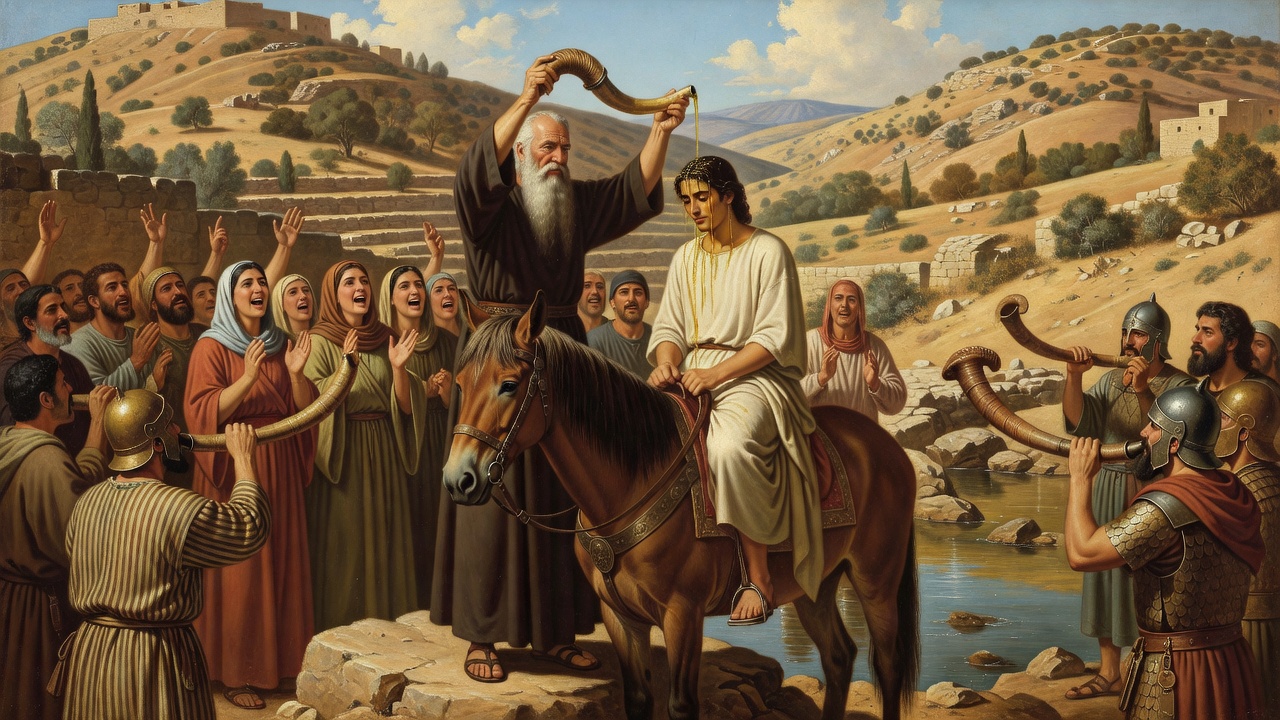
38El sacerdote Sadoc, el profeta Natán y Benaías, hijo de Joiada, junto con los cereteos y los peleteos, bajaron y montaron a Salomón sobre la mula del rey David y lo condujeron a Gihón. 39Entonces el sacerdote Sadoc tomó el cuerno de aceite del Tabernáculo y ungió a Salomón. Soplaron la corneta, y todo el pueblo exclamó: ¡Viva el rey Salomón! 40Todo el pueblo subió tras él, y el pueblo tocaba flautas y se regocijaba con tal regocijo que la tierra se hundía con el clamor de ellos.
41Adonías y todos los huéspedes que estaban con él oyeron eso cuando terminaron de comer. Y cuando Joab oyó el sonido de la corneta, dijo: ¿Por qué hay tanto bullicio y tanto alboroto en la ciudad?
42Mientras él aún hablaba, ahí llegaba Jonatán, hijo del sacerdote Abiatar, y Adonías le dijo: Entra, porque eres hombre digno y traes buenas noticias.
43Pero Jonatán respondió a Adonías: Al contrario, nuestro ʼadón el rey David designó como rey a Salomón. 44El rey envió con él al sacerdote Sadoc, al profeta Natán, a Benaías, hijo de Joiada, y a los cereteos y a los peleteos, y lo montaron sobre la mula del rey. 45El sacerdote Sadoc y el profeta Natán lo ungieron como rey en Gihón, y subieron desde allí con gran regocijo, de modo que la ciudad está alborotada. Ese es el bullicio que oyeron.
Salomón, rey de Israel
46Además, Salomón se sentó en el trono del reino, 47y también los esclavos del rey llegaron a bendecir a nuestro ʼadón, el rey David, y dijeron: ¡Tu ʼElohim haga el nombre de Salomón más ilustre que tu nombre, y engrandezca su trono más que el tuyo! Y el rey le hizo reverencia sobre su cama.
48Y el rey también dijo: ¡Bendito sea Yavé, ʼElohim de Israel, que actuó para que uno se siente en mi trono hoy, y que mis ojos lo vean!
49Entonces todos los huéspedes de Adonías se estremecieron, se levantaron y cada uno se fue por su camino. 50Pero Adonías tuvo temor a Salomón y se levantó. Fue y se agarró de los cuernos del altar.
51Informaron a Salomón y le dijeron: Mira, Adonías teme al rey Salomón, porque se agarró de los cuernos del altar y dijo: ¡Júreme hoy el rey Salomón que no matará a espada a su esclavo!
52Salomón dijo: Si él es un hombre digno, ni uno de sus cabellos caerá a la tierra, pero si es hallada en él perversidad, morirá. 53El rey Salomón ordenó que lo sacaran del altar. Y él fue y se inclinó ante el rey Salomón, quien le dijo: Vete a tu casa.
Did you know?
The Succession to David's Throne
- As David's oldest surviving son after the deaths of Amnon and Absalom, Adonijah claimed the royal succession, backed by the military commander Joab and the high priest Abiathar. However, David chose his younger son Solomon, who was supported by the prophet Nathan, the priest Zadok, and the royal bodyguard under Benaiah.Sources: Adonijah · Solomon · the Bible text itself
- Riding the king's own mule was a decisive public declaration of royal authority. By David's explicit instruction, Solomon was escorted down to the spring of Gihon, where Zadok anointed him king with oil taken from the tabernacle to the sound of ram's horns and popular celebration.Sources: Gihon · Zadok · the Bible text itself
- Upon hearing of Solomon's public coronation, Adonijah fled in terror and sought asylum by taking hold of the horns of the sacrificial altar. Solomon granted him conditional clemency, sparing his life so long as he proved himself a worthy man.Sources: Adonijah · the Bible text itself
Notes written with AI assistance from open sources (Theographic Bible Metadata, CC BY-SA 4.0; Easton’s Bible Dictionary, public domain) and reviewed before publishing.
Places in this chapter
- Shunem · Today: Sulam · 32.606, 35.334 · verse 3
- Serpent’s Stone · Today: within 100 m of Bir Ayub · 31.767, 35.236 · verse 9
- Gihon · Today: Gihon Spring · 31.773, 35.236 · verses 33, 38, 44, 45
- Jerusalem · 31.777, 35.234 · verse 40
Only places identified with high confidence are shown (90% or more according to the scholarly sources compiled by OpenBible). Period map: DARE (Digital Atlas of the Roman Empire), CC BY 4.0; modern map: © OpenStreetMap contributors; places: OpenBible.info (CC BY 4.0).
Credits and license for this translation
Palabra de Dios para ti
The Holy Bible in Spanish, Palabra de Dios para ti translation
copyright © 2020 Asociacion Biblica Latinoamericana
Language: Español (Spanish)
Dialect: South America
Translation by: Asociacion Biblica Latinoamericana
Contributor: Latinamerican Textual Bible Foundation, Inc.
Si encuentra algún error, infórmenos en [email protected].
This translation is made available to you under the terms of the
Creative Commons Attribution license 4.0.
You may share and redistribute this Bible translation or extracts from it in any format, provided that:
You include the above copyright and source information.
If you make any changes to the text, you must indicate that you did so in a way that makes it clear that the original licensor is not necessarily endorsing your changes.
Pictures included with Scriptures and other documents on this site are licensed just for use with those Scriptures and documents.
For other uses, please contact the respective copyright owners.
Note that in addition to the rules above, revising and adapting God's Word involves a great responsibility to be true to God's Word. See Revelation 22:18-19.
2026-10-02
Source: http://ebible.org/spapddpt/ · eBible.org