Titus 1
Biblica® Open Nueva Biblia Viva 2008 · Tap a verse to see its cross-references.
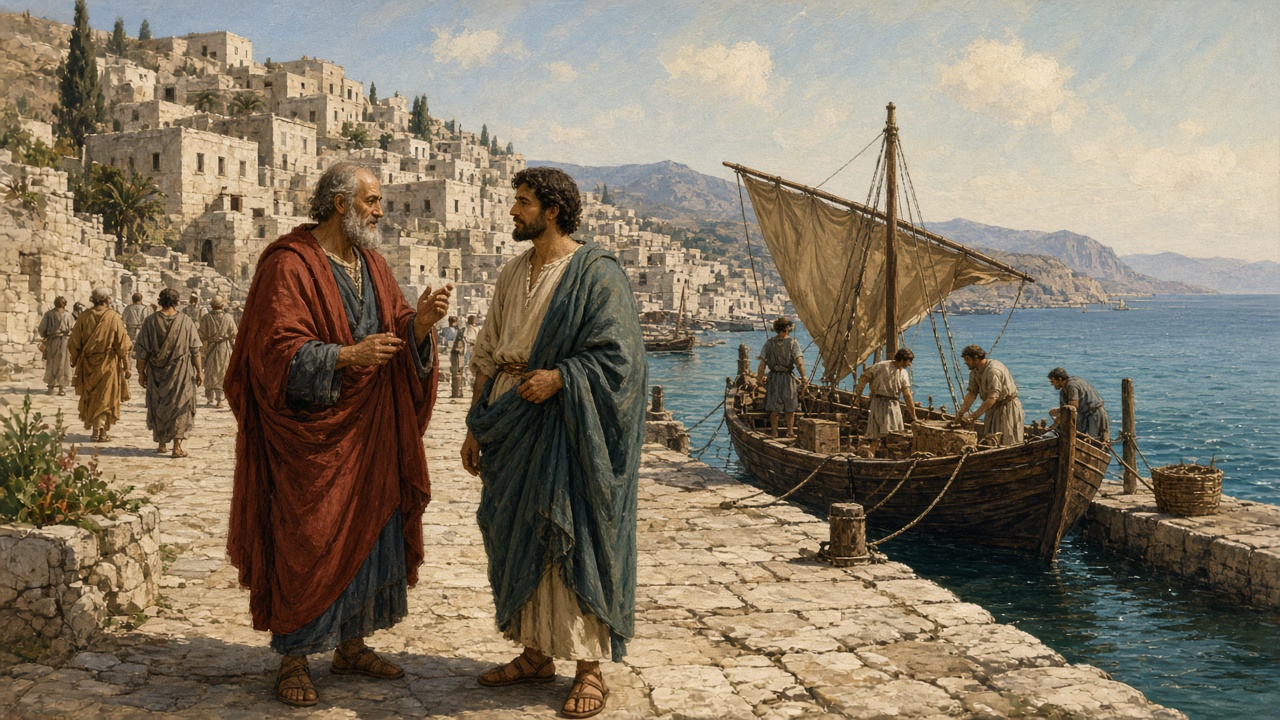
About this book
About Titus
- Easton's Bible Dictionary (1897) presents the Letter to Titus as written by Paul, probably about the same time as the first letter to Timothy, with which it has many affinities. Easton places it about A.D. 66 or 67, after a visit to Crete that he understands as following Paul's release from two years of imprisonment in Rome, and he supposes that Paul wrote it from Nicopolis in Epirus.Sources: Easton: Titus, Epistle to
- In that reconstruction, Paul left Titus in Crete "to set in order the things that were wanting," then went to Ephesus, where he left Timothy, and afterward to Macedonia and Nicopolis. Titus, whose name does not appear in Acts, had been with Paul and Barnabas at Antioch and at the Jerusalem council; Easton describes him as a Gentile whom Paul refused to have circumcised.Sources: Easton: Titus, Epistle to · Titus
- Easton notes that both letters were addressed to men left to preside in their churches during the writer's absence, and that both are chiefly occupied with the qualifications to be sought in those appointed to church offices. Timothy and Titus are also cautioned against the same prevailing corruptions and against misdirecting their cares and studies, and the letters often share the same phrases, salutation, and transition into the main business.Sources: Easton: Titus, Epistle to
- Easton calls Crete Candia and describes it as one of the largest islands in the Mediterranean, about 140 miles long and 35 broad, once very prosperous and populous, with a "hundred cities." The letter quotes "one of their own poets," identified there as Epimenides, on the Cretans: "The Cretans are alway liars, evil beasts, slow bellies."Sources: Crete
- Paul intended to winter at Nicopolis, "city of victory"; Easton thinks this was most probably the city in Epirus built by Augustus to commemorate his victory at Actium in 31 B.C., the modern Paleoprevesa. A later subscription calls the place "Nicopolis of Macedonia," but Easton says no such place is known and that the subscriptions to the epistles are not authentic. He also notes Zenas, called "the lawyer," whom Paul wished Titus to bring with him.Sources: Nicopolis · Easton: Titus, Epistle to · Zenas
Notes written with AI assistance from open sources (Theographic Bible Metadata, CC BY-SA 4.0; Easton’s Bible Dictionary, public domain) and reviewed before publishing.
1Escribo yo, Pablo, esclavo de Dios y mensajero a quien Jesucristo llamó y envió a llevar la fe a los escogidos de Dios y a instruirlos en la verdad que enseña nuestra religión. 2Esperamos la vida eterna que Dios, que no puede mentir, prometió desde antes de la creación del mundo; 3y ahora, a su debido tiempo, ha cumplido esta promesa por medio de las buenas noticias que, por mandato de Dios, nuestro Salvador, me han sido encomendadas proclamar.
4A Tito, verdadero hijo mío en la fe que compartimos:
Que Dios el Padre y Cristo Jesús nuestro Salvador te den su amor y paz.
Tarea de Tito en Creta
5Te dejé en la isla de Creta para que pusieras en orden lo que quedó pendiente y te pedí que nombraras líderes en las iglesias de cada pueblo, de acuerdo con las instrucciones que te di. 6El líder que escojas debe ser irreprochable y debe tener sólo una esposa; sus hijos deben ser creyentes y no deben tener fama de disolutos o desobedientes.
7El líder es uno que supervisa la obra de Dios, y por eso debe ser irreprensible; no debe ser arrogante ni colérico, no debe ser dado a la bebida ni a las riñas, ni debe ganar dinero de manera deshonesta; 8debe ser hospitalario, amigo del bien, sensato, justo, santo y disciplinado. 9Su fe en las verdades que hemos enseñado debe ser firme, para que pueda enseñarlas y convencer a los que la contradicen, 10porque hay muchos que son rebeldes, especialmente entre los que dicen que uno debe circuncidarse. Estos son también habladores y engañadores. 11Es preciso taparles la boca, pues en su afán por ganar dinero enseñando lo que no deben, ya han apartado de la verdad a varias familias.
12Uno de sus propios profetas dijo lo siguiente:
«Los cretenses son siempre mentirosos, malas bestias, glotones y perezosos».
13Y dijo la verdad. Por eso, repréndelos con severidad, para que se robustezcan en la fe 14y no hagan caso a las fábulas judaicas ni a mandamientos de individuos que se han alejado de la verdad. 15El que es puro de verdad, todo lo ve puro; pero los que tienen el corazón podrido y lleno de incredulidad lo ven todo malo, porque su mente y su conciencia corrompidas desfiguran lo que ven. 16Dicen que conocen a Dios, pero en la práctica demuestran no conocerlo. Son odiosos, desobedientes e incapaces de hacer lo bueno.
Did you know?
Elders in the towns of Crete
- Titus, whom Paul calls his true child in their common faith, appears to have been a Gentile and was chiefly engaged in ministry among Gentiles. He was with Paul and Barnabas at Antioch and went with them to the council in Jerusalem, where Paul refused to have him circumcised; his name never appears in Acts. Paul writes that he left Titus in Crete to set in order what was unfinished and to appoint elders in every town.Sources: Titus · the Bible text itself
- Crete is one of the largest islands in the Mediterranean, about 140 miles long and 35 miles wide, and it was once prosperous and populous, with a “hundred cities.” In this chapter Paul quotes a saying he attributes to one of the Cretans’ own prophets—“Cretans are always liars, evil beasts, lazy gluttons”—and the notes on the island identify that poet as Epimenides.Sources: Crete · the Bible text itself
- Jews from Crete were in Jerusalem on the day of Pentecost. Writing to Titus, Paul says that many are rebellious and full of empty talk and deception, especially those of the circumcision, who for dishonorable gain undermine whole households. He calls for a stern rebuke so that they will be sound in the faith and pay no attention to Jewish myths or to the commands of men who have rejected the truth.Sources: Crete · the Bible text itself
Notes written with AI assistance from open sources (Theographic Bible Metadata, CC BY-SA 4.0; Easton’s Bible Dictionary, public domain) and reviewed before publishing.
Places in this chapter
Only places identified with high confidence are shown (90% or more according to the scholarly sources compiled by OpenBible). Period map: DARE (Digital Atlas of the Roman Empire), CC BY 4.0; modern map: © OpenStreetMap contributors; places: OpenBible.info (CC BY 4.0).
Credits and license for this translation
Biblica® Open Nueva Biblia Viva 2008
The Holy Bible in Spanish: Biblica® Open Nueva Biblia Viva 2008 (Bible)
copyright © 2008 Biblica, Inc.
Language: Español
Contributor: Biblica, Inc.
Biblica® Open Nueva Biblia Viva™
Copyright © 2006, 2008 by Biblica, Inc.
“Biblica” es una marca registrada en la oficina de Patentes y Marcas de los Estados Unidos por Biblica, Inc. Usado con permiso.
“Biblica” is a trademark registered in the United States Patent and Trademark Office by Biblica, Inc. Used with permission.
Creative Commons license
This work is made available under the Creative Commons Attribution-ShareAlike 4.0 International License (CC BY-SA). To view a copy of this license, visit https://creativecommons.org/licenses/by-sa/4.0 or send a letter to Creative Commons, PO Box 1866, Mountain View, CA 94042, USA.
You have permission to copy and distribute this Work, as long as you do not change it and you keep the title as it is. Changing or translating this Work will create a derivative work. When you publish this derivative work, you must list what changes you have made where people can see them, such as on a website. You must also show where the original Work is from: “The original Work by its copyright holders is available for free at www.biblica.com and open.bible .”
Notice of copyright must appear on the title or copyright page of the work as follows:
Biblica® Open Nueva Biblia Viva™
Copyright © 2006, 2008 by Biblica, Inc.
“Biblica” es una marca registrada en la oficina de Patentes y Marcas de los Estados Unidos por Biblica, Inc. Usado con permiso.
“Biblica” is a trademark registered in the United States Patent and Trademark Office by Biblica, Inc. Used with permission.
You must also make your derivative work available under the same license (CC BY-SA).
If you would like to notify Biblica, Inc. regarding your translation of this work, please contact us at https://open.bible/#feedback .
This translation is made available to you under the terms of the
Creative Commons Attribution Share-Alike license 4.0.
You have permission to share and redistribute this Bible translation in any format and to make reasonable revisions and adaptations of this translation, provided that:
You include the above copyright and source information.
If you make any changes to the text, you must indicate that you did so in a way that makes it clear that the original licensor is not necessarily endorsing your changes.
If you redistribute this text, you must distribute your contributions under the same license as the original.
Pictures included with Scriptures and other documents on this site are licensed just for use with those Scriptures and documents.
For other uses, please contact the respective copyright owners.
Note that in addition to the rules above, revising and adapting God's Word involves a great responsibility to be true to God's Word. See Revelation 22:18-19.
2025-05-21
Source: http://ebible.org/spaonbv/ · eBible.org