Nehemiah 1
Biblica® Open Nueva Biblia Viva 2008 · Tap a verse to see its cross-references.
About this book
About Nehemiah
- Easton's Bible Dictionary (1897) presents Nehemiah as the author of the book, pointing to first-person writing in chapters 1–7, 12:27–47, and 13, and to third-person sections in chapters 8–10 that some suppose Ezra wrote, though it says there is no distinct evidence of that. The same entry dates the book to about 431–430 B.C., after Nehemiah returned a second time to Jerusalem from Persia, and excepts 12:11, 22, and 23 from his hand.Sources: Easton: Nehemiah, Book of
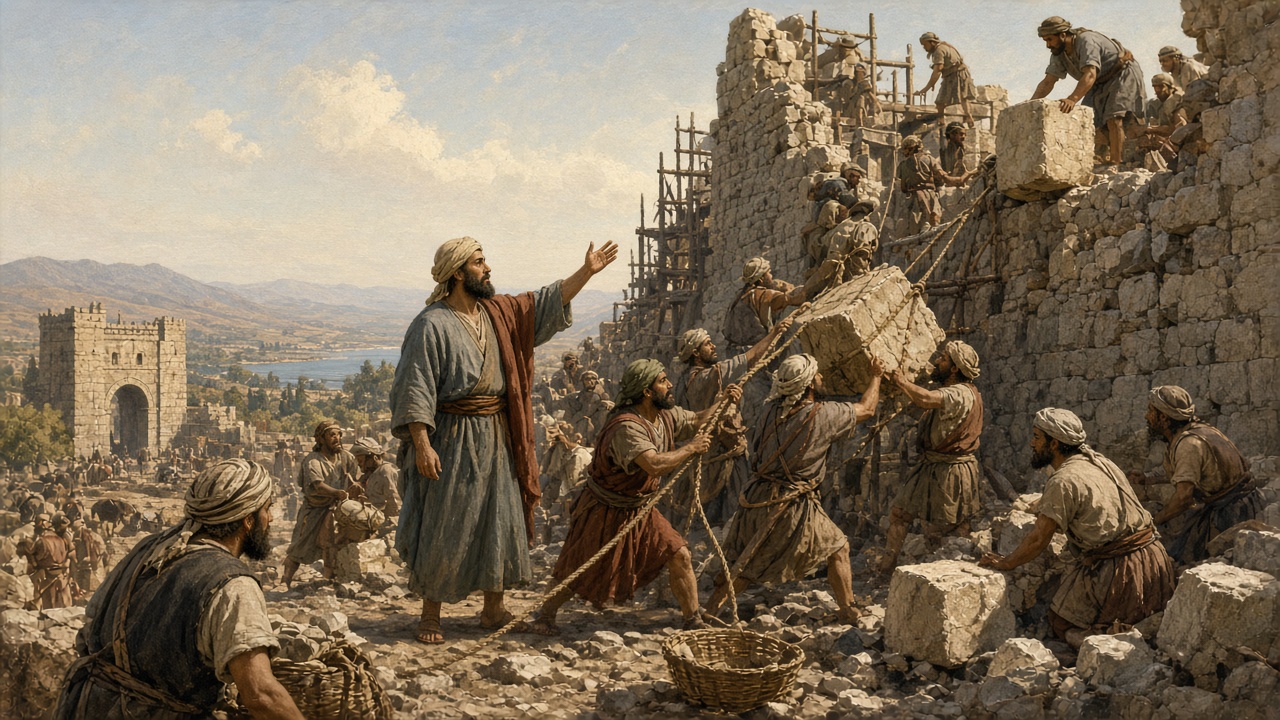
- Nehemiah, son of Hachaliah and probably of the tribe of Judah, belonged to a family of Jerusalem and was one of the Jews of the dispersion. In his youth he served as royal cup-bearer at the palace of Shushan under Artaxerxes Longimanus, and through his brother Hanani he learned that the holy city lay mournful and desolate.Sources: Nehemiah
- The scribe Ezra had led a second company of exiles from Babylon to Jerusalem in 459 B.C., and Easton's dictionary treats Nehemiah as a historical continuation of Ezra. When Nehemiah went up to rebuild the ruined walls, Sanballat, who held some place of authority in Samaria, tried to hinder the work, and Tobiah the Ammonite joined the opposition and sent letters to put him in fear.Sources: Ezra · Easton: Nehemiah, Book of · Sanballat · Tobiah
- Easton's Bible Dictionary (1897) divides the book into four parts: the rebuilding of Jerusalem's wall and the register of those who had returned from Babylon (chapters 1–7); the state of religion among the Jews (8–10); the growth of Jerusalem's population, a census of adult men, and lists of chiefs, priests, and Levites (11 through 12:1–26); and the dedication of the wall, the ordering of temple officers, and Nehemiah's reforms (12:27–13).Sources: Easton: Nehemiah, Book of
- While Nehemiah was away, the priest Eliashib prepared a chamber in the courts of the house of God for Tobiah; on his return Nehemiah cast out all of Tobiah's household goods. Easton's dictionary also notes that the book closes the history of the Old Testament and that the prophet Malachi was contemporary with Nehemiah.Sources: Tobiah · Easton: Nehemiah, Book of
Notes written with AI assistance from open sources (Theographic Bible Metadata, CC BY-SA 4.0; Easton’s Bible Dictionary, public domain) and reviewed before publishing.
Nehemías ora por su pueblo
1Autobiografía de Nehemías hijo de Jacalías:
En diciembre del año veinte del reinado de Artajerjes de Persia, cuando yo servía en el palacio de Susa, 2uno de mis compatriotas, un judío llamado Jananí, vino a visitarme con algunos hombres que habían llegado de Judá. Aproveché la oportunidad para preguntarles:
―¿Cómo está la ciudad de Jerusalén y cómo están los judíos que escaparon de ir cautivos a Babilonia?
3―Pues te diremos que las cosas no andan muy bien —contestaron—. Los que regresaron del destierro sufren grandes males y humillaciones. Los muros de Jerusalén aún están medio derribados y las puertas están quemadas.
4Cuando oí esto me senté y lloré. Durante varios días ayuné y oré así al Dios del cielo:
5« Señor, Dios del cielo, Dios grande y temible, que cumples las promesas y que amas y tienes misericordia de los que te aman y te obedecen, escucha mi oración. 6Escucha lo que yo te digo. Mírame y ve que noche y día oro por el pueblo de Israel. Confieso que hemos pecado contra ti. Yo mismo y mi pueblo hemos pecado. No hemos obedecido los mandamientos, estatutos y preceptos que nos entregaste por medio de tu siervo Moisés.
8»Recuerda que le dijiste a Moisés: “Si ustedes pecan, los esparciré entre las naciones. 9Pero si se vuelven a mí y obedecen mis leyes, y las ponen en práctica, aun de los rincones más lejanos del universo, a donde hayan sido llevados, los haré regresar a Jerusalén. Porque Jerusalén es el lugar que he escogido como mi lugar de residencia”.
10»Nosotros somos tus siervos, somos el pueblo que rescataste con tu gran poder. 11Señor, escucha mi oración. Escucha la oración de quienes se deleitan en darte gloria y honra. Te ruego que me permitas tener éxito cuando me presente ante el rey con mi petición. Haz que el rey me atienda y me trate bien».
Yo era entonces copero del rey.
Did you know?
Nehemiah's Grief and Prayer
- Nehemiah served as the cupbearer to the Persian king at the citadel of Susa, a prominent administrative center located east of the Tigris River. This royal office gave him direct, trusted access to the monarch.Sources: Nehemiah · Susa · the Bible text itself
- Hanani, a brother of Nehemiah, arrived from Judah with news that the survivors of the exile were in great distress because the walls of Jerusalem were broken down and its gates destroyed by fire.Sources: Hanani · Nehemiah · the Bible text itself
- Upon hearing the news, Nehemiah mourned, fasted, and prayed, recalling God's words to Moses that while unfaithfulness would scatter the people among the nations, turning back to God would bring them back together.Sources: Moses · the Bible text itself
Notes written with AI assistance from open sources (Theographic Bible Metadata, CC BY-SA 4.0; Easton’s Bible Dictionary, public domain) and reviewed before publishing.
Places in this chapter
Only places identified with high confidence are shown (90% or more according to the scholarly sources compiled by OpenBible). Period map: DARE (Digital Atlas of the Roman Empire), CC BY 4.0; modern map: © OpenStreetMap contributors; places: OpenBible.info (CC BY 4.0).
Credits and license for this translation
Biblica® Open Nueva Biblia Viva 2008
The Holy Bible in Spanish: Biblica® Open Nueva Biblia Viva 2008 (Bible)
copyright © 2008 Biblica, Inc.
Language: Español
Contributor: Biblica, Inc.
Biblica® Open Nueva Biblia Viva™
Copyright © 2006, 2008 by Biblica, Inc.
“Biblica” es una marca registrada en la oficina de Patentes y Marcas de los Estados Unidos por Biblica, Inc. Usado con permiso.
“Biblica” is a trademark registered in the United States Patent and Trademark Office by Biblica, Inc. Used with permission.
Creative Commons license
This work is made available under the Creative Commons Attribution-ShareAlike 4.0 International License (CC BY-SA). To view a copy of this license, visit https://creativecommons.org/licenses/by-sa/4.0 or send a letter to Creative Commons, PO Box 1866, Mountain View, CA 94042, USA.
You have permission to copy and distribute this Work, as long as you do not change it and you keep the title as it is. Changing or translating this Work will create a derivative work. When you publish this derivative work, you must list what changes you have made where people can see them, such as on a website. You must also show where the original Work is from: “The original Work by its copyright holders is available for free at www.biblica.com and open.bible .”
Notice of copyright must appear on the title or copyright page of the work as follows:
Biblica® Open Nueva Biblia Viva™
Copyright © 2006, 2008 by Biblica, Inc.
“Biblica” es una marca registrada en la oficina de Patentes y Marcas de los Estados Unidos por Biblica, Inc. Usado con permiso.
“Biblica” is a trademark registered in the United States Patent and Trademark Office by Biblica, Inc. Used with permission.
You must also make your derivative work available under the same license (CC BY-SA).
If you would like to notify Biblica, Inc. regarding your translation of this work, please contact us at https://open.bible/#feedback .
This translation is made available to you under the terms of the
Creative Commons Attribution Share-Alike license 4.0.
You have permission to share and redistribute this Bible translation in any format and to make reasonable revisions and adaptations of this translation, provided that:
You include the above copyright and source information.
If you make any changes to the text, you must indicate that you did so in a way that makes it clear that the original licensor is not necessarily endorsing your changes.
If you redistribute this text, you must distribute your contributions under the same license as the original.
Pictures included with Scriptures and other documents on this site are licensed just for use with those Scriptures and documents.
For other uses, please contact the respective copyright owners.
Note that in addition to the rules above, revising and adapting God's Word involves a great responsibility to be true to God's Word. See Revelation 22:18-19.
2025-05-21
Source: http://ebible.org/spaonbv/ · eBible.org