Genesis 46
Biblica® Open Nueva Biblia Viva 2008 · Tap a verse to see its cross-references.
Jacob viaja a Egipto
1Israel emprendió el viaje con todas sus posesiones, y fue hasta Berseba, donde ofreció sacrificios al Dios de su padre Isaac. 2Aquella noche Dios le habló en visión:
―¡Jacob, Jacob!
―¿Qué quieres, Señor? —respondió.
3―Yo soy Dios —dijo la voz—, el Dios de tu padre. No tengas miedo de ir a Egipto, porque allí te haré una nación grande. 4Yo iré contigo a Egipto y haré que tus descendientes vuelvan de allí. Tú morirás en Egipto, y José estará a tu lado.
5Entonces Jacob salió de Berseba, y sus hijos lo llevaron a Egipto, juntamente con sus descendientes y sus esposas, en los carros que el faraón les había proporcionado. 6También llevaron todo el ganado y todas las pertenencias que habían acumulado en la tierra de Canaán. De ese modo Jacob y sus familiares llegaron a Egipto. 7Es decir que a Jacob lo acompañaron todos sus seres queridos: hijos, hijas, nietos y nietas.
8Estos son los nombres de los hijos y nietos de Jacob que fueron con él a Egipto:
Rubén, su primogénito.
Los hijos de Rubén: Janoc, Falú, Jezrón y Carmí.
Simeón y sus hijos: Jemuel, Jamín, Oad, Jaquín, Zojar y Saúl (cuya madre era una cananea).
Leví y sus hijos: Guersón, Coat y Merari.
Judá y sus hijos: Er, Onán, Selá, Fares y Zera (pero Er y Onán murieron cuando todavía estaban en Canaán, antes de que Israel fuera a Egipto).
Los hijos de Fares fueron Jezrón y Jamul.
Isacar y sus hijos: Tola, Fuvá, Job y Simrón.
Zabulón y sus hijos: Séred, Elón y Yalel.
15Estos son los descendientes de Jacob y Lea, sin contar a Dina, que nacieron en Padán Aram. En total eran treinta y tres personas.
16También fueron con él:
Gad y sus hijos: Zefón, Jaguí, Esbón, Suni, Erí, Arodí y Arelí.
Aser y sus hijos: Imná, Isvá, Isví, Beriá, y Sera, hermana de ellos.
Los hijos de Beriá fueron Héber y Malquiel.
18Estas dieciséis personas fueron los hijos de Jacob y Zilpá, la esclava que Lea recibió de su padre Labán.
19Los siguientes son los descendientes de Jacob y Raquel: José y Benjamín.
Los hijos de José, que nacieron en Egipto, fueron Manasés y Efraín (la madre de ellos fue Asenat, hija de Potifera, sacerdote de Heliópolis).
Los hijos de Benjamín: Bela, Béquer, Asbel, Guerá, Naamán, Ehí, Ros, Mupín, Jupín y Ard.
En total, los descendientes de Jacob y Raquel fueron catorce personas.
23Además, en el grupo estaban estos siete descendientes de Jacob y Bilhá, la esclava que Raquel recibió de su padre Labán:
Dan y su hijo Jusín; Neftalí y sus hijos: Yazel, Guní, Jéser y Silén.
26De modo que el total de los que fueron a Egipto, de los descendientes directos, sin contar a las esposas de los hijos de Jacob, eran sesenta y seis. 27Considerando la familia de José con sus dos hijos, que estaban en Egipto, sumaban setenta.
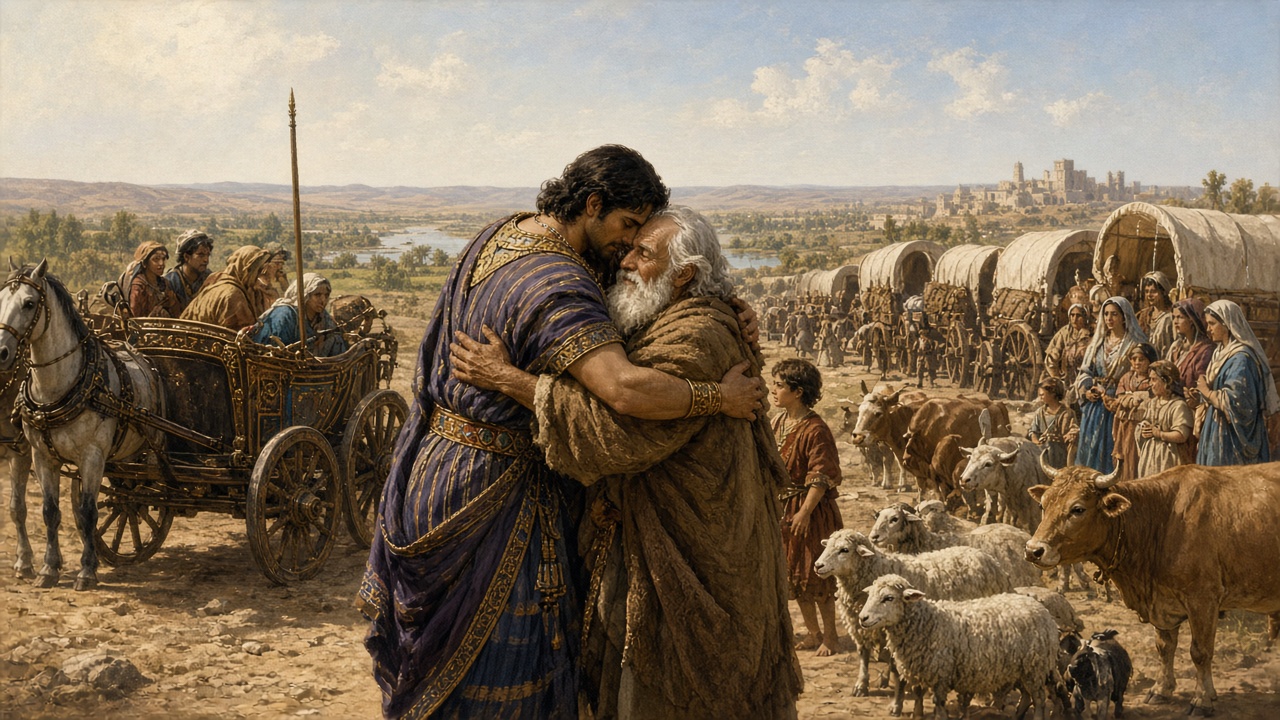
28Jacob envió a Judá adelante para que le dijera a José que ya estaban en camino y que pronto llegarían a Gosén. Cuando llegaron a ese lugar, 29José pidió que le prepararan su carro, y fue hasta allá, para ver a su padre. Cuando se encontraron se abrazaron y lloraron largo rato.
30Entonces Israel le dijo a José:
―¡Ya me puedo morir, porque te he vuelto a ver y sé que estás vivo!
31José entonces le dijo a sus hermanos y a sus familias:
―Voy a decirle al faraón que ustedes están aquí, que han venido de la tierra de Canaán a quedarse conmigo. 32Además le diré: “Estos hombres son pastores. Trajeron consigo sus ovejas y vacas, y todo lo que tenían”. 33Entonces, cuando el faraón los llame y les pregunte por su ocupación, 34díganle: “Hemos sido pastores de ovejas desde nuestra niñez, y nuestros padres lo han sido durante generaciones”. Cuando le digan esto, los dejará vivir en la tierra de Gosén, porque para los egipcios es cosa detestable vivir junto a pastores de ovejas.
Did you know?
Israel Goes Down to Egypt
- As Israel set out for Egypt with all that he had, he stopped at Beersheba and offered sacrifices to the God of his father Isaac. Beersheba, meaning well of the oath or well of seven, was a well Abraham dug and named after a compact with Abimelech; when Isaac reopened it, he gave it the same name. It was a favorite dwelling of both patriarchs, and there that night God spoke to Jacob in a vision, telling him not to fear going down to Egypt, for he would make him a great nation there.Sources: the Bible text itself · Beersheba
- Jacob sent Judah ahead to Joseph for directions to Goshen, an Egyptian district east of the Nile, apparently near the royal residence, where the family remained until the Exodus. Easton's Bible Dictionary (1897) calls it the best of the land, now a desert, and also the land of Rameses. Joseph told his brothers to say they had raised livestock from youth, so they might settle there, because shepherds were detestable to the Egyptians; that dictionary suggests Pharaoh was probably Apopi, last of the Hyksos, who welcomed these Asiatic shepherds, while native Egyptians abhorred them, though some argue Joseph arrived later, under Thothmes III, after the Hyksos were expelled.Sources: the Bible text itself · Goshen · Pharaoh (of Joseph)
- The chapter counts sixty-six of Jacob's direct descendants who came to Egypt, not counting the wives of his sons, and seventy when Joseph's two sons already born in Egypt are included. Leah's sons and her daughter Dinah are named in that tally, although Easton's Bible Dictionary (1897) says Leah herself had died in Canaan before the journey and was buried in the cave of Machpelah; Rachel had died earlier giving birth to Benjamin and was buried on the way to Ephrath, that is, Bethlehem. Manasseh and Ephraim were born to Joseph in Egypt by Asenath, daughter of Potiphera, priest of On, a center of sun-worship that the Septuagint and Vulgate call Heliopolis.Sources: the Bible text itself · Leah · Rachel · On
Notes written with AI assistance from open sources (Theographic Bible Metadata, CC BY-SA 4.0; Easton’s Bible Dictionary, public domain) and reviewed before publishing.
Places in this chapter
- Egypt · 30.129, 31.308 · verses 1, 3, 4, 5, 6, 7, 8, 20, 26, 27
- Canaan · 32.767, 35.333 · verses 6, 12, 31
- Heliopolis · Today: Ain Shams · 30.129, 31.308 · verse 20
- Goshen · Today: Goshen 1 · 30.799, 31.834 · verses 28, 29, 34
Only places identified with high confidence are shown (90% or more according to the scholarly sources compiled by OpenBible). Period map: DARE (Digital Atlas of the Roman Empire), CC BY 4.0; modern map: © OpenStreetMap contributors; places: OpenBible.info (CC BY 4.0).
Credits and license for this translation
Biblica® Open Nueva Biblia Viva 2008
The Holy Bible in Spanish: Biblica® Open Nueva Biblia Viva 2008 (Bible)
copyright © 2008 Biblica, Inc.
Language: Español
Contributor: Biblica, Inc.
Biblica® Open Nueva Biblia Viva™
Copyright © 2006, 2008 by Biblica, Inc.
“Biblica” es una marca registrada en la oficina de Patentes y Marcas de los Estados Unidos por Biblica, Inc. Usado con permiso.
“Biblica” is a trademark registered in the United States Patent and Trademark Office by Biblica, Inc. Used with permission.
Creative Commons license
This work is made available under the Creative Commons Attribution-ShareAlike 4.0 International License (CC BY-SA). To view a copy of this license, visit https://creativecommons.org/licenses/by-sa/4.0 or send a letter to Creative Commons, PO Box 1866, Mountain View, CA 94042, USA.
You have permission to copy and distribute this Work, as long as you do not change it and you keep the title as it is. Changing or translating this Work will create a derivative work. When you publish this derivative work, you must list what changes you have made where people can see them, such as on a website. You must also show where the original Work is from: “The original Work by its copyright holders is available for free at www.biblica.com and open.bible .”
Notice of copyright must appear on the title or copyright page of the work as follows:
Biblica® Open Nueva Biblia Viva™
Copyright © 2006, 2008 by Biblica, Inc.
“Biblica” es una marca registrada en la oficina de Patentes y Marcas de los Estados Unidos por Biblica, Inc. Usado con permiso.
“Biblica” is a trademark registered in the United States Patent and Trademark Office by Biblica, Inc. Used with permission.
You must also make your derivative work available under the same license (CC BY-SA).
If you would like to notify Biblica, Inc. regarding your translation of this work, please contact us at https://open.bible/#feedback .
This translation is made available to you under the terms of the
Creative Commons Attribution Share-Alike license 4.0.
You have permission to share and redistribute this Bible translation in any format and to make reasonable revisions and adaptations of this translation, provided that:
You include the above copyright and source information.
If you make any changes to the text, you must indicate that you did so in a way that makes it clear that the original licensor is not necessarily endorsing your changes.
If you redistribute this text, you must distribute your contributions under the same license as the original.
Pictures included with Scriptures and other documents on this site are licensed just for use with those Scriptures and documents.
For other uses, please contact the respective copyright owners.
Note that in addition to the rules above, revising and adapting God's Word involves a great responsibility to be true to God's Word. See Revelation 22:18-19.
2025-05-21
Source: http://ebible.org/spaonbv/ · eBible.org