Genesis 46
Rote Dela Alkitab · Tap a verse to see its cross-references.
Yakob no bobꞌonggi nara raꞌalilinuꞌ fo rae Masir reu
1Basa naa ma, Yakob naꞌalilinuꞌ sudꞌiꞌ a saa nara, de lao hela Kanaꞌan. Losa kambo Berseba, ana hala banda tao tutunu-hohotuꞌ fee Lamatualain, fo mia dalahulu na aman Isak namahereꞌ a.
2Tetembaꞌ sa, nalamein. Sia meit naa, ana rena Lamatualain noꞌe nae, “Wei! Yakob! Yakob! Fela fo rena dei!”
Boe ma ana nataa nae, “Taꞌo bee?”
3Lamatualain nae, “Au ia, Lamatualain fo ama ma namahere mia maꞌahulu na. Afiꞌ mumutau Masir muu. Te dei fo Au tao tititi-nonosi mara dadꞌi leo monaeꞌ sia naa. 4Au o nggo Masir muu boe. Ma dei fo Au o baliꞌ tititi-nonosi mara risiꞌ Kanaꞌan fai. Leleꞌ ho mate, naa, ana ma Yusuf sia bobꞌoa ma.”
5De Yakob no ana nara lao hela kambo Berseba. Ara fua e, no sao-ana nara, reu kareta fo mane Masir haituaꞌ ra. 6Ara rendi hata-heto nara, ma basa banda mana dadꞌi sira ena na mia Kanaꞌan. No taꞌo naa, Yakob no ana mone nara, ana feton, ma basa umbu nara ma sufe nara, lao Masir reu.
Yakob bobꞌonggi nara mana tungga Masir reu
8Yakob no bobꞌonggi nara mana lao Masir reu, naeni:
Ruben, ana uluꞌ a, 9no ana nara Henok, Palu, Hesron, ma Karmi.
10Simeon, no ana nara Yemuel, Yamin, Ohad, Yakin, ma Sohar. No Saul, fo Simeon ana na mia sao ina Kanaꞌan.
11Lewi, no ana nara Gerson, Kehat, ma Merari.
12Yahuda, no ana nara Sela, Peres ma Sera. Yahuda ana feaꞌ na, Er ma Onan, mate se mia Kanaꞌan. Ana o no Peres ana nara Hesron ma Hamul.
13Isaskar, no ana nara Tola, Pua, Ayub, ma Simron.
14Sebulon, no ana nara Sered, Elon, ma Yahleel.
15Basa se, Yakob no Lea ana nara. Ara bꞌonggi se mia Mesopotamia. Ara o ma ana inaꞌ esa, nara na Dina. Dadꞌi Yakob no Lea tititi-nonosi nara, basa se atahori telu nulu telu.
16Boe ma, Yakob ana nara mia sao esa fai, naeni:
Gad no ana nara Sifion, Hagi, Suni, Esbon, Eri, Arodi, ma Areli.
17Aser, no ana nara Yimna, Yiswa, Yiswi, Beria, no feto na, naran Sera.
Ma Beria ana nara Heber no Malkiel.
18Basa se, atahori sanahulu nee. Sira, Yakob no sao na Silpa umbu-ana nara. Silpa naa, ate fo Labꞌan fee neu anan Lea, Yakob sao ulu na.
19Boe ma, hambu Yakob sao feaꞌ na fai, naran Rahel. Ana bꞌonggi anaꞌ rua, nara nara Yusuf no Benyamin.
20Leleꞌ naa, Yusuf sao nala Asnat mia Masir. Ama ari na, malangga agama sia kamboꞌ On, naran Potifera. Yusuf no Asnat ana nara, Efraim no Manase.
21Benyamin o tungga Masir neu no ana nara Bela, Beker, Asibel, Gera, Naaman, Ehi, Ros, Mupim, Hupim, ma Ared.
22De Yakob no sao na Rahel tititi-nonosi na, atahori sanahulu haa.
23Yakob sao na feꞌe esa fai, naran Bilha. Ana nara, Dan no Naftali.
Dan o tungga Masir neu no ana na Husim.
24Ma Naftali no ana nara Yasel, Guni, Yeser ma Silem.
25Yakob no Bilha tititi-nonosi na, atahori hitu. Bilha naa, Rahel ate na fo ana hambu ma ama na Labꞌan.
26Dadꞌi Yakob tititi-nonosi nara fo mana risiꞌ Masir reu a, atahori nee nulu nee. Nda feꞌe ana mone-ana feto feu nara sa. 27Tamba Yusuf no ana na rua fo bꞌonggi se sia Masir, de reken naa Yakob no basa bobꞌonggi nara mana leo sia Masir, atahori hitu nulu.
Yakob nandaa baliꞌ no ana na Yusuf
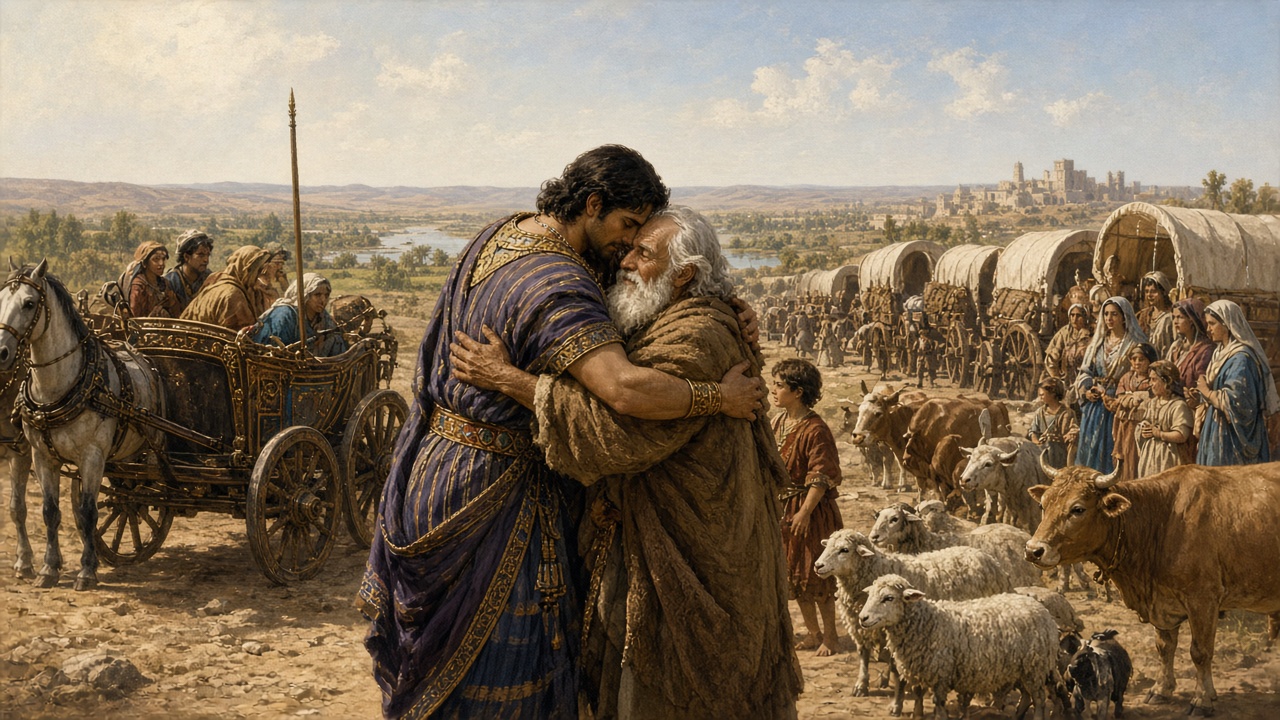
28Ara rae deka Masir ma, Yakob denu ana na Yahuda laoꞌ naꞌahuluꞌ, neu noꞌe Yusuf, nema nandaa no e sia Gosen. Ara losa Gosen boe ma, 29Yusuf sae kareta na, de neu nandaa no aman sia naa. Ara randaa ma, Yusuf holu aman, de nggae doo na seli.
30Yakob olaꞌ no Yusuf nae, “Ana Yusuf e! Ia naa, au ita nggo ena. Ma bubꞌuluꞌ ho feꞌe masodꞌaꞌ. Naa de, mae au mate oras ia o, malole.”
31Basa de, Yusuf nafadꞌe basa odꞌi-aꞌa nara nae, “Au musi uu ufadꞌe maneꞌ a, ae bobꞌonggi nggara rema mia Kanaꞌan. 32Dei fo au ufadꞌe ae hei ia, atahori mana maꞌaboi bibꞌi lombo ma sapi. Naa de hei mendi banda ma hata-hetoꞌ mara mia Kanaꞌan. 33Mete ma maneꞌ a noꞌe hei, ma natane ue-tatao mara saa, 34na mitaa mae, basa hai mana miꞌiboi banda mia anadikiꞌ ima, onaꞌ hei bei-baꞌi mara boe. No naa, dei fo ana fee hei leo sia Gosen.” Yusuf nafadꞌe taꞌo naa, huu atahori Masir ra melumudꞌu, leo raꞌabꞌue ro atahori manatadꞌa ra.
Did you know?
Israel Goes Down to Egypt
- As Israel set out for Egypt with all that he had, he stopped at Beersheba and offered sacrifices to the God of his father Isaac. Beersheba, meaning well of the oath or well of seven, was a well Abraham dug and named after a compact with Abimelech; when Isaac reopened it, he gave it the same name. It was a favorite dwelling of both patriarchs, and there that night God spoke to Jacob in a vision, telling him not to fear going down to Egypt, for he would make him a great nation there.Sources: the Bible text itself · Beersheba
- Jacob sent Judah ahead to Joseph for directions to Goshen, an Egyptian district east of the Nile, apparently near the royal residence, where the family remained until the Exodus. Easton's Bible Dictionary (1897) calls it the best of the land, now a desert, and also the land of Rameses. Joseph told his brothers to say they had raised livestock from youth, so they might settle there, because shepherds were detestable to the Egyptians; that dictionary suggests Pharaoh was probably Apopi, last of the Hyksos, who welcomed these Asiatic shepherds, while native Egyptians abhorred them, though some argue Joseph arrived later, under Thothmes III, after the Hyksos were expelled.Sources: the Bible text itself · Goshen · Pharaoh (of Joseph)
- The chapter counts sixty-six of Jacob's direct descendants who came to Egypt, not counting the wives of his sons, and seventy when Joseph's two sons already born in Egypt are included. Leah's sons and her daughter Dinah are named in that tally, although Easton's Bible Dictionary (1897) says Leah herself had died in Canaan before the journey and was buried in the cave of Machpelah; Rachel had died earlier giving birth to Benjamin and was buried on the way to Ephrath, that is, Bethlehem. Manasseh and Ephraim were born to Joseph in Egypt by Asenath, daughter of Potiphera, priest of On, a center of sun-worship that the Septuagint and Vulgate call Heliopolis.Sources: the Bible text itself · Leah · Rachel · On
Notes written with AI assistance from open sources (Theographic Bible Metadata, CC BY-SA 4.0; Easton’s Bible Dictionary, public domain) and reviewed before publishing.
Places in this chapter
- Egypt · 30.129, 31.308 · verses 1, 3, 4, 5, 6, 7, 8, 20, 26, 27
- Canaan · 32.767, 35.333 · verses 6, 12, 31
- Heliopolis · Today: Ain Shams · 30.129, 31.308 · verse 20
- Goshen · Today: Goshen 1 · 30.799, 31.834 · verses 28, 29, 34
Only places identified with high confidence are shown (90% or more according to the scholarly sources compiled by OpenBible). Period map: DARE (Digital Atlas of the Roman Empire), CC BY 4.0; modern map: © OpenStreetMap contributors; places: OpenBible.info (CC BY 4.0).
Credits and license for this translation
Rote Dela Alkitab
Genesis and the New Testament in the Rote Dela language of Indonesia
Kejadian dan Perjanjian Baru dalam bahasa Rote Dela
copyright © 2016 Unit Bahasa dan Budaya
Language: Rote Dela (Dela-Oenale)
Translation by: Wycliffe Bible Translators
This translation is made available to you under the terms of the
Creative Commons Attribution Share-Alike license 4.0.
You have permission to share and redistribute this Bible translation in any format and to make reasonable revisions and adaptations of this translation, provided that:
You include the above copyright and source information.
If you make any changes to the text, you must indicate that you did so in a way that makes it clear that the original licensor is not necessarily endorsing your changes.
If you redistribute this text, you must distribute your contributions under the same license as the original.
Pictures included with Scriptures and other documents on this site are licensed just for use with those Scriptures and documents.
For other uses, please contact the respective copyright owners.
Note that in addition to the rules above, revising and adapting God's Word involves a great responsibility to be true to God's Word. See Revelation 22:18-19.
2022-03-11
Source: http://ebible.org/row/ · eBible.org