Matthew 3
Suha' Maseho: Kadadiam anna Pa'dandiam Bakahu · Tap a verse to see its cross-references.
Yohanes to si mantedo' untula' loppo' pengkähänganna Puang Yesus
1Masäei lessu'na ia too, iya sulem Yohanes to si mantedo' dio pohiallasam illaam lembäna Yudea anna napahandu'i umpalanda' kadanna Puang Allataala naua: 2“Tihokongannia' ingganna gau' kadakemu aka bambannam umpalako kapahentaanna Puang Allataala.” 3Yohanes iam too inde indo puha napayolo lambam nabi Yesaya naua:
“Deem tau dio pohiallasam metamba-tamba naua:
‘Patokaanni lalam Debata,
maloloanganni lalam la naolanna.’”
4Indo Yohanes to si mantedo' umpa'poheba bulu unta anna ma'beke' lollo'. Anna bati' sola duho si naande. 5Iya sulem buda tau buttu yabo mai Yerusalem, anna dio mai lembäna Yudea anna ingganna tondä' dio sikahuku'na Salu Yordan umpellambi'i Yohanes. 6Sangngim muakui dosana anna natedo'i dio Salu Yordan.
7Anna buda toi duka' to illaam kakalebuanna Parisi anna to illaam kakalebuanna Saduki sule umpellambi'i Yohanes aka maelo' la ditedo'. Sapo' naitanna Yohanes sulei, iya nauaammi: “O inggammua' to si mambaba bulim, pessubunna to kadake gau'! Ussanga haka iko la malakoa' lappa' dio mai aha' kasallena Puang Allataala? 8Pa'baju polekoa' anna pa'dodo pole anna mala tandaam diua ussosso si'dangkoa' gau'mu anna untingko' basabammu. 9Daa muuaia': ‘Tä'kam la napassala Puang Allataala aka peampoannakam Abraham.’ Aka kutulasangkoa', inde mai batu la mala duka' napadadi Puang Allataala peampoanna Abraham! 10Tentomai la dipembattaammi wase di ada'na Puang Allataala dilemposam ingganna kaju tää'na kembua manappa anna ditibei tama api. 11Kao-kao uwai kupake untedo'koa' mendadi tanda katihokongammua'. Sapo' dako'i too sulem To kuasa puha Ia anna la kao. Aka moi la kubabaam sapatunna, tala sihatannä'. Ia-Ia Penaba Maseho anna api la napake natedosangkoa'. 12Sihhapam to ma'tappi tokam dio limanna petappi la nase'laam banne maläpu' anna läkko'na. Ingganna banne maläpu' la dianna manappa tama loko, anna läkko'na la ditibe ia tama api tapi'de-pi'de.”
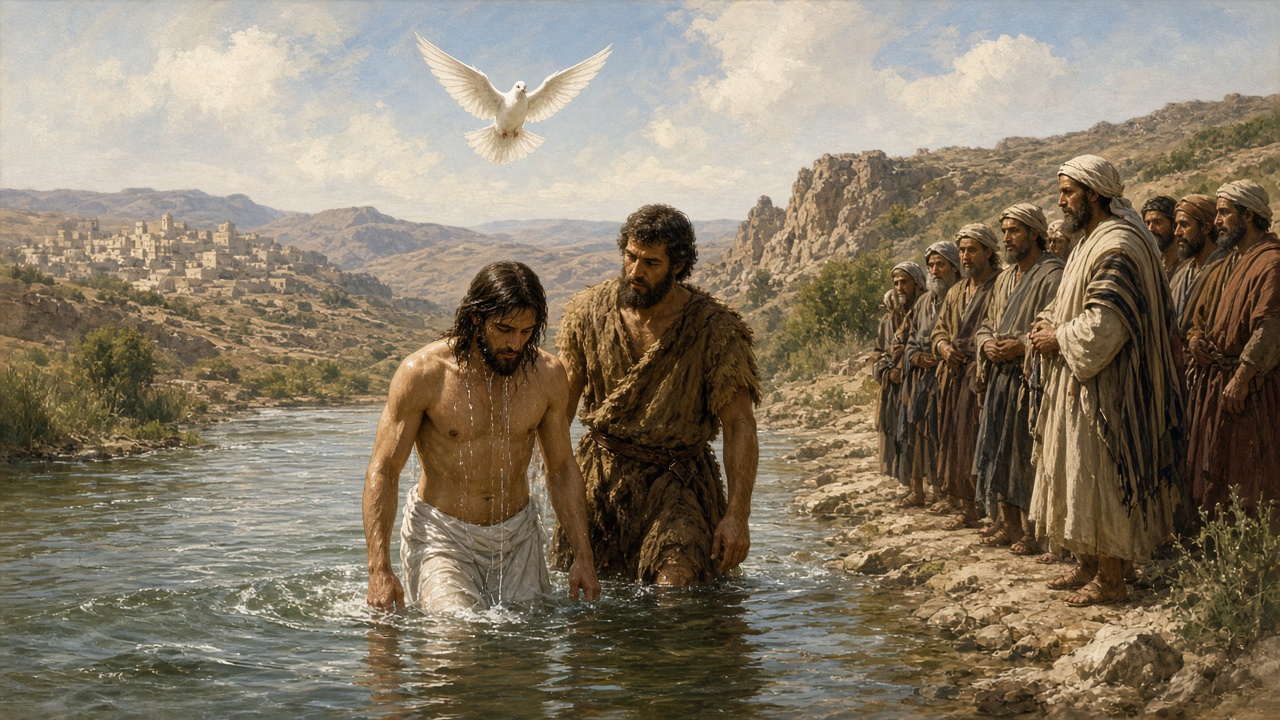
Puang Yesus natedo' Yohanes
13Wattu eta too, mengkalaom Puang Yesus dio Galilea le'ba' lako Salu Yordan. Dioi, umpellambi'im Yohanes anna napelaui la natedo'. 14Sapo' moka salapi Yohanes untedo'i, naua: “Setonganna tuam, Iko hia la sihatam untedo'ä'! Maaka anna Iko ohi muuai: ‘Tedo'ä'’?”
15Sapo' natimba'i Puang Yesus naua: “Päbäi untedo'ä' temo. Aka ia anna tapateenni aka pahallu la taponnoi asam ingganna pa'elo'na Puang Allataala.” Iya natuhu'im pelauanna lambi' natedo'.
16Puhai ditedo', iya kende'um dio mai uwai. Iya naita siaham Puang Yesus tibukka langi' anna tuhunni Penabanna Puang Allataala susi dangam-dangam uhhampoi. 17Iya dihingngi siaham kamaha buttu yabo mai suhuga naua: “Iam too inde Änä' pa'pakamajangku to umpomasannam penabangku.”
Did you know?
Repentance and Baptism at the Jordan
- Matthew identifies John the Baptist as the one spoken of through the prophet Isaiah: a voice calling in the wilderness, “Prepare the way for the Lord.” Easton's Bible Dictionary (1897) records that John’s mission was the subject of prophecy, citing this passage, Isaiah 40:3, and Malachi 3:1, and that he was of priestly descent—his father Zacharias a priest of the course of Abia, and his mother Elisabeth of the daughters of Aaron. A chronology dates both the beginning of John’s ministry and his baptism of Jesus to AD 26.Sources: the Bible text itself · John the Baptist · John the Baptist Begins Ministry · John Baptizes Jesus
- John came preaching in the wilderness of Judea, and people went out to him from Jerusalem, all Judea, and the whole region around the Jordan, confessing their sins and being baptized in the Jordan River. Easton's Bible Dictionary (1897) notes that under the Romans, in the time of Christ, Judea denoted the southernmost of the three divisions of Palestine, as distinguished from Galilee and Samaria, and included the territories of Judah, Benjamin, Dan, Simeon, and part of Ephraim. Jesus came from Galilee—called Galil by the Jews—to the Jordan to be baptized by John.Sources: the Bible text itself · Judea · Galilee
- John warned the Pharisees and Sadducees not to rely on the claim, “We have Abraham as our father,” saying that God could raise up children for Abraham from the stones. Easton's Bible Dictionary (1897) explains the name Abraham as “father of a multitude” and describes him as the son of Terah, named before his older brothers because he was the heir of the promises.Sources: the Bible text itself · Abraham
Notes written with AI assistance from open sources (Theographic Bible Metadata, CC BY-SA 4.0; Easton’s Bible Dictionary, public domain) and reviewed before publishing.
Places in this chapter
- Judea · Today: Judea 1 · 31.777, 35.234 · verses 1, 5
- Jerusalem · 31.777, 35.234 · verse 5
- Jordan · Today: Jordan River · 31.761, 35.558 · verses 5, 6, 13
- Galilee · 32.760, 35.527 · verse 13
Only places identified with high confidence are shown (90% or more according to the scholarly sources compiled by OpenBible). Period map: DARE (Digital Atlas of the Roman Empire), CC BY 4.0; modern map: © OpenStreetMap contributors; places: OpenBible.info (CC BY 4.0).
Credits and license for this translation
Suha' Maseho: Kadadiam anna Pa'dandiam Bakahu
The New Testament and Genesis in the Bambam language of Indonesia
Perjanjian Baru dan bagian dari Perjanjian Lama dalam bahasa Bambam dari Indonesia
copyright © 2004 Lembaga Alkitab Indonesia
Language: Bambam
Translation by: Wycliffe Bible Translators
This translation is made available to you under the terms of the
Creative Commons Attribution-No Derivatives license 4.0.
You may share and redistribute this Bible translation or extracts from it in any format, provided that:
You include the above copyright and source information.
You do not make any derivative works that change any of the actual words or punctuation of the Scriptures.
Pictures included with Scriptures and other documents on this site are licensed just for use with those Scriptures and documents.
For other uses, please contact the respective copyright owners.
2022-03-11
Source: http://ebible.org/ptu/ · eBible.org