Leviticus 17
Bíblia Livre · Tap a verse to see its cross-references.
O lugar de sacrifício
1E falou o SENHOR a Moisés, dizendo: 2Fala a Arão e a seus filhos, e a todos os filhos de Israel, e dize-lhes: Isto é o que mandou o SENHOR, dizendo: 3Qualquer homem da casa de Israel que degolar boi, ou cordeiro, ou cabra, no acampamento, ou fora do acampamento, 4E não o trouxer à porta do tabernáculo do testemunho, para oferecer oferta ao SENHOR diante do tabernáculo do SENHOR, sangue será imputado ao tal homem: sangue derramou; eliminado será o tal homem dentre seu povo: 5A fim de que tragam os filhos de Israel seus sacrifícios, os que sacrificam sobre a face do campo, para que os tragam ao SENHOR à porta do tabernáculo do testemunho ao sacerdote, e sacrifiquem eles sacrifícios pacíficos ao SENHOR. 6E o sacerdote espargirá o sangue sobre o altar do SENHOR, à porta do tabernáculo do testemunho, e queimará a gordura em cheiro suave ao SENHOR. 7E nunca mais sacrificarão seus sacrifícios aos demônios, atrás dos quais se prostituíram: terão isto por estatuto perpétuo por suas gerações. 8Tu Lhes dirás também: Qualquer homem da casa de Israel, ou dos estrangeiros que peregrinam entre vós, que oferecer holocausto ou sacrifício, 9E não o trouxer à porta do tabernáculo do testemunho, para fazê-lo ao SENHOR, o tal homem será igualmente eliminado de seus povos.
A proibição de comer sangue
10E qualquer homem da casa de Israel, ou dos estrangeiros que peregrinam entre eles, que comer algum sangue, eu porei meu rosto contra a pessoa que comer sangue, e lhe cortarei dentre seu povo. 11Porque a vida da carne no sangue está: e eu vos a dei para expiar vossas pessoas sobre o altar: pelo qual o mesmo sangue expiará a pessoa. 12Portanto, disse aos filhos de Israel: Nenhuma pessoa de vós comerá sangue, nem o estrangeiro que peregrina entre vós comerá sangue. 13E qualquer homem dos filhos de Israel, ou dos estrangeiros que peregrinam entre eles, que recolher caça de animal ou de ave que seja de comer, derramará seu sangue e o cobrirá com terra: 14Porque a alma de toda carne, sua vida, está em seu sangue: portanto disse aos filhos de Israel: Não comereis o sangue de nenhuma carne, porque a vida de toda carne é seu sangue; qualquer um que a comer será eliminado. 15E qualquer um pessoa que comer coisa morta ou despedaçada por fera, tanto dos naturais como dos estrangeiros, lavará suas roupas e a si mesmo se lavará com água, e será impuro até à tarde; e se limpará. 16E se não os lavar, nem lavar sua carne, levará sua iniquidade.
Did you know?
Sacrificial Slaughter and the Sacredness of Blood
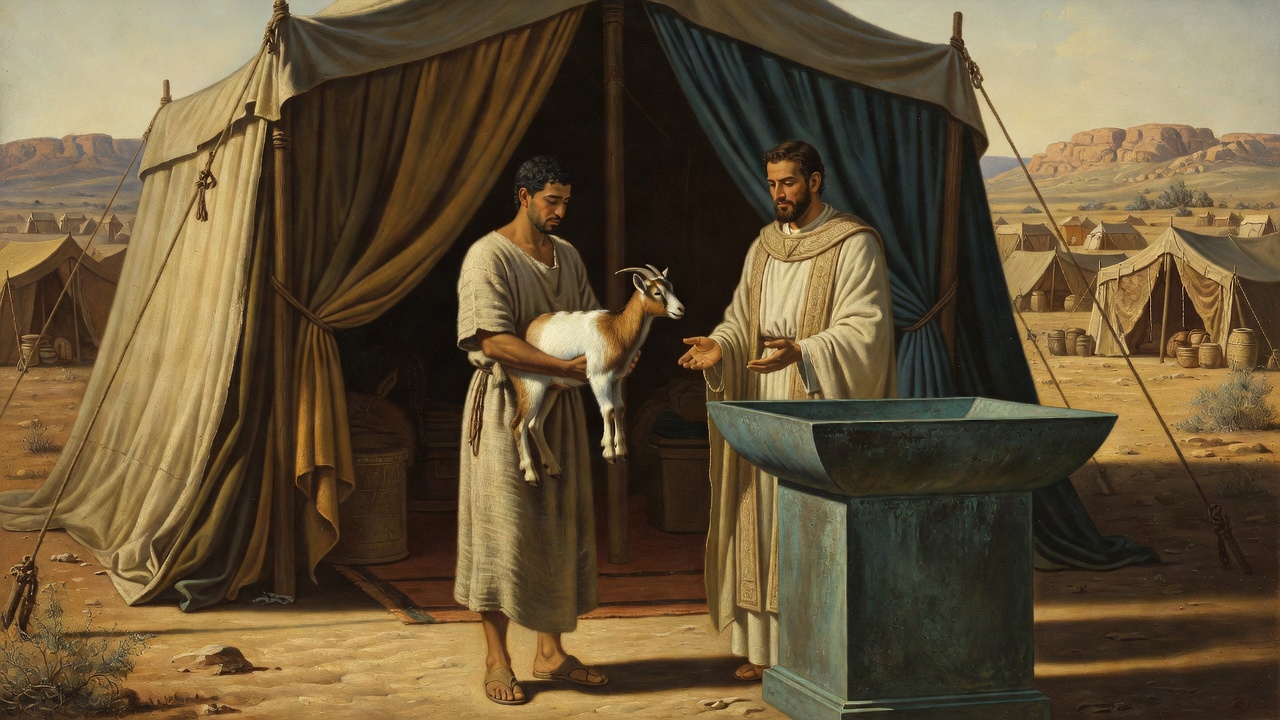
- Leviticus mandates that domestic animals such as oxen, lambs, and goats be brought directly to the entrance of the Tent of Meeting rather than slaughtered in open fields. This rule ensured sacrifices were presented exclusively as peace offerings to the LORD and halted illicit sacrifices to goat demons.Sources: the Bible text itself
- Both native Israelites and resident foreigners were strictly prohibited from eating blood, on penalty of being cut off from the community. The text grounds this law in the theological principle that the life of the flesh is in the blood, which God appointed specifically for making atonement upon the altar.Sources: the Bible text itself
- When Israelites or resident aliens hunted wild animals or birds that were clean for food, they were commanded to drain the blood upon the ground and cover it with dirt. This instruction reinforced that life belongs to God and preserved the sanctity of blood outside the sacrificial sanctuary.Sources: the Bible text itself
Notes written with AI assistance from open sources (Theographic Bible Metadata, CC BY-SA 4.0; Easton’s Bible Dictionary, public domain) and reviewed before publishing.
Credits and license for this translation
Bíblia Livre
The Holy Bible in Brazilian Portuguese, updated from from the 1819 translation by João Ferreira de Almeida, Textus Receptus edition
A Bíblia Sagrada em português do Brasil, atualizada a partir da tradução de 1819 de João Ferreira de Almeida, edição Textus Receptus
copyright © 2018 Diego Santos, Mario Sérgio, e Marco Teles
Language: Português (Portuguese)
Dialect: Brasil
Como dar crédito à Bíblia Livre
A Bíblia Livre tem uso livre, porém a menção da obra de forma adequada é obrigatória. Essa menção pode ser feita de qualquer maneira razoável, dependendo do meio, em conformidade com a Licença Creative Commons Atribuição 4.0 Brasil. Uma sugestão de créditos é a seguinte:
Todas as Escrituras em português citadas são da Bíblia Livre (BLIVRE), Copyright © Diego Santos, Mario Sérgio, e Marco Teles, http://sites.google.com/site/biblialivre/ - fevereiro de 2018. Licença Creative Commons Atribuição 4.0 Brasil ( http://creativecommons.org/licenses/by/4.0/br/ ). Reprodução permitida desde que devidamente mencionados fonte e autores.
Lembre-se que a Bíblia Livre é um trabalho em andamento, por isso sempre indique a data correta da versão.
Onde o espaço não for suficiente, tal como tweets, folhetos pequenos, slides de apresentações etc. basta usar a sigla BLIVRE.
This translation is made available to you under the terms of the
Creative Commons Attribution license 4.0.
You may share and redistribute this Bible translation or extracts from it in any format, provided that:
You include the above copyright and source information.
If you make any changes to the text, you must indicate that you did so in a way that makes it clear that the original licensor is not necessarily endorsing your changes.
Pictures included with Scriptures and other documents on this site are licensed just for use with those Scriptures and documents.
For other uses, please contact the respective copyright owners.
Note that in addition to the rules above, revising and adapting God's Word involves a great responsibility to be true to God's Word. See Revelation 22:18-19.
2022-03-08
Section headings adapted from the Berean Standard Bible (public domain); they are not part of this translation’s text.
Source: http://ebible.org/porbr2018/ · eBible.org