Jeremiah 25
Waratau Siaga Tatuei mo Vilegi · Tap a verse to see its cross-references.

About this book
About Jeremiah
- Easton's Bible Dictionary (1897) presents Jeremiah, son of Hilkiah, a priest of Anathoth, as one of the greater prophets, called to that office while still young, in the thirteenth year of Josiah (628 B.C.). It says his prophecies cover about thirty years and are not recorded in chronological order, and that no one knows when or how the book took its present form. The same entry supposes that, after an interval in Egypt, Jeremiah added three further sections.Sources: Easton: Jeremiah, Book of · Jeremiah
- Easton's Bible Dictionary (1897) says Jeremiah left his native Anathoth for Jerusalem, where he assisted Josiah's reformation, and that he mourned Josiah's death as a national calamity. It dates Jehoiakim's eleven-year reign to 610–599 B.C.: Pharaoh Necho had deposed Jehoahaz and set Eliakim on the throne under the name Jehoiakim, and at the beginning of that reign the people's enmity against Jeremiah broke out in bitter persecution. After the Chaldeans defeated Egypt at Carchemish, the king of Egypt took no further part in Jewish politics.Sources: Jeremiah · Jehoiakim
- Zedekiah, the third son of Josiah, was the last king of Judah. Nebuchadnezzar placed him on the throne as successor to Jehoiachin and changed his name from Mattaniah to Zedekiah; the kingdom was then tributary to Nebuchadnezzar, and Jeremiah was his counsellor. After Jerusalem was destroyed, Nebuchadnezzar left Gedaliah to govern the country as his tributary at Mizpah, some four miles northwest of the city, where about three months later Ishmael killed Gedaliah and the Jews who were with him.Sources: Zedekiah · Gedaliah · Mizpah
- Easton's Bible Dictionary (1897) describes the book as twenty-three separate sections arranged in five books: an introduction, reproofs of the sins of the Jews, a review of the nations, sections picturing hopes of better times, and a conclusion, with historical appendices. It notes the frequent repetition of the same words, phrases, and images. It also records that the Septuagint differs sharply in arrangement and in other details, and omits about 2,700 words.Sources: Easton: Jeremiah, Book of
- Baruch, of the tribe of Judah, was Jeremiah's secretary. Jeremiah dictated to him prophecies about the Babylonian invasion and the captivity; in the fourth year of Jehoiakim, Baruch read them to the people from a window in the temple, then to the king's counsellors and to the king himself. After hearing part of the roll, Jehoiakim cut it with a penknife and threw it into the fire of the winter parlour where he was sitting.Sources: Baruch
Notes written with AI assistance from open sources (Theographic Bible Metadata, CC BY-SA 4.0; Easton’s Bible Dictionary, public domain) and reviewed before publishing.
Higao Ngavulu Geibitu Lo Garovauveu
1A leo mo vumai lawe Jeremae huri na sinobu tau Juda lo higao gaivesigi tavohe Jehoiakim netui Josaea Ratahigi tau Juda, lo muei higao noi Nebukadnesa Ratahigi tau Babilon. 2I Jeremae a tangaloi ligoligogi mo veve lawe na sinobu tau Juda me lawera doluegi ram toga Jerusalem: 3Lolo higao hangavulu dongwagai gaitolu, tavohe Josaea netui Amon tau Juda mo ratahigi Huqe mo gato mei eu me neu nam gato mei gimiu. Mo dadari bagataha higao ngavulu geirue domwagi tolugi lehe, maraga gimiu hateve nem rorontagi.
4Me hate huri i Huqe u hora na nona tangaloi ligoligogi lawe gimiu taligu siu taligu nge nehi rorongtagi tevohogi. 5Ram veve vena, “Tudor, vataha gimiu dena nomiu galegaleasi mena doridori esi, siu nei toga lai lolo vanue i Huqe u bete lawe gimiu, meire tubumiu vagituei. 6Mese huri re huqe dolue ve nen tamba nora me sige nen huduhudu lawera; mese vutu na nongu meroana gena nunui huqe lime miu u veie. Siu nain mese arahi gimiu.”
7I Huqe mo veve, “Nge nei rorontagi eu tea, me gimiu neu vutu na nogu meroana gena havagi a lime miu u veie, me neu lei na tatuana lawe gimiu sibomiu.”
8Hurihi lehe a havai i Huqe Managi u veve: “Huri nei rorontagi na nogu leo tea, 9Nain hora na leo lawe na sinobu lo matai wai bilage me nongu tangaloi tabana Nebukadnesa Ratahigi tau Babilon,” Huqe mo veve, “Siu nain leire vohivohi na vanue ngaha mena nona tangaloi me vohivohi na taureure dalire doluegi. Nain vei vohogi nire me nain veire rai vuragi na gineu vurogi, me a tangaloi rai lehire rai matagu siu, rain esi tavagi tuei. 10Nain vei goro na nora diloi havuhevu mena rongarea, me a diloi havuhevui hinagai laginana. Vin hate na nora leleoi bulu, me vin hate na gara hinaga. 11Vanue doluegi vin vuragi na gineu vurogi, me a taureure ngerehi rain tabana noi ratahigi tau Babilon higao ngavulu geibitu.
12Nge tavohe a higao ngavulu geisiwo bitu u rovo, neu nain arahi na ratahigi tau Babilon mena nona sinobu, a tano tau Babilon huri na bugure,” Huqe mo veve, “Me vin veie vin esi vagituei. 13Nain teu lo tano hi gineu doluegi hi nau veve vovohoie, gineu doluegi hi u uliana lolo nogu bugu a tangaloi ligoligogi Jeremae waratau vohivohi na taureure doluegi. 14Ngere sibora rain vuragi na gaihora nora taureure sao mena ratahigi lalawua: Nain malaire vin huri na nora doridori mena tabana mo vaiana gena limara.”
Did you know?
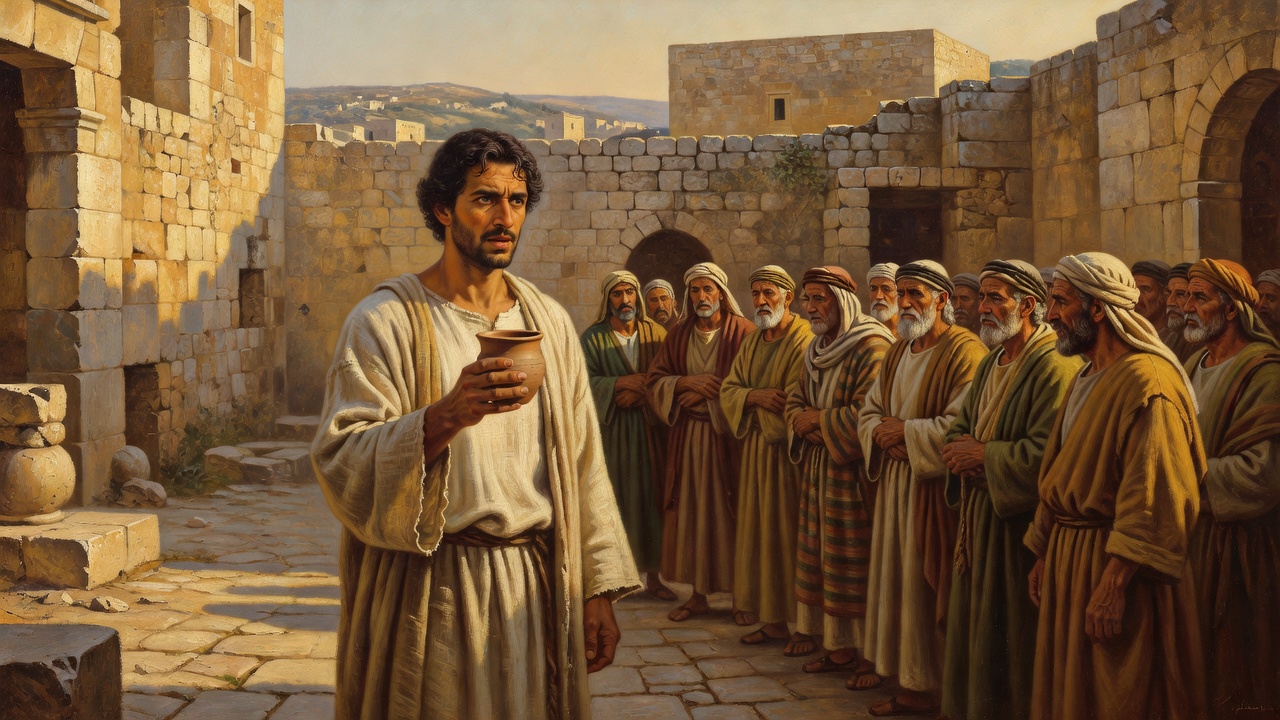
Seventy Years of Exile and the Cup of Wrath
- The prophecy is specifically dated to the fourth year of King Jehoiakim of Judah, coinciding with the first year of Nebuchadnezzar king of Babylon. Jeremiah remarks that he had been persistently delivering God's warnings for twenty-three years, beginning in the thirteenth year of King Josiah.Sources: the Bible text itself · Jeremiah · Jehoiakim · Nebuchadnezzar
- This chapter introduces the prominent prophecy that Judah and neighboring nations would serve the king of Babylon for seventy years. The text also foretells that once those seventy years were completed, Babylon itself and the land of the Chaldeans would be punished and reduced to desolation.Sources: the Bible text itself · Babylon
- The judgment vision extends far beyond Judah through the symbol of a cup of wrath given to many surrounding peoples. These included Egypt, the Philistine cities of Ashkelon, Gaza, and Ashdod, as well as regional neighbors such as Edom and Moab.Sources: the Bible text itself · Ashdod · Ashkelon · Gaza
Notes written with AI assistance from open sources (Theographic Bible Metadata, CC BY-SA 4.0; Easton’s Bible Dictionary, public domain) and reviewed before publishing.
Places in this chapter
- Babylon · 32.543, 44.422 · verses 1, 9, 11, 12, 14
- Jerusalem · 31.777, 35.234 · verses 2, 18, 29
- Chaldea · 30.962, 46.104 · verse 12
- Egypt · 30.129, 31.308 · verses 19, 20
- Ashdod · Today: Tel Ashdod · 31.757, 34.658 · verse 20
- Ashkelon · Today: Tel Ashkelon · 31.664, 34.546 · verse 20
- Ekron · Today: Tel Miqne · 31.777, 34.852 · verse 20
- Gaza · Today: Tell Harube · 31.504, 34.464 · verse 20
- Ammon · 31.955, 35.934 · verse 21
- Edom · 30.746, 35.604 · verse 21
- Moab · Today: Moab 1 · 31.181, 35.701 · verse 21
- Sidon · Today: Sandikli archaeological site in Sidon · 33.561, 35.372 · verse 22
- Tyre · 33.271, 35.196 · verse 22
- Tema · Today: Tayma · 27.630, 38.552 · verse 23
- Arabia · Today: Arabian Peninsula · 23.000, 46.000 · verse 24
- Elam · 32.189, 48.258 · verse 25
- Media · 34.806, 48.516 · verse 25
- Sheshach · Today: Babylon · 32.543, 44.422 · verse 26
Only places identified with high confidence are shown (90% or more according to the scholarly sources compiled by OpenBible). Period map: DARE (Digital Atlas of the Roman Empire), CC BY 4.0; modern map: © OpenStreetMap contributors; places: OpenBible.info (CC BY 4.0).
Credits and license for this translation
Waratau Siaga Tatuei mo Vilegi
Ambae, East: Waratau Siaga Tatuei mo Vilegi (Old Testament)
copyright © 2022 Pioneer Bible Translators
Language: Havai (Ambae, East)
Contributor: The Seed Company
© Pioneer Bible Translators of Dallas, Texas, USA.
This translation is made available to you under the terms of the
Creative Commons Attribution Share-Alike license 4.0.
You have permission to share and redistribute this Bible translation in any format and to make reasonable revisions and adaptations of this translation, provided that:
You include the above copyright and source information.
If you make any changes to the text, you must indicate that you did so in a way that makes it clear that the original licensor is not necessarily endorsing your changes.
If you redistribute this text, you must distribute your contributions under the same license as the original.
Pictures included with Scriptures and other documents on this site are licensed just for use with those Scriptures and documents.
For other uses, please contact the respective copyright owners.
Note that in addition to the rules above, revising and adapting God's Word involves a great responsibility to be true to God's Word. See Revelation 22:18-19.
2025-05-20
Source: http://ebible.org/omb/ · eBible.org