Judges 2
Waratau Siaga Tatuei mo Vilegi · Tap a verse to see its cross-references.

About this book
About Judges
- The book is called Judges because it contains the history of Israel's deliverance and government by the men who bore that title. Easton's Bible Dictionary (1897) sets their story in repeated times of servitude under neighboring peoples and of deliverance by the judges, and it states that the chronology of the whole period is uncertain.Sources: Easton: Judges, Book of
- Easton's Bible Dictionary (1897) holds that the author was most probably Samuel, and that the book was probably composed during Saul's reign or at the very beginning of David's reign. Easton notes that the words in Judges 18:30–31 imply a date after the Philistines took the ark and after it was set up at Nob, whereas in David's reign the ark was at Gibeon.Sources: Easton: Judges, Book of
- As Easton outlines it, the book has an introduction (1–3:6) linking it with the narrative in Joshua, a history of thirteen judges (3:7–16:31) in four periods, and an appendix (chapters 17–21) with no formal connection to what goes before. If Eli and Samuel are included, Easton counts fifteen judges.Sources: Easton: Judges, Book of
- Easton's outline presents the setting as a succession of servitudes: under Chushan-rishathaim of Mesopotamia, under Eglon of Moab, under Jabin of Hazor in Canaan, under Midian with Amalek and the children of the east, under the Ammonites together with the Philistines, and again under the Philistines. Gideon, also called Jerubbaal, begins what Easton calls the second period; Jephthah, brought from Tob by the elders of Gilead, judged Israel for six years after delivering the people from the Ammonites; Samson, son of Manoah of Zorah, was a Nazirite to God from birth.Sources: Easton: Judges, Book of · Gideon · Jephthah · Samson
- The appendix records the conquest of Laish by a portion of the tribe of Dan, and the near extinction of Benjamin at the hands of the other tribes because Benjamin had assisted the men of Gibeah. Easton places these events only a few years after Joshua's death and says they show the people's religious and moral degeneracy. Easton also notes that Ruth originally formed part of Judges and was separated from it about A.D. 450, then placed in the Hebrew scriptures immediately after the Song of Solomon.Sources: Easton: Judges, Book of · Gibeah
Notes written with AI assistance from open sources (Theographic Bible Metadata, CC BY-SA 4.0; Easton’s Bible Dictionary, public domain) and reviewed before publishing.
Israel He Huri Huqe Tea
6Jesua mo hora vohogi na tangaloi tau Israel. Gagategalegi vin vano vin lei na vanue ngehi vin vuragi na nona hagogineu. 7Me a tangaloi ram galohagi na Huqe lolo taro tavohe i Jesua u mwaso. Lo tagui taro noi Jesua, ram galohagi Huqe tau duruhi na taro nora sesea ngerehi rau lehi na tabana lawua doluegi ngehi Huqe uvei beno lawera Israel. 8Jesua netui Nun, tangaloi tabana noi Huqe, u mate lo higaona vudolue avigi hangavulu. 9Siu ram tulegi nie lolo vanue hi a nona lo Timnat Heres, lolo vusi tanoi Evrem, gangarani lo Vusi Gaas.
10Siu lo babagi leheno mei Jesua rau mate beno, me ngerehi rau vora lo tagugi hateve rau ilo Huqe mena tabana lawua ngehi u veiana beno lawera Israel.
11Siu tangaloi tau Israel ram vai na gineu esi lolo matai nora Huqe me ram tabana noi tagaro vurogi saosao. 12Ram siregi na Huqe a Huqe noi retubure, ngehi u lei vohogi nire dena vanue Ijib. Ngerehi ru vora atagu ram huri na huqe wagineu nora tangaloi doluegi ngehi dalire, me ram huduhudu lawera. Ram vai na Huqe mo mero, 13huri ram siregi Huqe me ram tabana noi Tagaro me ngere huqe vavinegi. 14Tavohe Huqe mo merogi nire Israel mo betera sulo limara tangaloi vuro sao ramo wehire me ramo balu na nora vai gineu. Huqe mo siregi nire sulo limara nora tavalui vuro ngerehi ram toga dalire. Lo taro hi ngere Israel rahe vai lai tea vena rain labe lo nagoi nora tavalui vuro. 15Lo taro hi ram vano lolo vuro, limei Huqe mo eno vovohire mo vai asisigi nire mwere hi nge u veve me u haharigi. U gagarasi lawuagi lawera tau Israel.
16Siu me Huqe mo ragasire na tangaloi vagamwasoi me ramo vagamwasoire Israel dena limara tangaloi vuro. 17Me tangaloi tau Israel hateve rau rongo na leo nora tangaloi vagamwasoi, me ram dori mwere na vavine huri turegi lo tagure huqe wagineu me ram huduhudu lawera. Ram begi siseri dena turegi ngehi retubure rau dige lune me rai ronghuri leo hora noi Huqe tea. 18Lo taro hi Huqe mo ragasi na nora tangaloi vagamwasoi, Huqe mo toga meire tangaloi vagamwasoi. Ngeie mo vagamwasoire dena limei nora tavalui vuro lolo taro nora tangaloi vagamwasoi, huri Huqe mo hagavire lo taroi nora raveana huri ngerehi ram vai asisigi nire me ram vai gagarasigi nire. 19Me lo taro hi tangaloi vagamwasoi u mate, me ram tudori ramo vai gineu rau esi liu retubure. Ram dige mo hurire huqe wagineu vena rain tabana nora, me vena rain huduhudu lawera. Ram rao siregi na nora doridori esi mena turegi na qatusiaga.
20Mo vai i Huqe mo mero lawuagi meire Israel me mo veve vena, “Huri a sinobu lehe he huri na nogu waratau siaga tea hi nau veve lawe tubure me hateve rau ronghuri na dilogu, 21siu neu nain he livusi na buri sinobu lehe tea ngerehi ram toga mwaso mosigei tavohe Jesua u mate beno. 22Neu nain veire huri siu rain vailehire Israel vena ngere Israel rain huri na nogu turegi me rain dige lune mwerei retubure sige hatie.”
23Me Huqe mo siregi na buri sinobu hi ram toga. Nge he livusire tea vena siseri, me hateve u betera sulo limei Jesua.
Did you know?
Israel's Cycle of Disobedience and the Judges
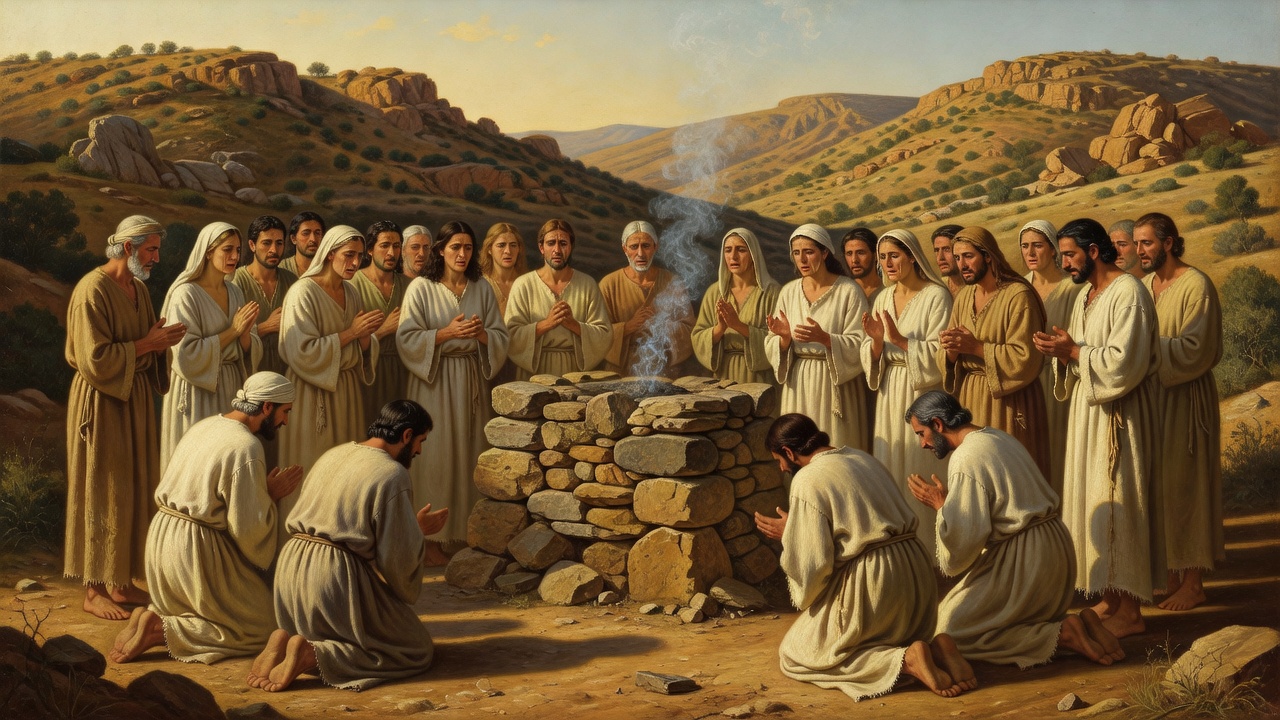
- The name Bochim means "weepers." The site, likely situated between Gilgal and Shiloh, received this name after the Israelites wept aloud when the angel of the Lord rebuked them for making compromises with the inhabitants of the land.Sources: Bochim · the Bible text itself
- Joshua was buried at Timnath-heres, which means "portion of the sun," located north of the hill of Gaash in the hill country of Ephraim. He had led the Israelites following the death of Moses and died at the age of 110.Sources: Timnath-heres · Gaash · Joshua · the Bible text itself
- The term Baalim is the plural form referring to local manifestations of Baal, the principal male deity of the Phoenicians. Judges 2 establishes the book's recurring cycle: Israel abandons the Lord for regional gods, suffers under enemies, and is delivered when God raises up a judge.Sources: Baal · the Bible text itself
Notes written with AI assistance from open sources (Theographic Bible Metadata, CC BY-SA 4.0; Easton’s Bible Dictionary, public domain) and reviewed before publishing.
Places in this chapter
Only places identified with high confidence are shown (90% or more according to the scholarly sources compiled by OpenBible). Period map: DARE (Digital Atlas of the Roman Empire), CC BY 4.0; modern map: © OpenStreetMap contributors; places: OpenBible.info (CC BY 4.0).
Credits and license for this translation
Waratau Siaga Tatuei mo Vilegi
Ambae, East: Waratau Siaga Tatuei mo Vilegi (Old Testament)
copyright © 2022 Pioneer Bible Translators
Language: Havai (Ambae, East)
Contributor: The Seed Company
© Pioneer Bible Translators of Dallas, Texas, USA.
This translation is made available to you under the terms of the
Creative Commons Attribution Share-Alike license 4.0.
You have permission to share and redistribute this Bible translation in any format and to make reasonable revisions and adaptations of this translation, provided that:
You include the above copyright and source information.
If you make any changes to the text, you must indicate that you did so in a way that makes it clear that the original licensor is not necessarily endorsing your changes.
If you redistribute this text, you must distribute your contributions under the same license as the original.
Pictures included with Scriptures and other documents on this site are licensed just for use with those Scriptures and documents.
For other uses, please contact the respective copyright owners.
Note that in addition to the rules above, revising and adapting God's Word involves a great responsibility to be true to God's Word. See Revelation 22:18-19.
2025-05-20
Source: http://ebible.org/omb/ · eBible.org