Genesis 21
Waratau Siaga Tatuei mo Vilegi · Tap a verse to see its cross-references.
Valuhuri Sera mo Bamba Netui Ebraham
1Huqe u vei gareagi Sera mwere nge u warataugi lawea. 2I Sera mo tinogi na maresu me mo bamba na maresu hi mwera lawe Ebraham lo taro hi nge u tamaragai beno vovohoi mwere u waratau beno lawea. 3Ebraham mo suri na henai maresu hi, i Aesak. Sera u bamba lawea. 4Tavohe netune Aesak bongine mo gaiwelu Ebraham mo teve gigilegi nie mwerei Huqe Mauri u vevea lawea. 5Ebraham higaona vudolue tavohe netune Aesak mo vora. 6Sera mo veve vena, “Huqe Mauri u vei gareagi eu, u vei eu nam mana tare hine vi rongo na rorogu, rain rongarea mei eu me rain mana.” 7Me nge mo veve vena, “Hine vi veve lawe Ebraham huri ve i ?Sera vin vagatiti na maresu? Nge ko leo, neu tongu Ebraham guru sesea lawuagi me neu nau bamba na maresu lawea.”
Ebraham mo hora vohogi Hega tona Ismael
8Ngaha a maresu u lawua mo siregi titi, Ebraham mo lagogi na hinaga lawua vuragi na gai tovoi rani ngehi. 9Nge i Sera nge mo leo huri ve netui Hega vavine tau Ijib nge u bambae lawe Ebraham mo bilibili esi mei Aesak. 10Siu mo veve lawe Ebraham, “Ko hora vohogi na vavine hora mei netune, huri a vavine hora netune vin mese lai na duvi hango gineu noi netuku Aesak.” 11A gineu ngaha mo vai Ebraham mo rongesi lawuagi huri netune. 12Nge i Huqe Mauri mo veve lawe Ebraham “Mese romasi huri na maresu mena vavine hora; goin ronghuri na hava leo i Sera mo veve lawego, huri vevenagi duruhi Aesak a maresu ngere hi rain waregi renetumu vovohoi. 13Nain vei netui vavine hora vage vin voragi na vanue lawua, huri na maresu ngehi i netumu.”
14Robongi siaga lo rain tuegi, Ebraham mo lai na hinaga, vurugi wai, me mo bete lawe Hega. Mo taure lo siqei Hega, siu mo hora vohoginire tona netune Ismael. Mo dige lategi lolo vanue vurogi waregi Bereseba. 15Tavohe a wai u rovo lolo vurugi, nge mo tau na maresu lo vavai gei gategale. 16Siu nge mo vano mo toga vidiregi dena maresu mwere na liue mo olo, huri mo lado, “Neu nain mese lehi netuku ve vin mate lo nagogu,” me nge mo toga taie mo ngara gena dilo siaga. 17Huqe Mauri u rongo na diloi Ismael me a Gaihora noi Huqe Mauri mo ware na henai Hega dena taetae mo veve lawea move “?Mwere hilogo Hega? Mese matagu Huqe Mauri u rongo na diloi maresu lo tanona nge mo eno. 18Raka na maresu ta aulu me gom dulae, huri nain veie vin vuragi na vanue lawua.” 19Siu i Huqe Mauri mo waga na matai Hega me mo lehi na walui tungu. Me mo vano mo utu na wai lolo vurugi, me mo bete lawe na maresu mo inue. 20Huqe Mauri nge mo bului na maresu hi mo dadari lune nge mo lawua. U toga lolo vanue vurogi me nge mo vuragi na tangaloi venvene masogo lo vuhu. 21Lo tarogi nge mo toga lolo vanue vurogi tau Baran, i retahine mo lai gaihorana tau Ijib lawea.
Did you know?
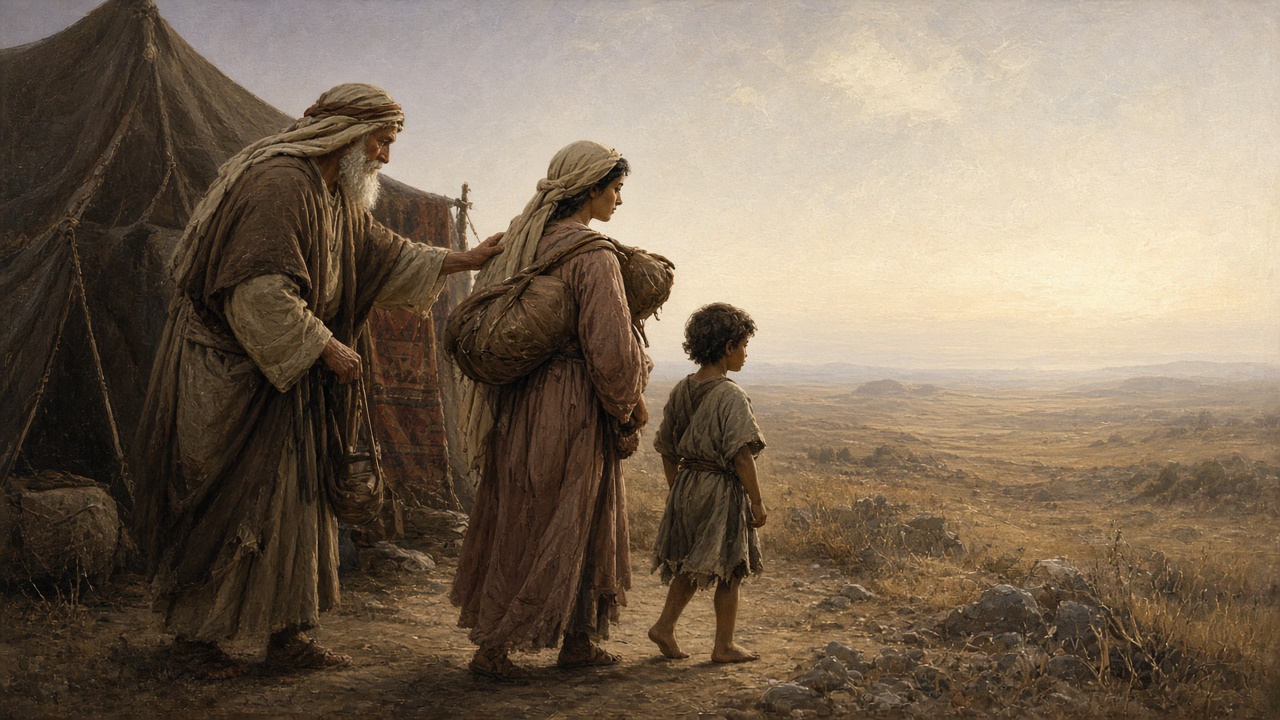
Isaac’s birth, Hagar’s departure, and Beersheba
- Abraham was a hundred years old when Sarah bore him Isaac, their only son together, and he circumcised the child at eight days old, as God had commanded. Sarah said that God had made her laugh, and that everyone who heard of this would laugh with her. Easton's Bible Dictionary (1897) notes that a great feast was held when Isaac was weaned, probably when he was about two years old.Sources: the Bible text itself · Isaac
- Hagar, whose name is explained as “flight” or, according to others, “stranger,” was an Egyptian and Sarah’s handmaid, whom Sarah gave to Abraham as a secondary wife. After Isaac’s birth, Abraham sent Hagar and their son Ishmael into the Wilderness of Beersheba with bread and a skin of water. Ishmael later settled in the Wilderness of Paran, a desert tract in the northeastern Sinai Peninsula between the Arabah on the east and the wilderness of Shur on the west, became a great archer, and his mother got him a wife from Egypt.Sources: the Bible text itself · Hagar · Paran
- Beersheba, “well of the oath” or “well of seven,” was named when Abraham and Abimelech swore an oath there over a well that Abraham said he had dug; he set apart seven ewe lambs as a witness, and the two made a covenant. Phicol, chief captain of the army of Abimelech, the Philistine king of Gerar, entered that alliance with Abraham. Abraham then planted a tamarisk at Beersheba and lived for a long time in the land of the Philistines.Sources: the Bible text itself · Beersheba · Phichol
Notes written with AI assistance from open sources (Theographic Bible Metadata, CC BY-SA 4.0; Easton’s Bible Dictionary, public domain) and reviewed before publishing.
Places in this chapter
Only places identified with high confidence are shown (90% or more according to the scholarly sources compiled by OpenBible). Period map: DARE (Digital Atlas of the Roman Empire), CC BY 4.0; modern map: © OpenStreetMap contributors; places: OpenBible.info (CC BY 4.0).
Credits and license for this translation
Waratau Siaga Tatuei mo Vilegi
Ambae, East: Waratau Siaga Tatuei mo Vilegi (Old Testament)
copyright © 2022 Pioneer Bible Translators
Language: Havai (Ambae, East)
Contributor: The Seed Company
© Pioneer Bible Translators of Dallas, Texas, USA.
This translation is made available to you under the terms of the
Creative Commons Attribution Share-Alike license 4.0.
You have permission to share and redistribute this Bible translation in any format and to make reasonable revisions and adaptations of this translation, provided that:
You include the above copyright and source information.
If you make any changes to the text, you must indicate that you did so in a way that makes it clear that the original licensor is not necessarily endorsing your changes.
If you redistribute this text, you must distribute your contributions under the same license as the original.
Pictures included with Scriptures and other documents on this site are licensed just for use with those Scriptures and documents.
For other uses, please contact the respective copyright owners.
Note that in addition to the rules above, revising and adapting God's Word involves a great responsibility to be true to God's Word. See Revelation 22:18-19.
2025-05-20
Source: http://ebible.org/omb/ · eBible.org