Genesis 11
Waratau Siaga Tatuei mo Vilegi · Tap a verse to see its cross-references.
Tangaloi ram vutu na vale tu aulu garagara.
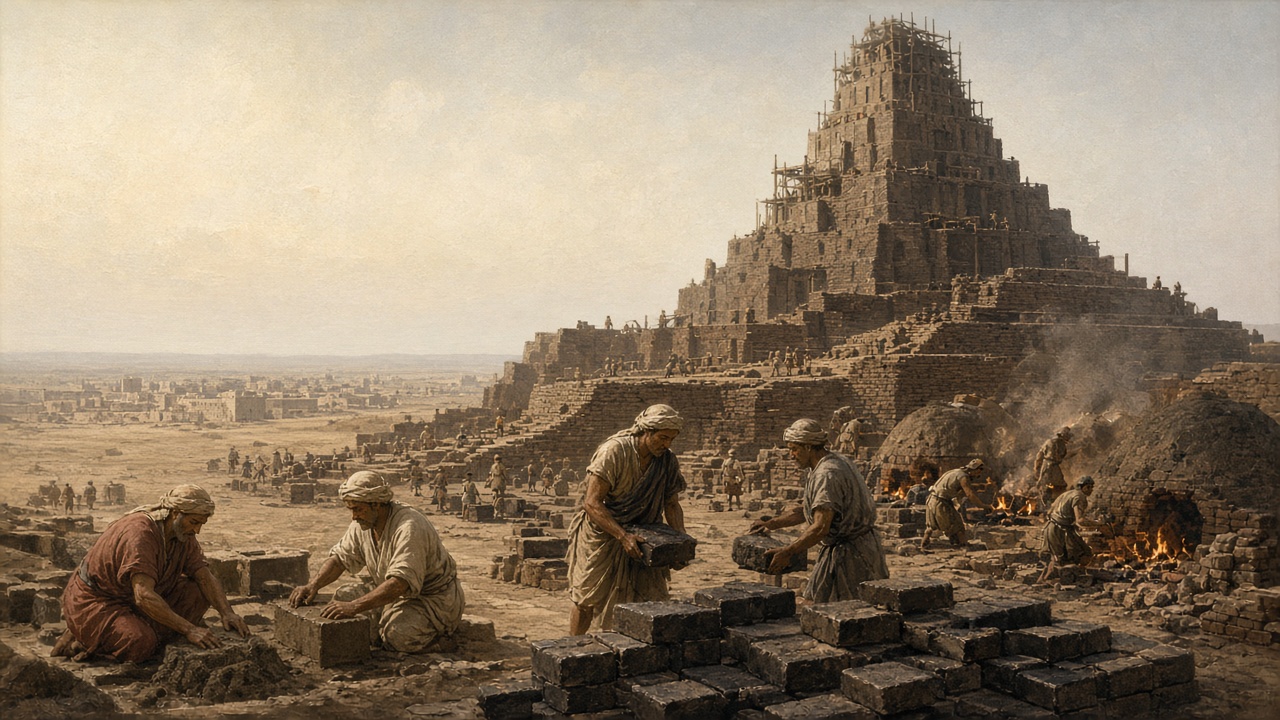
1Tomuegi ureure doluegi nora leo gategale me ram laqa gategale. 2Ngere ram mwalue dena tanora tautomue ram hivo vagi matenaho kalo ram haqe na ute tavola lolo vanue Babelonia me ram toga lune. 3Siu ngere ram veve vena, “Ngaraha. Ne vomai, u garea ve da lai na tano damo dorie, dam hurae huri vin siaga mo vuragi vatu.” Ram vai na vatu mo sao me ram lai na wai kolta mo voragi na bulu. 4Siu ngere ram veve vena, “Mai ginde dan bulu na vanue rege mena vale ulugi vi dadari lolo mahava, huri dain vei na henada vin lawua, siu vi vei ginde dain mese mawahewahe lolo ure.” 5Nge i Huqe mo hivo mo lehi na vanuara mena vale tueulu lolo mahava ngere sinobu rau bulue. 6Me Huqe mo veve vena, “Wo! Tangaloi gategale me leora gategale doluegi me ngaha nora tavuigi ve rain vei, siu havagineu ram lado huri ve rain vei vin veiana mwere hi ram lado. 7Mai, ginde da hivo vuine me da roigi na nora leo huri rain mese ronghuri na leo noi rehavara.” 8Me i Huqe mo vile wahera tavuigi Aie me ngere doluegi lo ului tano lolo ureure me ram siregi rain bulu na vanue rege tea. 9Siu tangaloi gategale mo maraga mo waregi na henai ute hi Babel, huri taie hi Huqe u roigi na leo doluegi na ureure, me tahi Huqe mo maraga mo wahera lo ului tano doluegi lolo ureure.
Tangaloi rau vomai lo tagui Sem.
10Nge ngaha a valuhuri Sem. Tavohe a higaona mo dadari vudolue vagategale, me nge mo bamba Avaksad. Ngelehe u veiana higao gairue lo tagui waga. 11Me lo tagugi u bamba Avaksad Sem u toga higao vudolue vagalime me lolo taro hi mo bamba na maresu mwera mena vavine rau sao. 12Me i Avaksad toga higao ngavulu geitolu domwagi gailime me nge mo bamba Sela. 13Vunu lo tagugi i Avaksad u bamba Sela, u toga higao vudolue vaga vesi avigi gaitolu me lolo taro hi mo bamba netune mwera mena vavine rau sao. 14I Sela utoga higao ngavulu geitolu siu nge mo bamba Eba. 15Lo tagugi nge u bamba Eba, Sela u toga higao vudolue vaga vesi avigi gaitolu me lolo taro hi mo bamba renetune mwera me vavine rau sao. 16Eba u toga higao ngavulu geitolu domwagi gaivesi mo bamba Belek. 17Me lo tagugi nge u bamba Belek, Eba toga higao vudolue vaga vesi avigi ngavulu geitolu me lolo taro hi mo bamba netune maresu mwera mena vavine rau sao. 18Me Belek u toga higao ngavulu geitolu, nge mo bamba Reu. 19Lo tagugi nge u bamba Reu, Belek u toga higao vudolue vaga rue avigi gaisiwo me lolo taro hi mo bamba na maresu mwera mena vavine rau sao. 20Reu toga higao ngavulu geitolu domwagi gairue me mo bamba Seruk. 21Me lo tagugi nge mo bamba Seruk, Reu u toga higao vudolue vaga rue avigi gaibitu me lolo taro hi mo bamba na maresu vage mwera mena vavine rau sao. 22Tavohe Seruk u toga higao ngavulu geitolu mo bamba Naho. 23Lo tagugi Seruk u bamba Naho, nge u toga higao vudolue vaga rue me nge, lolo taro hi mo bamba netune vage mwera mena vavine rau sao. 24Tavohe Naho u toga higao ngavulu geirue domwagi gaisiwo nge mo bamba Tera. 25Me lo tagui nge u bamba Tera, Naho u toga higao vudolue vaga tegale avigi hangavulu domwagi gaisiwo me lolo taro hi mo bamba na mwera vage mwera mena vavine rau sao. 26Lo tagugi Tera u toga higao ngavulu gaibitu. Nge mo bamba Ebram, Naho mei Haran.
Rehavai Tera
27Nge ngaha a valuhuri Tera. Mo bamba Ebram, Naho mei Haran me i Haran mo bamba Lot. 28Tavohe Tera mo mwaso tau, i Haran mo mate lolo vanue rege Ur lolo tano tanora Kaldea nge u vora taie. 29Ebram tona Naho ngere vunu ru legi, A henai tubui lo valei Ebram i Serai, me a henai tubui lo valei Naho i Milka netui Haran; Milka mei Iska tamara i Haran. 30Ko siu Serai u bamba samwegi maresu teu; siu nge netune hatie. 31Tera mo lai netune Ebram, vagabuine Lot netui Haran, vagabui qelige, Serai, me ram bubugi ram mwalue dena vanue rege Ur tanora Kaldea huri ve rain vano Kenan. Nge tavohe ram vomai Haran, ram toga taie. 32Doluegi Tera u toga higao vudolue vagarue avigi gailime, me mo mate lolo vanue rege Haran.
Did you know?
Babel and the Road from Ur
- Travelers in this chapter settle on a plain in Shinar and build with baked brick and tar instead of stone and mortar. A dictionary treats Shinar as probably Babylonia or southern Mesopotamia, extending almost to the Persian Gulf, says the tower of Babel was built there, and describes the land's early inhabitants as people who made bricks and built cities.Sources: the Bible text itself · Shinar
- The unfinished city is named Babel because, the narrative says, there the Lord confused the language of the whole world and scattered its people. A dictionary explains the name as 'confusion' and suggests the tower was probably meant as a rallying-point on the wide plain of Shinar, after a migration from the uplands of Armenia, so the builders would not be scattered.Sources: the Bible text itself · Babel
- The chapter ends with Terah leaving Ur of the Chaldeans for Canaan with Abram, Sarai, and his grandson Lot, then settling in Haran, where he dies at 205; his son Haran had already died in Ur. A dictionary calls Ur that son's birthplace, the largest city of Shinar or northern Chaldea, and a center of trade and political power, and places Haran, now Harran and called Charran in the Greek Old Testament and in Acts, on the Belik, a Euphrates tributary in Upper Mesopotamia, where Abram stayed until Terah died.Sources: the Bible text itself · Terah · Ur of the Chaldees · Haran
Notes written with AI assistance from open sources (Theographic Bible Metadata, CC BY-SA 4.0; Easton’s Bible Dictionary, public domain) and reviewed before publishing.
Places in this chapter
- Shinar · Today: Babylonia · 32.543, 44.422 · verse 2
- Chaldea · 30.962, 46.104 · verses 28, 31
- Canaan · 32.767, 35.333 · verse 31
- Haran · Today: Harran · 36.864, 39.033 · verses 31, 32
Only places identified with high confidence are shown (90% or more according to the scholarly sources compiled by OpenBible). Period map: DARE (Digital Atlas of the Roman Empire), CC BY 4.0; modern map: © OpenStreetMap contributors; places: OpenBible.info (CC BY 4.0).
Credits and license for this translation
Waratau Siaga Tatuei mo Vilegi
Ambae, East: Waratau Siaga Tatuei mo Vilegi (Old Testament)
copyright © 2022 Pioneer Bible Translators
Language: Havai (Ambae, East)
Contributor: The Seed Company
© Pioneer Bible Translators of Dallas, Texas, USA.
This translation is made available to you under the terms of the
Creative Commons Attribution Share-Alike license 4.0.
You have permission to share and redistribute this Bible translation in any format and to make reasonable revisions and adaptations of this translation, provided that:
You include the above copyright and source information.
If you make any changes to the text, you must indicate that you did so in a way that makes it clear that the original licensor is not necessarily endorsing your changes.
If you redistribute this text, you must distribute your contributions under the same license as the original.
Pictures included with Scriptures and other documents on this site are licensed just for use with those Scriptures and documents.
For other uses, please contact the respective copyright owners.
Note that in addition to the rules above, revising and adapting God's Word involves a great responsibility to be true to God's Word. See Revelation 22:18-19.
2025-05-20
Source: http://ebible.org/omb/ · eBible.org