Song of Songs 7
NBG-vertaling 1951 · Tap a verse to see its cross-references.
1Hoe schoon zijn uw schreden in de sandalen,vorstendochter!De welvingen van uw heupen zijn als sieraden,werk van meesterhanden. 2Uw navel is een welgerond bekken,waaraan geen gemengde wijn ontbreke;uw schoot is een tarwehoop,omzoomd met leliën. 3Uw beide borsten zijn als tweelingjongenvan gazellen. 4Uw hals is als de ivoren toren,uw ogen zijn als de vijvers van Chesbonbij de poort Bat-Rabbim,uw neus is als de toren van de Libanon,uitziende op Damascus. 5Uw hoofd op u is als de Karmel,uw haardos is als purper:een Koning is gevangen in die lokken.
Liefdesovergave
6– Hoe schoon zijt gij, liefde;hoe heerlijk onder wat men verlangen kan! 7– Ja, uw ranke gestalte is als een palm,en uw borsten zijn als dadeltrossen. 8Ik zeide: Ik wil die palm beklimmenen zijn vruchtentrossen plukken.Mogen uw borsten als druiventrossen zijn,de geur van uw adem zij als appels, 9uw verhemelte als de kostelijkste wijn . . .– . . . die regelrecht mijn geliefde toestroomt,en in zijn slaap naar zijn lippen vloeit. 10Van mijn geliefde ben ik,en naar mij gaat zijn begeerte uit. 11Kom, mijn geliefde, laten wij uitgaan naar het veld,laten wij vernachten tussen de hennabloemen. 12Laten wij vroeg naar de wijngaarden gaanen zien of de wijnstok uitbot,of de bloesems zijn opengesprongen,de granaten bloeien.Daar zal ik u mijn liefde geven. 13De liefdesappelen geven hun geur,en bij onze deuren groeien allerlei kostelijke vruchten,jonge en oude:ik heb ze voor u, mijn geliefde, bewaard.
Did you know?
Poetry of Love and Landscape
- The poem describes the woman's beauty using prominent landmarks of the region. Her eyes are compared to the calm pools of Heshbon near the gate of Bath-rabbim east of the Jordan, while her profile is likened to a majestic tower in the mountain range of Lebanon overlooking Damascus.Sources: the Bible text itself · Heshbon · Bath-rabbim · Lebanon
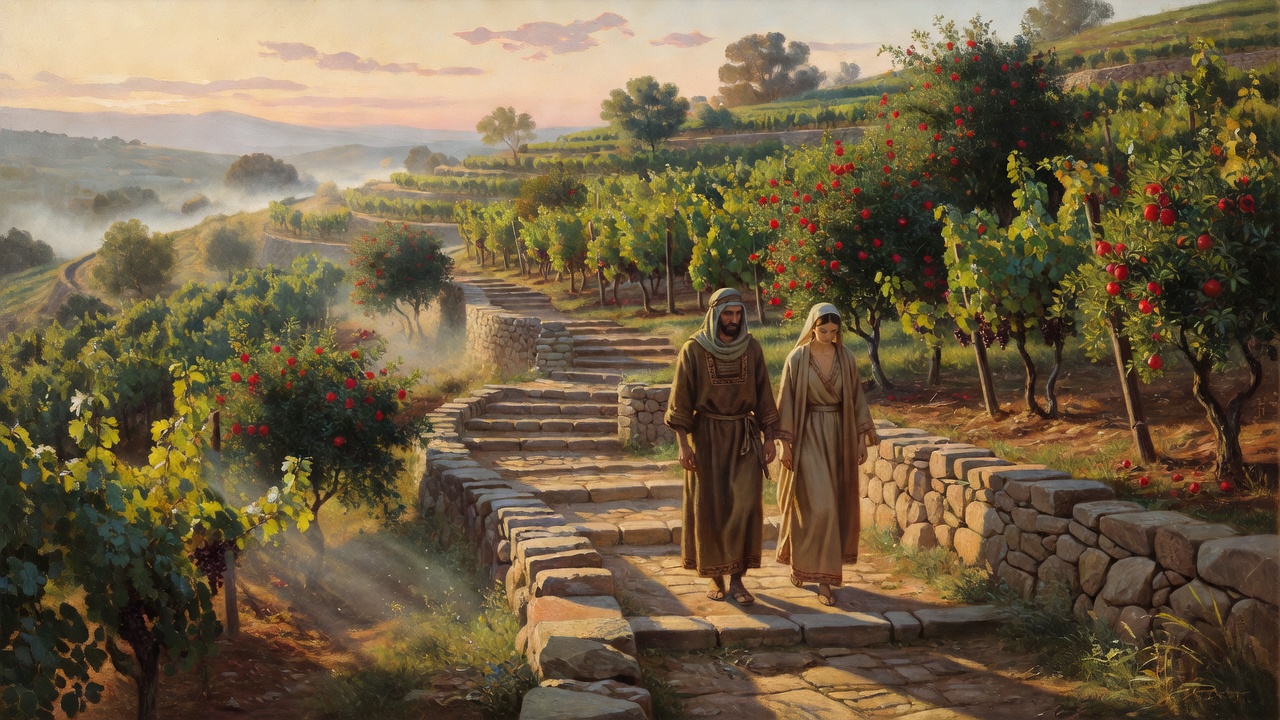
- The chapter concludes with an invitation to the countryside during the renewal of spring. The lovers seek out budding grapevines, blooming pomegranates, and fragrant mandrakes, reflecting the close connection in ancient Hebrew poetry between romantic intimacy and the vitality of the natural world.Sources: the Bible text itself
Notes written with AI assistance from open sources (Theographic Bible Metadata, CC BY-SA 4.0; Easton’s Bible Dictionary, public domain) and reviewed before publishing.
Places in this chapter
- Bath-rabbim · Today: in Tell Hesban · 31.801, 35.809 · verse 4
- Damascus · 33.511, 36.306 · verse 4
- Lebanon · 33.540, 35.584 · verse 4
- Mount Carmel · 32.672, 35.023 · verse 5
Only places identified with high confidence are shown (90% or more according to the scholarly sources compiled by OpenBible). Period map: DARE (Digital Atlas of the Roman Empire), CC BY 4.0; modern map: © OpenStreetMap contributors; places: OpenBible.info (CC BY 4.0).
Credits and license for this translation
NBG-vertaling 1951
The Holy Bible in Dutch, NBG 1951 translation.
copyright © 2024 Jantinus Daling
Language: Nederlandse taal (Dutch)
Released under the GNU Free Documentation License https://www.gnu.org/licenses/fdl-1.3.en.html
2024-08-13
Source: http://ebible.org/nldnbg/ · eBible.org