Song of Songs 2
De Heilige Schrift, Petrus Canisiusvertaling, 1939 · Tap a verse to see its cross-references.
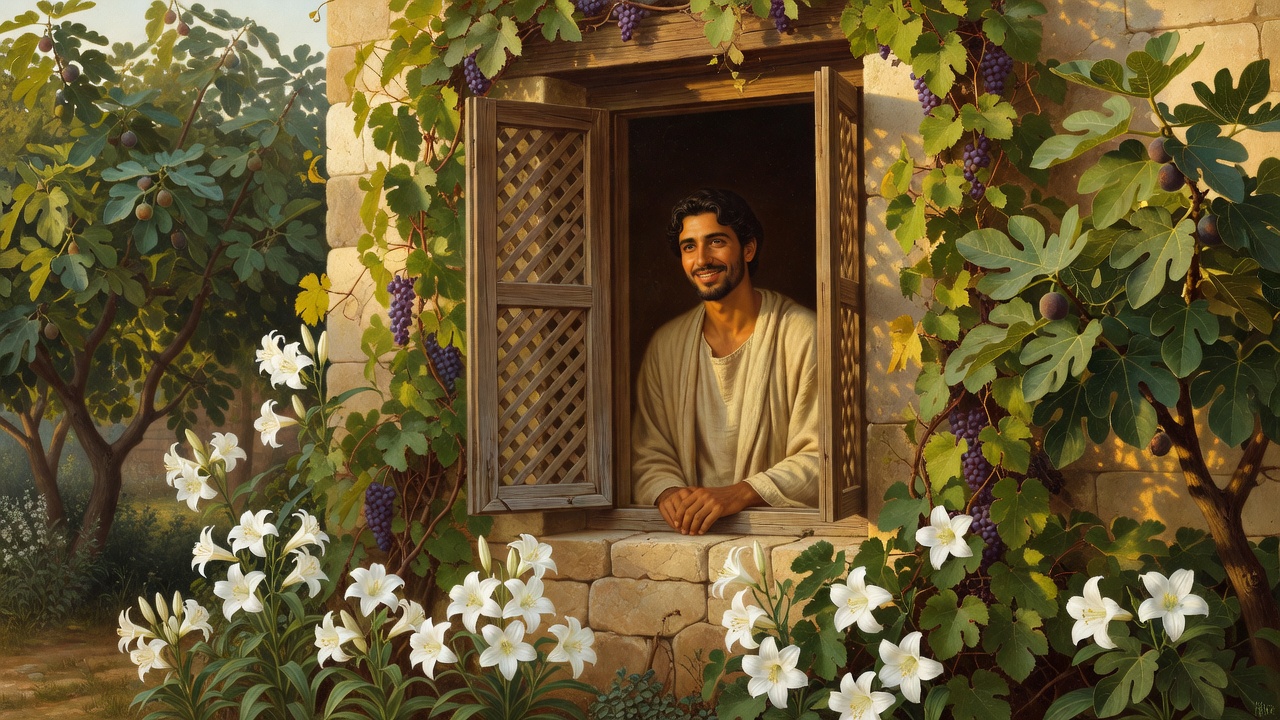
1Maar ik ben een crocus van Sjaron, Een lelie der dalen! 2Als een lelie tussen de doornen, Is mijn liefste onder de meisjes. 3Als een appelboom tussen de bomen in het woud, Is mijn beminde onder de jongemannen; Ik smacht er naar, in zijn schaduw te zitten, Zijn vrucht is zoet voor mijn mond. 4Brengt mij naar het huis van de wijn, Ontplooit over mij de standaard der liefde; 5Verkwikt mij met druivenkoeken, Versterkt mij met appels. Want ik ben krank, Ben krank van liefde! 6Zijn linker moet rusten onder mijn hoofd, Zijn rechter houde mij omstrengeld! 7Ik bezweer u, Jerusalems dochters, Bij de gazellen en de hinden in het veld: Wekt en lokt de liefde niet, Voordat het haar lust! … 8Maar hoor, mijn beminde! Zie, hij komt! Hij springt over de bergen, Hij huppelt over de heuvels. 9Mijn beminde gelijkt een gazel, Of het jong van een hert. Zie, daar staat hij reeds Achter onze muur. Hij staart door het venster, En blikt door de tralies; 10Mijn beminde heft aan, En spreekt tot mij! Sta op, mijn geliefde, Mijn schone, kom mede! 11Want zie, de winter is voorbij, De regen is voorgoed verdwenen. 12De bloemen prijken op het land, Men hoort de duiven al kirren; 13De vijg kleurt reeds zijn jonge vrucht, De wingerds bloeien en geuren. Sta op, mijn geliefde, Mijn schone, kom mede; 14Mijn duifje in de spleten der rotsen, In de holen der klippen! Laat mij zien uw gelaat, Laat mij horen uw stem; Want uw stem is zo zoet, Uw gelaat is zo lief. 15Vangt ons de jakhalzen De kleine vossen, Die de tuinen vernielen, Ofschoon onze wijngaard al bloeit. 16Want mijn beminde is mijn, en ik van hem: Hij is het, die in de leliën weidt, 17Totdat de dag is afgekoeld En de schaduwen vlieden! Blijf hier, mijn beminde, En doe zoals de gazel Of het jong van het hert Op de balsembergen!
Did you know?
Springtime and Awakening Love
- Sharon was a fertile coastal plain stretching between the Mediterranean Sea and the hill country west of Jerusalem, celebrated for its beauty and vegetation, which gave rise to imagery like the rose of Sharon.Sources: Saron · the Bible text itself
- The poem marks the arrival of spring through natural changes in the countryside, such as the end of winter rains, the cooing of turtledoves, ripening fig trees, and flowering grapevines that needed protection from foraging foxes.Sources: the Bible text itself
- The speaker repeatedly appeals to the daughters of Jerusalem, framing her cautions about love around wild animals of the open hills, such as gazelles and does of the field.Sources: Jerusalem · the Bible text itself
Notes written with AI assistance from open sources (Theographic Bible Metadata, CC BY-SA 4.0; Easton’s Bible Dictionary, public domain) and reviewed before publishing.
Places in this chapter
Only places identified with high confidence are shown (90% or more according to the scholarly sources compiled by OpenBible). Period map: DARE (Digital Atlas of the Roman Empire), CC BY 4.0; modern map: © OpenStreetMap contributors; places: OpenBible.info (CC BY 4.0).
Credits and license for this translation
De Heilige Schrift, Petrus Canisiusvertaling, 1939
The Holy Bible in Dutch, Petrus Canisius translation, 1939
Public Domain
Language: Nederlandse taal (Dutch)
Eerste uitgave: Het Spectrum, Utrecht, Brussel, 1939
De Petrus Canisiusvertaling is een Nederlandse rooms-katholieke bijbelvertaling, waarvan de eerste complete uitgave verscheen in 1939. De volledige naam luidt: "De Heilige Schrift, vertaling uit de grondtekst met aantekeningen, in opdracht van de Apologetische Vereniging 'Petrus Canisius' ondernomen met goedkeuring van de hoogwaardige bisschoppen van Nederland". De Petrus Canisiusvertaling is de eerste Nederlandse katholieke vertaling die gebaseerd is op de grondteksten in hun oorspronkelijke taal. Andere vertalingen gingen uit van de Vulgaat. Het taalgebruik van de uitgave is naar hedendaagse normen licht archaïsch te noemen, maar nog steeds vlot verstaanbaar.
Verantwoording in verband met de auteursrechten
In verband met de auteursrechten is contact opgenomen met de oorspronkelijke uitgever (1), de Katholieke Vereniging voor Oecume (2) en de Katholieke Bijbelstichting (3) en werden geen bezwaren gevonden tegen deze publicatie. Rekening houdend met de wettelijke termijnen, kan deze uitgave beschouwd worden als vrij van auteursrechten.
First publication: Het Spectrum, Utrecht, Brussel, 1939
The translation "Petrus Canisius" is a dutch roman catholic bible translation, that was first published in 1939. Its full title is "The Holy Scripture, translation of the original texts with annotations, commissioned by the Apologetical Society 'Petrus Canisius' and executed with the approval of the most reverend bishops of the Netherlands". The translation "Petrus Canisius" is the first dutch catholic translation that was based on the scripture texts in their original language. Other translations were based on the Vulgate. The language of this edition is to current standards moderately archaic, but still easily understood.
Accountability in relation to copyright
Concerning the copyright contacts have been made with the original publisher (1), the Katholieke Vereniging voor Oecumene (Catholic Society for Ecumenism) (2) and the Katholieke Bijbelstichting (Catholic Bible Foundation) (3) and no objections have been found against this publication. Taking into account the legal terms, this edition can be considered to be in the public domain.
UITGEVERIJ UNIEBOEK|HET SPECTRUM BV, HOUTEN, THE NETHERLANDS
KATHOLIEKE VERENIGING VOOR OECUMENE, 'S HERTOGENBOSCH, THE NETHERLANDS
KBS, HOEVEN, THE NETHERLANDS
2024-08-06
Source: http://ebible.org/nld1939/ · eBible.org