Psalms 80
De Heilige Schrift, Petrus Canisiusvertaling, 1939 · Tap a verse to see its cross-references.
1Voor muziekbegeleiding; op de wijze: “Leliën der Wet.” Een psalm van Asaf. Herder van Israël, ach, wil toch horen: Gij, die Josef leidt als een kudde; Die troont op de Cherubs, laat stralen uw licht 2Over Efraïm, Benjamin en Manasse; Doe uw kracht weer ontwaken, En kom ons te hulp! 3O God, richt ons weer op; Laat uw aanschijn lichten, dat we worden gered! 4God der heirscharen, Jahweh, Hoelang nog blijft Gij vergramd ondanks het gebed van uw volk! 5Hoelang nog laat Gij ons tranenbrood eten, En tranen drinken bij stromen; 6Maakt Gij ons tot twistappel voor onze buren, En zal onze vijand de spot met ons drijven? 7God der heirscharen, richt ons weer op; Laat uw aanschijn lichten, dat we worden gered! 8Een wijnstok hebt Gij uit Egypte overgebracht, Volkeren uitgetrokken, om hem te planten; 9Gij hebt hem plaats gemaakt, zodat hij wortel kon schieten, En het hele land kon begroeien. 10Zijn lommer bedekte de bergen, Zijn ranken Gods ceders; 11Hij strekte zijn takken uit tot de Zee, Zijn loten naar de Rivier. 12Maar waarom hebt Gij dan zijn omheining vernield, Zodat iedereen, die voorbij gaat, hem leeg plukt, 13Het everzwijn uit het woud hem ontwortelt, Het veldgedierte hem kaal vreet? 14Jahweh der heirscharen, ach, keer toch terug, Blik neer uit de hemel, zie toe; Zoek deze wijnstok weer op, 15De stek, die uw rechterhand heeft geplant! 16Laat, die hem als vuilnis verbranden, Vergaan voor uw dreigende blik! 17Maar laat uw hand op de man blijven rusten, Uw rechter op het mensenkind, dat Gij groot hebt gebracht; 18Laat ons toch nimmermeer van U wijken, Maar doe ons weer leven, en wij eren uw Naam! 19God der heirscharen, Jahweh, richt ons weer op; Laat uw aanschijn lichten, dat we worden gered!
Did you know?
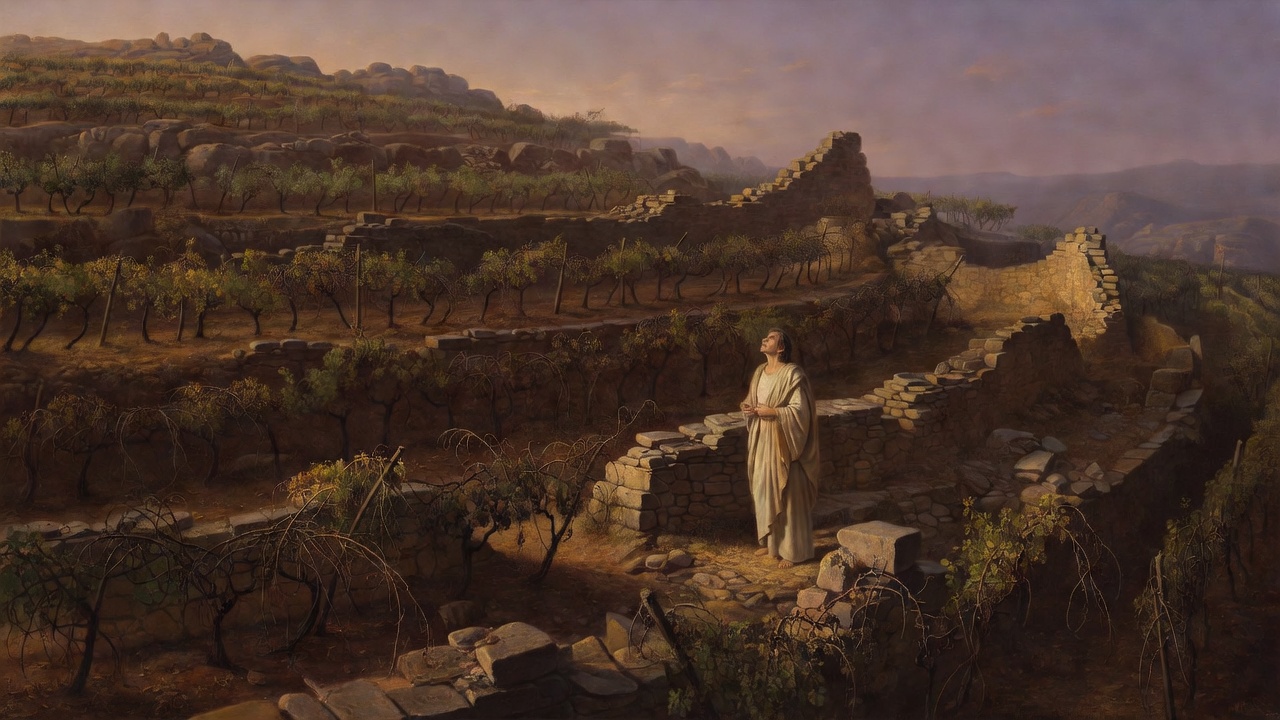
A Prayer for the Uprooted Vine
- The psalm specifically mentions Ephraim, Benjamin, and Manasseh, tribes closely linked by descent from Rachel through Joseph and Benjamin. During Israel's wilderness wanderings, these three tribes were assigned to camp and march together on the western side of the tabernacle.Sources: Benjamin (patriarch) · Manasseh (son of Joseph) · the Bible text itself
- The author uses an extended allegory comparing the nation of Israel to a grapevine brought out of Egypt and replanted in Canaan. The song laments that God had torn down the protective vineyard walls, leaving the fruitful vine exposed to wild beasts and passersby.Sources: Egypt · the Bible text itself
- This poem is part of a distinct collection spanning Psalms 73 through 83 attributed to Asaph. The biblical record describes Asaph as a leading Levite musician in the time of King David whose musical guild or descendants continued his tradition in temple worship.Sources: Asaph (Levite) · the Bible text itself
Notes written with AI assistance from open sources (Theographic Bible Metadata, CC BY-SA 4.0; Easton’s Bible Dictionary, public domain) and reviewed before publishing.
Places in this chapter
- Egypt · 30.129, 31.308 · verse 8
- Euphrates · Today: Euphrates River · 31.004, 47.442 · verse 11
- Great Sea · Today: Mediterranean Sea · 31.805, 34.170 · verse 11
Only places identified with high confidence are shown (90% or more according to the scholarly sources compiled by OpenBible). Period map: DARE (Digital Atlas of the Roman Empire), CC BY 4.0; modern map: © OpenStreetMap contributors; places: OpenBible.info (CC BY 4.0).
Credits and license for this translation
De Heilige Schrift, Petrus Canisiusvertaling, 1939
The Holy Bible in Dutch, Petrus Canisius translation, 1939
Public Domain
Language: Nederlandse taal (Dutch)
Eerste uitgave: Het Spectrum, Utrecht, Brussel, 1939
De Petrus Canisiusvertaling is een Nederlandse rooms-katholieke bijbelvertaling, waarvan de eerste complete uitgave verscheen in 1939. De volledige naam luidt: "De Heilige Schrift, vertaling uit de grondtekst met aantekeningen, in opdracht van de Apologetische Vereniging 'Petrus Canisius' ondernomen met goedkeuring van de hoogwaardige bisschoppen van Nederland". De Petrus Canisiusvertaling is de eerste Nederlandse katholieke vertaling die gebaseerd is op de grondteksten in hun oorspronkelijke taal. Andere vertalingen gingen uit van de Vulgaat. Het taalgebruik van de uitgave is naar hedendaagse normen licht archaïsch te noemen, maar nog steeds vlot verstaanbaar.
Verantwoording in verband met de auteursrechten
In verband met de auteursrechten is contact opgenomen met de oorspronkelijke uitgever (1), de Katholieke Vereniging voor Oecume (2) en de Katholieke Bijbelstichting (3) en werden geen bezwaren gevonden tegen deze publicatie. Rekening houdend met de wettelijke termijnen, kan deze uitgave beschouwd worden als vrij van auteursrechten.
First publication: Het Spectrum, Utrecht, Brussel, 1939
The translation "Petrus Canisius" is a dutch roman catholic bible translation, that was first published in 1939. Its full title is "The Holy Scripture, translation of the original texts with annotations, commissioned by the Apologetical Society 'Petrus Canisius' and executed with the approval of the most reverend bishops of the Netherlands". The translation "Petrus Canisius" is the first dutch catholic translation that was based on the scripture texts in their original language. Other translations were based on the Vulgate. The language of this edition is to current standards moderately archaic, but still easily understood.
Accountability in relation to copyright
Concerning the copyright contacts have been made with the original publisher (1), the Katholieke Vereniging voor Oecumene (Catholic Society for Ecumenism) (2) and the Katholieke Bijbelstichting (Catholic Bible Foundation) (3) and no objections have been found against this publication. Taking into account the legal terms, this edition can be considered to be in the public domain.
UITGEVERIJ UNIEBOEK|HET SPECTRUM BV, HOUTEN, THE NETHERLANDS
KATHOLIEKE VERENIGING VOOR OECUMENE, 'S HERTOGENBOSCH, THE NETHERLANDS
KBS, HOEVEN, THE NETHERLANDS
2024-08-06
Source: http://ebible.org/nld1939/ · eBible.org