Psalms 48
De Heilige Schrift, Petrus Canisiusvertaling, 1939 · Tap a verse to see its cross-references.
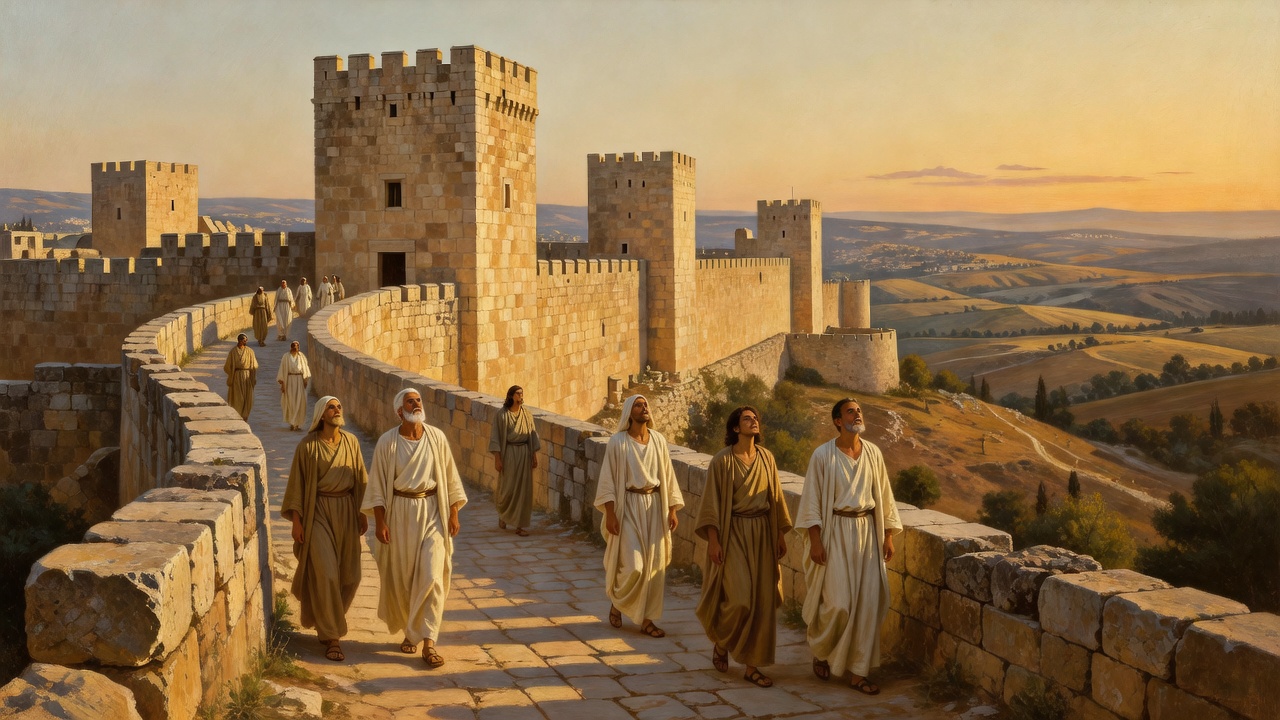
1Een lied; een psalm van de zonen van Kore. Groot is Jahweh, hoog geprezen In de stad van onzen God! 2Lieflijk verheft zich zijn heilige berg, Voor heel de aarde een vreugde. De Sionsberg is de Spits van het Noorden, De stad van een machtigen Koning; 3God woont in haar burchten, En toont zich een veilige schuts. 4Want zie, de koningen hadden zich met elkander verbonden, En rukten gezamenlijk aan; 5Maar toen ze haar zagen, stonden ze stom van ontzetting, En stoven verschrokken uiteen. 6Vreselijke angst greep hen aan, En wee als een barende vrouw: 7Ineens als een storm uit het oosten, Die de Tarsjisj-schepen vernielt. 8Wat we vroeger hadden gehoord, Hebben we nu ook gezien: Jahweh der heirscharen woont in de stad, Onze God woont in de stad, en laat haar eeuwig bestaan! 9Wij gedenken uw goedheid, o God, Binnen uw tempel. 10Uw lof, o God, reikt als uw Naam Tot aan de grenzen der aarde. Vol gerechtigheid is uw rechterhand, 11Sions berg is er over verheugd; En Juda’s dochteren juichen van vreugde, O Jahweh, om uw gericht. 12Trekt rond de Sion, loopt er omheen: Telt zijn torens, 13Let op zijn wallen Ziet naar zijn burchten; Om aan een volgend geslacht te vertellen, 14Dat God hier woont, Dat onze God ons leidt Voor eeuwig en immer!
Did you know?
Zion, the City of the Great King
- Mount Zion, originally the fortified southeastern hill of Jerusalem captured by David from the Jebusites, became known as the City of David and the site of his citadel. In Psalm 48, it is celebrated as God's holy mountain, elevated and fortified against advancing enemy kings.Sources: the Bible text itself · Mount Zion · Zion
- The psalm depicts God's power shattering enemy forces like an east wind wrecking the ships of Tarshish. Many scholars identify Tarshish with a distant Phoenician trading port in southwestern Spain, while other ancient traditions proposed locations such as Carthage or ports in the east.Sources: the Bible text itself · Tarshish
- Worshippers are invited to walk around the perimeter of Zion to inspect its ramparts, count its towers, and view its citadels. This survey of the city's defenses was meant to be recounted to future generations as a witness of God's steadfast protection.Sources: the Bible text itself
Notes written with AI assistance from open sources (Theographic Bible Metadata, CC BY-SA 4.0; Easton’s Bible Dictionary, public domain) and reviewed before publishing.
Places in this chapter
- Mount Zion · 31.772, 35.229 · verses 2, 11
- Zaphon · Today: Jebel Aqra · 35.953, 35.969 · verse 2
- Jerusalem · 31.777, 35.234 · verse 3
- Zion · Today: Jerusalem · 31.777, 35.234 · verse 12
Only places identified with high confidence are shown (90% or more according to the scholarly sources compiled by OpenBible). Period map: DARE (Digital Atlas of the Roman Empire), CC BY 4.0; modern map: © OpenStreetMap contributors; places: OpenBible.info (CC BY 4.0).
Credits and license for this translation
De Heilige Schrift, Petrus Canisiusvertaling, 1939
The Holy Bible in Dutch, Petrus Canisius translation, 1939
Public Domain
Language: Nederlandse taal (Dutch)
Eerste uitgave: Het Spectrum, Utrecht, Brussel, 1939
De Petrus Canisiusvertaling is een Nederlandse rooms-katholieke bijbelvertaling, waarvan de eerste complete uitgave verscheen in 1939. De volledige naam luidt: "De Heilige Schrift, vertaling uit de grondtekst met aantekeningen, in opdracht van de Apologetische Vereniging 'Petrus Canisius' ondernomen met goedkeuring van de hoogwaardige bisschoppen van Nederland". De Petrus Canisiusvertaling is de eerste Nederlandse katholieke vertaling die gebaseerd is op de grondteksten in hun oorspronkelijke taal. Andere vertalingen gingen uit van de Vulgaat. Het taalgebruik van de uitgave is naar hedendaagse normen licht archaïsch te noemen, maar nog steeds vlot verstaanbaar.
Verantwoording in verband met de auteursrechten
In verband met de auteursrechten is contact opgenomen met de oorspronkelijke uitgever (1), de Katholieke Vereniging voor Oecume (2) en de Katholieke Bijbelstichting (3) en werden geen bezwaren gevonden tegen deze publicatie. Rekening houdend met de wettelijke termijnen, kan deze uitgave beschouwd worden als vrij van auteursrechten.
First publication: Het Spectrum, Utrecht, Brussel, 1939
The translation "Petrus Canisius" is a dutch roman catholic bible translation, that was first published in 1939. Its full title is "The Holy Scripture, translation of the original texts with annotations, commissioned by the Apologetical Society 'Petrus Canisius' and executed with the approval of the most reverend bishops of the Netherlands". The translation "Petrus Canisius" is the first dutch catholic translation that was based on the scripture texts in their original language. Other translations were based on the Vulgate. The language of this edition is to current standards moderately archaic, but still easily understood.
Accountability in relation to copyright
Concerning the copyright contacts have been made with the original publisher (1), the Katholieke Vereniging voor Oecumene (Catholic Society for Ecumenism) (2) and the Katholieke Bijbelstichting (Catholic Bible Foundation) (3) and no objections have been found against this publication. Taking into account the legal terms, this edition can be considered to be in the public domain.
UITGEVERIJ UNIEBOEK|HET SPECTRUM BV, HOUTEN, THE NETHERLANDS
KATHOLIEKE VERENIGING VOOR OECUMENE, 'S HERTOGENBOSCH, THE NETHERLANDS
KBS, HOEVEN, THE NETHERLANDS
2024-08-06
Source: http://ebible.org/nld1939/ · eBible.org