Psalms 144
De Heilige Schrift, Petrus Canisiusvertaling, 1939 · Tap a verse to see its cross-references.
1Van David. Geprezen zij Jahweh, Mijn Rots; Die mijn handen leert strijden, En mijn vingers leert kampen. 2Mijn sterkte en burcht, Mijn schuilplaats en toevlucht, Mijn schild, waarop ik vertrouw: Die de volkeren aan mij onderwerpt. 3Jahweh, wat is de mens, dat Gij acht op hem slaat; Een mensenkind, dat Gij om hem U bekommert? 4De mens lijkt enkel een zucht, Zijn dagen een vluchtige schaduw. 5Jahweh, buig uw hemel omlaag, en daal neer, Raak de bergen aan, en ze roken; 6Slinger uw bliksems, en strooi ze in het rond, Schiet uw pijlen, en jaag ze uiteen. 7Reik mij uw hand uit den hoge, En verlos mij uit de macht der barbaren, 8Wier mond alleen maar leugentaal spreekt, En wier rechter een hand van bedrog is. 9Dan zal ik een nieuw lied voor U zingen, o God, Op de tiensnarige harp voor U spelen: 10Voor U, die aan koningen de zege verleent, Die redding brengt aan David, uw dienaar. 11Ja, Hij hééft mij gered van het moordende zwaard, Mij verlost uit de macht der barbaren, Wier mond alleen maar leugentaal spreekt, En wier rechter een hand van bedrog is. 12Nu zijn onze zonen als planten, Zorgvuldig gekweekt in hun jeugd; Onze dochters als zuilen, Voor de bouw van paleizen gehouwen. 13Onze schuren gevuld, Boordevol van allerlei vrucht; Onze schapen bij duizenden werpend, 14De runderen in onze weiden bij tienduizenden drachtig. Geen bres en geen stormloop, Op onze pleinen geen kermen: 15Gelukkig het volk, wat zo’n lot is beschoren; Gelukkig het volk, waarvan Jahweh de God is!
Did you know?
A King's Prayer for Deliverance and Prosperity
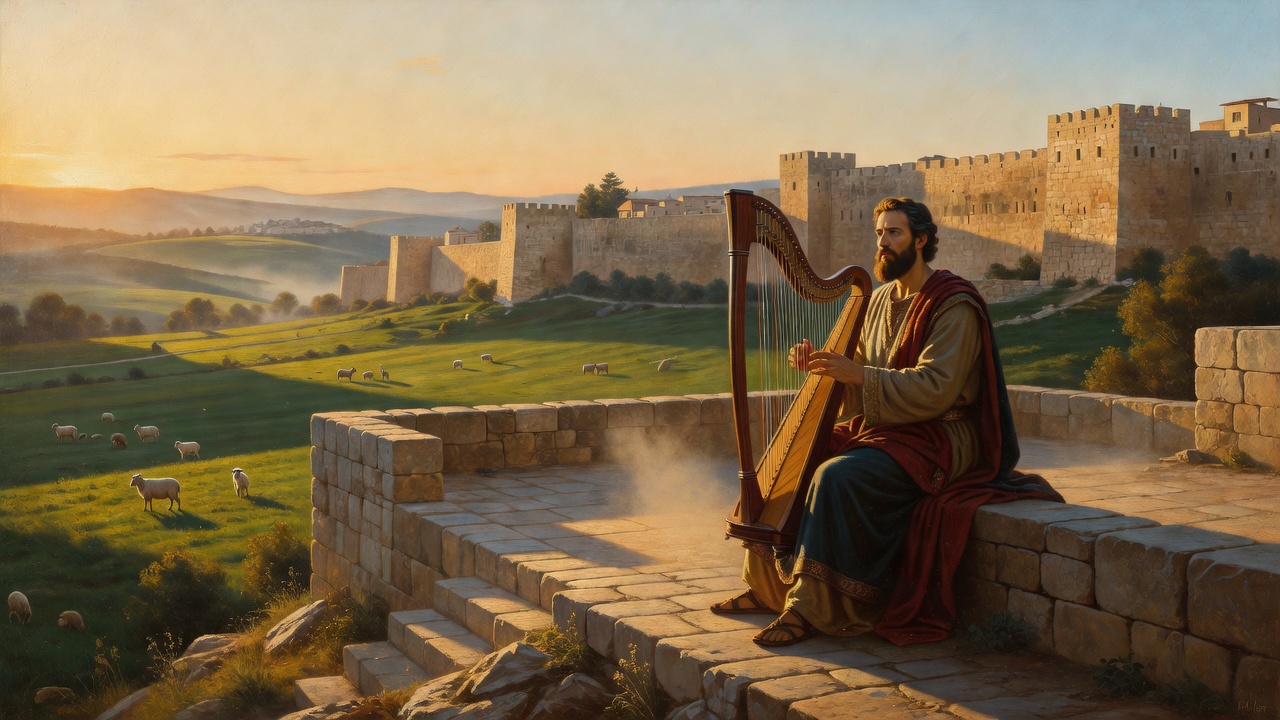
- The psalm is attributed to David, who combines prayers for military deliverance with musical praise, promising to sing a new song to God accompanied by a ten-stringed harp.Sources: David · the Bible text itself
- The text reflects on human fragility, describing man as a mere breath and human life as a passing shadow in contrast to divine majesty and power.Sources: the Bible text itself
- The concluding section envisions communal security and agricultural abundance, praying for thriving children, full storehouses, multiplying flocks, and cities with unbroken walls free from siege or captivity.Sources: the Bible text itself
Notes written with AI assistance from open sources (Theographic Bible Metadata, CC BY-SA 4.0; Easton’s Bible Dictionary, public domain) and reviewed before publishing.
Credits and license for this translation
De Heilige Schrift, Petrus Canisiusvertaling, 1939
The Holy Bible in Dutch, Petrus Canisius translation, 1939
Public Domain
Language: Nederlandse taal (Dutch)
Eerste uitgave: Het Spectrum, Utrecht, Brussel, 1939
De Petrus Canisiusvertaling is een Nederlandse rooms-katholieke bijbelvertaling, waarvan de eerste complete uitgave verscheen in 1939. De volledige naam luidt: "De Heilige Schrift, vertaling uit de grondtekst met aantekeningen, in opdracht van de Apologetische Vereniging 'Petrus Canisius' ondernomen met goedkeuring van de hoogwaardige bisschoppen van Nederland". De Petrus Canisiusvertaling is de eerste Nederlandse katholieke vertaling die gebaseerd is op de grondteksten in hun oorspronkelijke taal. Andere vertalingen gingen uit van de Vulgaat. Het taalgebruik van de uitgave is naar hedendaagse normen licht archaïsch te noemen, maar nog steeds vlot verstaanbaar.
Verantwoording in verband met de auteursrechten
In verband met de auteursrechten is contact opgenomen met de oorspronkelijke uitgever (1), de Katholieke Vereniging voor Oecume (2) en de Katholieke Bijbelstichting (3) en werden geen bezwaren gevonden tegen deze publicatie. Rekening houdend met de wettelijke termijnen, kan deze uitgave beschouwd worden als vrij van auteursrechten.
First publication: Het Spectrum, Utrecht, Brussel, 1939
The translation "Petrus Canisius" is a dutch roman catholic bible translation, that was first published in 1939. Its full title is "The Holy Scripture, translation of the original texts with annotations, commissioned by the Apologetical Society 'Petrus Canisius' and executed with the approval of the most reverend bishops of the Netherlands". The translation "Petrus Canisius" is the first dutch catholic translation that was based on the scripture texts in their original language. Other translations were based on the Vulgate. The language of this edition is to current standards moderately archaic, but still easily understood.
Accountability in relation to copyright
Concerning the copyright contacts have been made with the original publisher (1), the Katholieke Vereniging voor Oecumene (Catholic Society for Ecumenism) (2) and the Katholieke Bijbelstichting (Catholic Bible Foundation) (3) and no objections have been found against this publication. Taking into account the legal terms, this edition can be considered to be in the public domain.
UITGEVERIJ UNIEBOEK|HET SPECTRUM BV, HOUTEN, THE NETHERLANDS
KATHOLIEKE VERENIGING VOOR OECUMENE, 'S HERTOGENBOSCH, THE NETHERLANDS
KBS, HOEVEN, THE NETHERLANDS
2024-08-06
Source: http://ebible.org/nld1939/ · eBible.org