Malachi 1
De Heilige Schrift, Petrus Canisiusvertaling, 1939 · Tap a verse to see its cross-references.
About this book
About Malachi
- Easton's Bible Dictionary (1897) presents Malachi, a name meaning "messenger" or "angel," as the last of the minor prophets and the writer of the last book of the Old Testament canon. Nothing is known of him beyond what is contained in his book of prophecies.Sources: Easton: Malachi · Malachi
- Some have supposed that the name is simply a title for a messenger of Jehovah, not a proper name. Easton's Bible Dictionary (1897) concludes, however, that there is reason to regard Malachi as the prophet's ordinary name.Sources: Easton: Malachi · Malachi
- Easton's Bible Dictionary (1897) dates the prophecies to about 420 B.C., after Nehemiah's second return from Persia, or possibly before that return. Because Ezra does not mention him and he does not mention the restoration of the temple, the dictionary infers that he prophesied after Haggai and Zechariah.Sources: Easton: Malachi
- Easton's Bible Dictionary (1897) treats Malachi as a contemporary of Nehemiah, comparing Malachi 2:8 with Nehemiah 13:15 and Malachi 2:10-16 with Nehemiah 13:23. It also notes that the temple services were still in existence, citing Malachi 1:10, 3:1 and 3:10.Sources: Easton: Malachi
Notes written with AI assistance from open sources (Theographic Bible Metadata, CC BY-SA 4.0; Easton’s Bible Dictionary, public domain) and reviewed before publishing.
1Een godsspraak: het woord van Jahweh, door Malakias tot Israël gericht. 2Ik heb u lief, spreekt Jahweh! Gij zegt: Waaruit blijkt dan uw liefde tot ons? Was Esau niet de broer van Jakob, is de godsspraak van Jahweh; toch heb Ik Jakob liefgehad, 3maar Esau heb Ik gehaat: een wildernis van zijn bergen gemaakt, van zijn erfdeel een steppe in de woestijn. 4En als Edom zegt: We zijn wel vernield, maar we bouwen onze puinen weer op; dan spreekt Jahweh der heirscharen: Zij mogen bouwen, maar Ik zal verwoesten; men zal ze noemen: goddeloos volk, waarop Jahweh voor immer vergramd blijft! 5Met eigen ogen zult ge het zien, en moeten erkennen: Jahweh is groot, ook buiten Israëls gebied! 6De zoon eert zijn vader, de knecht vreest zijn meester! Maar zo Ik dan een Vader ben, waar is de eer, die Mij toekomt; en ben Ik een Meester, waar is dan de vrees voor Mij? Zo spreekt Jahweh der heirscharen tot u, priesters; gij die mijn Naam durft verachten! En dan vraagt ge nog: Waardoor hebben wij Uw Naam veracht? 7Door op mijn altaar onreine spijzen te offeren! Gij zegt: Hoe hebben wij die dan verontreinigd? Door te zeggen: De tafel van Jahweh is zoveel bijzonders toch niet; 8of als gij een blind dier ten offer brengt, te zeggen: Dat is geen kwaad; of als gij een kreupel of ziek dier offert: Dat is niet zo erg! Biedt het dan uw landvoogd eens aan; zal hèm dat bevallen en hij u gunsten bewijzen, spreekt Jahweh der heirscharen! 9Zoekt zo maar de gunsten van Jahweh: Hij zal u zeker genadig zijn; door u is het bedreven: moet Hij u nu maar gunstig zijn? 10O, dat iemand van u de deuren maar sloot; dan zoudt gij niet tevergeefs het vuur op mijn altaar ontsteken! Neen, Ik heb geen behagen in u, spreekt Jahweh der heirscharen. geen lust in het offer uit uw handen. 11Want van de opgang der zon tot aan haar ondergang is mijn Naam groot onder de volken; op iedere plaats wordt mijn Naam een wierookoffer en een reine offerande gebracht! Waarachtig, mijn Naam is groot onder de volken, spreekt Jahweh der heirscharen! 12Maar gij ontwijdt hem door te zeggen: De tafel van Jahweh is onrein, en de spijs, die er afkomt, is minderwaardig! 13Gij zegt: Wat een last; en gij trekt er uw neus voor op, zegt Jahweh der heirscharen! Of gij offert iets wat gestolen is, of wat kreupel of ziek is; en zou Ik dat van u aanvaarden, spreekt Jahweh? 14Vervloekt de bedrieger, die een mannelijk dier in zijn kudde bezit, maar aan den Heer een ondeugdelijk offert, als hij een gelofte heeft gedaan! Want Ik ben een grote Koning, spreekt Jahweh der heirscharen, en mijn Naam is onder de volken geducht!
Did you know?
Honoring God and Defective Offerings
- The name Malachi means messenger or angel. While some have suggested it was a title rather than a proper name, scholars and traditions widely treat it as the prophet's personal name, placing his ministry during the period of Nehemiah, after Haggai and Zechariah.Sources: Malachi
- The opening dispute recalls the twin brothers Jacob and Esau, the ancestors of Israel and Edom. The text contrasts God's covenant love for Israel with the judgment and desolation coming upon the mountainous region of Edom.Sources: Esau (Edom) · Jacob (Israel) · Edom · the Bible text itself
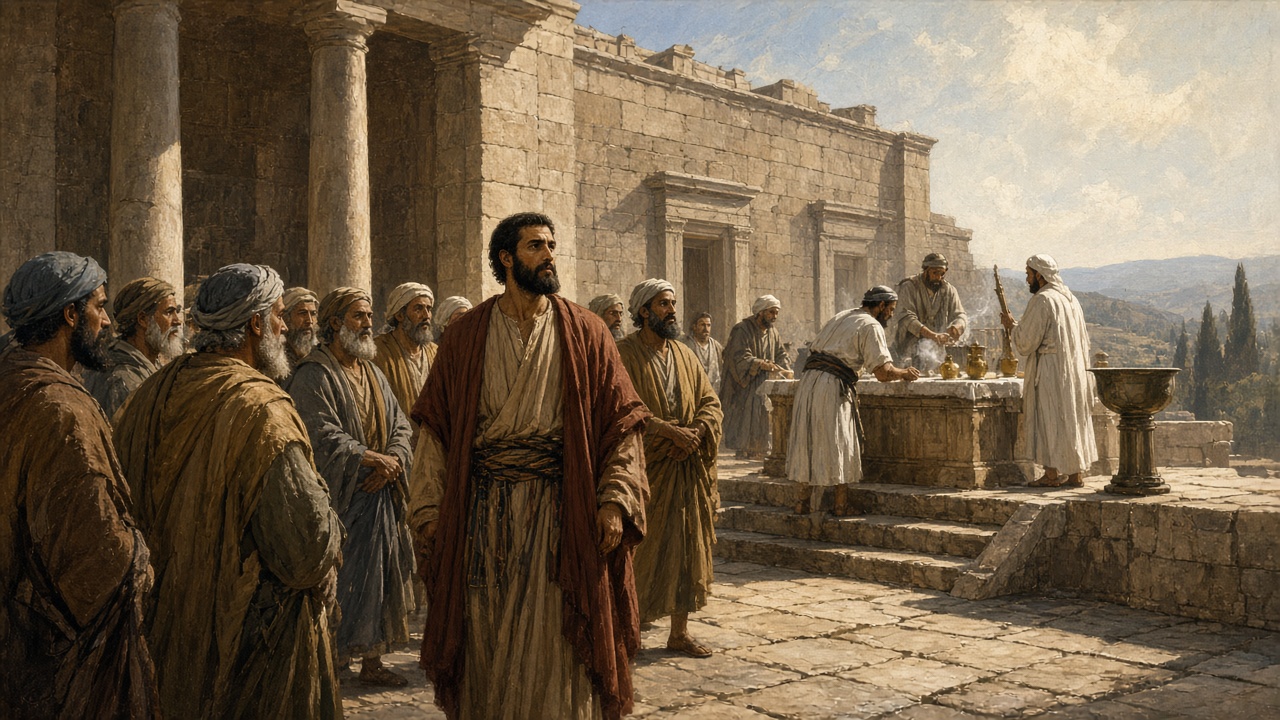
- The priests are rebuked for offering blind, lame, and diseased animals on the altar rather than unblemished livestock. Malachi exposes their disrespect by asking whether a civil governor would accept such inferior gifts.Sources: the Bible text itself
Notes written with AI assistance from open sources (Theographic Bible Metadata, CC BY-SA 4.0; Easton’s Bible Dictionary, public domain) and reviewed before publishing.
Places in this chapter
- Edom · 30.746, 35.604 · verse 4
Only places identified with high confidence are shown (90% or more according to the scholarly sources compiled by OpenBible). Period map: DARE (Digital Atlas of the Roman Empire), CC BY 4.0; modern map: © OpenStreetMap contributors; places: OpenBible.info (CC BY 4.0).
Credits and license for this translation
De Heilige Schrift, Petrus Canisiusvertaling, 1939
The Holy Bible in Dutch, Petrus Canisius translation, 1939
Public Domain
Language: Nederlandse taal (Dutch)
Eerste uitgave: Het Spectrum, Utrecht, Brussel, 1939
De Petrus Canisiusvertaling is een Nederlandse rooms-katholieke bijbelvertaling, waarvan de eerste complete uitgave verscheen in 1939. De volledige naam luidt: "De Heilige Schrift, vertaling uit de grondtekst met aantekeningen, in opdracht van de Apologetische Vereniging 'Petrus Canisius' ondernomen met goedkeuring van de hoogwaardige bisschoppen van Nederland". De Petrus Canisiusvertaling is de eerste Nederlandse katholieke vertaling die gebaseerd is op de grondteksten in hun oorspronkelijke taal. Andere vertalingen gingen uit van de Vulgaat. Het taalgebruik van de uitgave is naar hedendaagse normen licht archaïsch te noemen, maar nog steeds vlot verstaanbaar.
Verantwoording in verband met de auteursrechten
In verband met de auteursrechten is contact opgenomen met de oorspronkelijke uitgever (1), de Katholieke Vereniging voor Oecume (2) en de Katholieke Bijbelstichting (3) en werden geen bezwaren gevonden tegen deze publicatie. Rekening houdend met de wettelijke termijnen, kan deze uitgave beschouwd worden als vrij van auteursrechten.
First publication: Het Spectrum, Utrecht, Brussel, 1939
The translation "Petrus Canisius" is a dutch roman catholic bible translation, that was first published in 1939. Its full title is "The Holy Scripture, translation of the original texts with annotations, commissioned by the Apologetical Society 'Petrus Canisius' and executed with the approval of the most reverend bishops of the Netherlands". The translation "Petrus Canisius" is the first dutch catholic translation that was based on the scripture texts in their original language. Other translations were based on the Vulgate. The language of this edition is to current standards moderately archaic, but still easily understood.
Accountability in relation to copyright
Concerning the copyright contacts have been made with the original publisher (1), the Katholieke Vereniging voor Oecumene (Catholic Society for Ecumenism) (2) and the Katholieke Bijbelstichting (Catholic Bible Foundation) (3) and no objections have been found against this publication. Taking into account the legal terms, this edition can be considered to be in the public domain.
UITGEVERIJ UNIEBOEK|HET SPECTRUM BV, HOUTEN, THE NETHERLANDS
KATHOLIEKE VERENIGING VOOR OECUMENE, 'S HERTOGENBOSCH, THE NETHERLANDS
KBS, HOEVEN, THE NETHERLANDS
2024-08-06
Source: http://ebible.org/nld1939/ · eBible.org