Lamentations 5
De Heilige Schrift, Petrus Canisiusvertaling, 1939 · Tap a verse to see its cross-references.
1Gedenk toch, Jahweh, wat wij verduren, Zie toe, en aanschouw onze smaad: 2Ons erfdeel is aan anderen vervallen, Onze huizen aan vreemden. 3Wezen zijn wij, vaderloos, Als weduwen zijn onze moeders; 4Ons water drinken wij voor geld, Wij moeten ons eigen hout betalen. 5Voortgezweept, met het juk om de hals, Uitgeput, maar men gunt ons geen rust! 6Naar Egypte steken wij de handen uit, Naar Assjoer om brood! 7Onze vaderen hebben gezondigd: zij zijn niet meer, Wij dragen hun schuld: 8Slaven zijn onze heersers, En niemand, die ons uit hun handen verlost. 9Met gevaar voor ons leven halen wij brood, Voor het dreigende zwaard der woestijn; 10Onze huid is heet als een oven, Door de koorts van de honger. 11De vrouwen worden in Sion onteerd, De maagden in de steden van Juda; 12Vorsten door hen opgehangen, Geen oudsten gespaard. 13De jongens moeten de molensteen torsen, De knapen bezwijken onder het hout; 14Geen grijsaards meer in de poorten, Geen jonge mannen meer met hun lier. 15Geen blijdschap meer voor ons hart, Onze reidans veranderd in rouw, 16Gevallen de kroon van ons hoofd: Wee onzer, wij hebben gezondigd! 17Hierom is ons hart verslagen, Staan onze ogen zo dof: 18Om de Sionsberg, die ligt verlaten, Waar enkel jakhalzen lopen. 19Maar Gij zetelt in eeuwigheid, Jahweh; Uw troon van geslacht tot geslacht! 20Waarom zoudt Gij ons dan altijd vergeten, Ten einde toe ons verlaten? 21Ach Jahweh, breng ons tot U terug: wij willen bekeren; Maak onze dagen weer als voorheen! 22Neen, Gij hebt ons niet voor immer verworpen, Gij blijft op ons niet zo hevig verbolgen!
Did you know?
A Prayer for Restoration and the Desolation of Zion
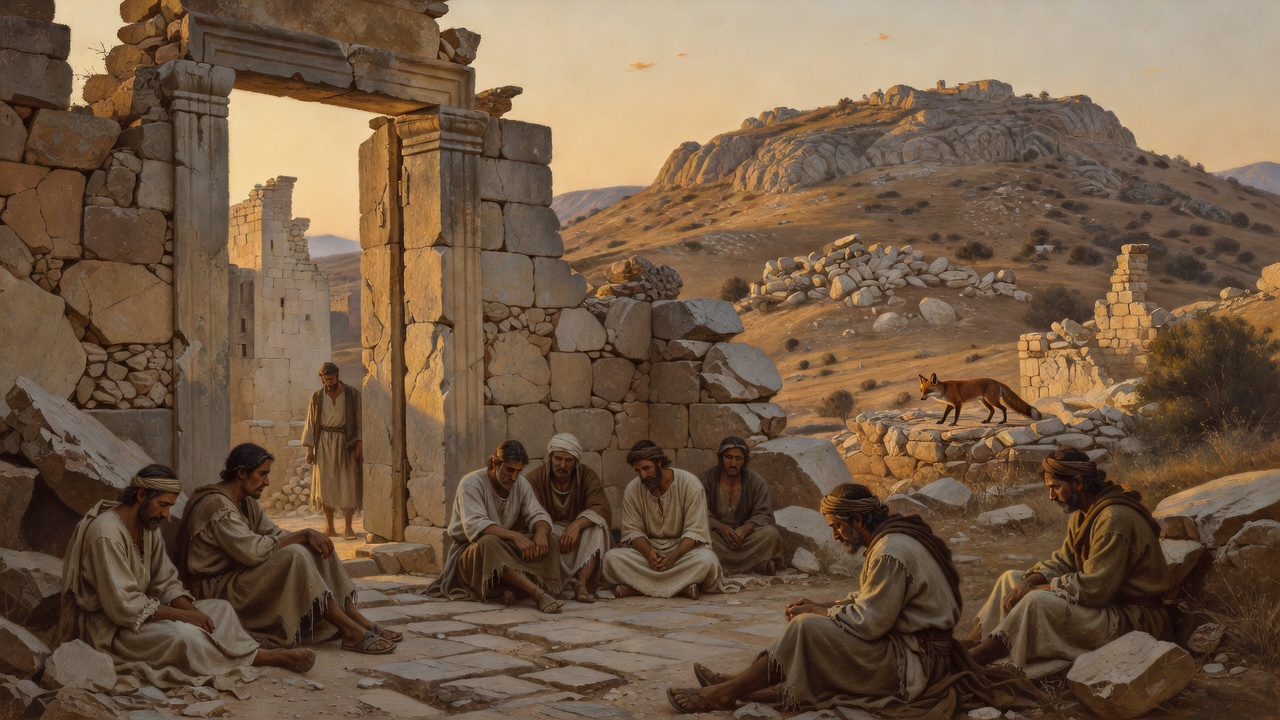
- Mount Zion, one of the prominent hills of Jerusalem where King David once established his citadel, is portrayed in this chapter as lying completely desolate, left in such abandonment that wild foxes roam over it.Sources: the Bible text itself · Mount Zion
- The chapter illustrates the breakdown of everyday social and civic structures, noting that elders have abandoned the city gate, young men have ceased their music to toil at millstones, and basic necessities like water and firewood must now be purchased.Sources: the Bible text itself
Notes written with AI assistance from open sources (Theographic Bible Metadata, CC BY-SA 4.0; Easton’s Bible Dictionary, public domain) and reviewed before publishing.
Places in this chapter
- Assyria · 36.359, 43.153 · verse 6
- Egypt · 30.129, 31.308 · verse 6
- Zion · Today: Jerusalem · 31.777, 35.234 · verse 11
- Mount Zion · 31.772, 35.229 · verse 18
Only places identified with high confidence are shown (90% or more according to the scholarly sources compiled by OpenBible). Period map: DARE (Digital Atlas of the Roman Empire), CC BY 4.0; modern map: © OpenStreetMap contributors; places: OpenBible.info (CC BY 4.0).
Credits and license for this translation
De Heilige Schrift, Petrus Canisiusvertaling, 1939
The Holy Bible in Dutch, Petrus Canisius translation, 1939
Public Domain
Language: Nederlandse taal (Dutch)
Eerste uitgave: Het Spectrum, Utrecht, Brussel, 1939
De Petrus Canisiusvertaling is een Nederlandse rooms-katholieke bijbelvertaling, waarvan de eerste complete uitgave verscheen in 1939. De volledige naam luidt: "De Heilige Schrift, vertaling uit de grondtekst met aantekeningen, in opdracht van de Apologetische Vereniging 'Petrus Canisius' ondernomen met goedkeuring van de hoogwaardige bisschoppen van Nederland". De Petrus Canisiusvertaling is de eerste Nederlandse katholieke vertaling die gebaseerd is op de grondteksten in hun oorspronkelijke taal. Andere vertalingen gingen uit van de Vulgaat. Het taalgebruik van de uitgave is naar hedendaagse normen licht archaïsch te noemen, maar nog steeds vlot verstaanbaar.
Verantwoording in verband met de auteursrechten
In verband met de auteursrechten is contact opgenomen met de oorspronkelijke uitgever (1), de Katholieke Vereniging voor Oecume (2) en de Katholieke Bijbelstichting (3) en werden geen bezwaren gevonden tegen deze publicatie. Rekening houdend met de wettelijke termijnen, kan deze uitgave beschouwd worden als vrij van auteursrechten.
First publication: Het Spectrum, Utrecht, Brussel, 1939
The translation "Petrus Canisius" is a dutch roman catholic bible translation, that was first published in 1939. Its full title is "The Holy Scripture, translation of the original texts with annotations, commissioned by the Apologetical Society 'Petrus Canisius' and executed with the approval of the most reverend bishops of the Netherlands". The translation "Petrus Canisius" is the first dutch catholic translation that was based on the scripture texts in their original language. Other translations were based on the Vulgate. The language of this edition is to current standards moderately archaic, but still easily understood.
Accountability in relation to copyright
Concerning the copyright contacts have been made with the original publisher (1), the Katholieke Vereniging voor Oecumene (Catholic Society for Ecumenism) (2) and the Katholieke Bijbelstichting (Catholic Bible Foundation) (3) and no objections have been found against this publication. Taking into account the legal terms, this edition can be considered to be in the public domain.
UITGEVERIJ UNIEBOEK|HET SPECTRUM BV, HOUTEN, THE NETHERLANDS
KATHOLIEKE VERENIGING VOOR OECUMENE, 'S HERTOGENBOSCH, THE NETHERLANDS
KBS, HOEVEN, THE NETHERLANDS
2024-08-06
Source: http://ebible.org/nld1939/ · eBible.org