Joshua 1
De Heilige Schrift, Petrus Canisiusvertaling, 1939 · Tap a verse to see its cross-references.
About this book
About Joshua
- Easton's Bible Dictionary (1897) explains Joshua's name as "Jehovah is his help" or "Jehovah the Saviour." He was the son of Nun, of the tribe of Ephraim, born in Egypt, and Moses' successor as leader of Israel; the wars of conquest he carried on are recorded in the book that bears his name. That entry does not name the book's author or give a date for its writing.Sources: Easton: Joshua · Joshua
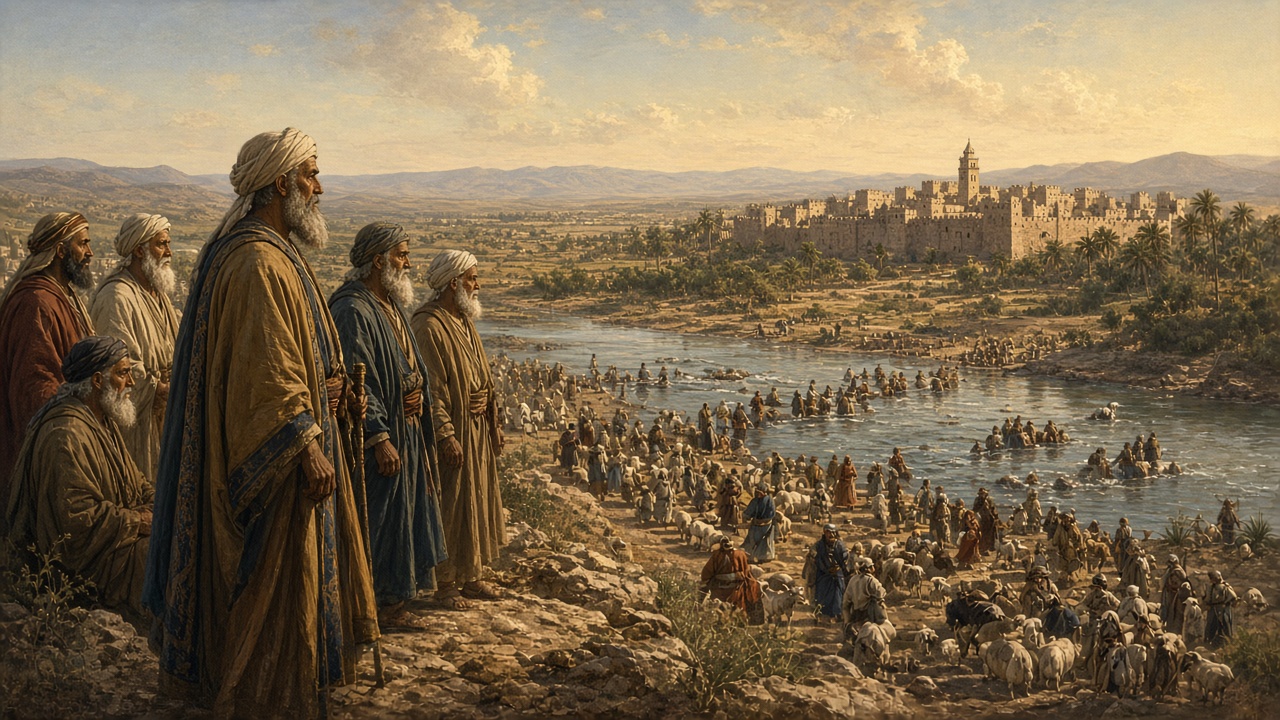
- When Joshua took command, the people were encamped at Shittim. They crossed the Jordan and camped at Gilgal, where, Easton says, he circumcised the people and kept the Passover. Jericho, a fortified city among palm trees about five miles west of the Jordan, is described as Canaan's strongest fortress and the key to western Palestine; Ai, east of Bethel, was the second Canaanite city taken, after an initial defeat.Sources: Easton: Joshua · Jericho · Ai
- Easton's Bible Dictionary (1897) says Joshua conquered six nations and thirty-one kings, then divided the land among the tribes, with Timnath-serah in Mount Ephraim assigned to himself. East of the Jordan, Gilead is described as a mountainous region held by the tribes of Gad and Reuben and the southern part of Manasseh.Sources: Easton: Joshua · Gilead
- Quoting Edersheim, the dictionary says Joshua's name was changed from Oshea, "help," to Jehoshua, "Jehovah is help," and notes that he is called Jesus in Acts 7:45 and Hebrews 4:8. It states that he died at the age of one hundred and ten, twenty-five years after crossing the Jordan, and was buried in his own city of Timnath-serah; of his father Nun, nothing more is recorded than that he was Joshua's father.Sources: Easton: Joshua · Joshua · Nun
- Before leading the conquest, Joshua commanded Israel's host against the Amalekites at Rephidim, served as Moses' minister, and was one of twelve sent to explore Canaan; only he and Caleb brought back an encouraging report. As Easton sketches the book, it runs from the crossing of the Jordan and the taking of Jericho through years of war to the division of the land and Joshua's last address.Sources: Easton: Joshua
Notes written with AI assistance from open sources (Theographic Bible Metadata, CC BY-SA 4.0; Easton’s Bible Dictionary, public domain) and reviewed before publishing.
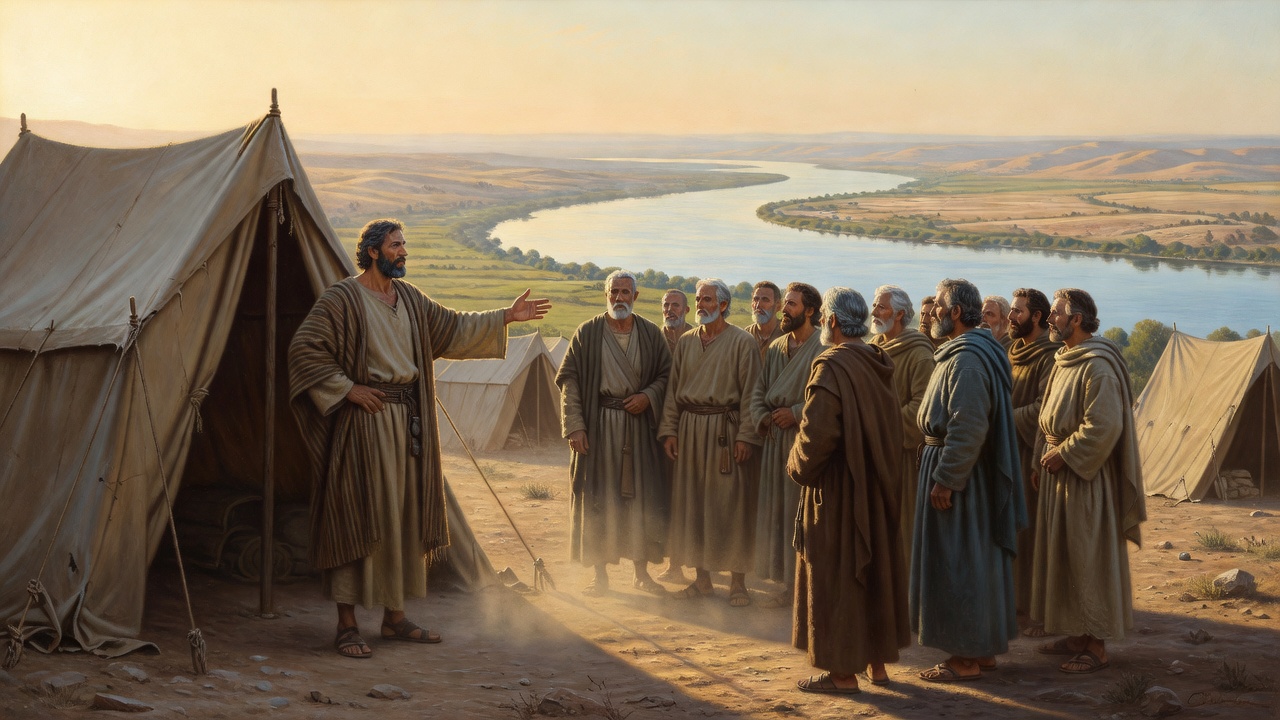
1Toen Moses, de dienaar van Jahweh, gestorven was, sprak Jahweh tot Josuë, den zoon van Noen, die Moses’ dienaar was geweest: 2Mijn dienaar Moses is gestorven. Op! Trek met heel dit volk de Jordaan hier over naar het land, dat Ik hun geven zal. 3Iedere plek, die uw voetzool betreedt, zal Ik u geven, zoals Ik aan Moses beloofd heb. 4Van de woestijn tot de Libanon, en van de grote rivier de Eufraat tot aan de Grote Zee in het westen zal uw gebied zich uitstrekken. 5Zolang ge leeft, zal niemand tegen u bestand zijn! Zoals Ik met Moses was, zo zal Ik ook met u zijn; Ik zal u niet verlaten, en Mij niet van u terugtrekken. 6Wees sterk en dapper; want gij zult dit volk bezit doen nemen van het land, dat Ik hun vaderen onder ede beloofd heb, hun te geven. 7Doe slechts uw uiterste best, om in alles nauwgezet te handelen volgens de wet, die mijn dienaar Moses voorgeschreven heeft; wijk er ter rechter noch ter linker zijde van af, opdat het u overal, waar ge heen trekt, goed moge gaan. 8Dit wetboek mag niet wijken uit uw mond; dag en nacht moet gij het overwegen, om nauwgezet alles te volbrengen, wat er in geschreven staat. Dàn zult ge voorspoed hebben op uw weg, dàn zal het u goed gaan. 9Ik beveel het u dus: Wees sterk en dapper, vrees niet en laat u geen schrik aanjagen; want Jahweh, uw God, is met u, overal waar ge gaat. 10Toen gaf Josuë aan de leiders van het volk het bevel: 11Trekt het kamp door, en gelast het volk: “Maakt proviand gereed; want over drie dagen moet ge hier de Jordaan oversteken, om het land in bezit te gaan nemen, dat Jahweh, uw God, u in eigendom geeft.” 12En tot de Rubenieten en de Gadieten en tot de halve stam van Manasse sprak Josuë: 13Denkt aan het bevel, dat Moses, de dienaar van Jahweh, u heeft gegeven. Jahweh, uw God, heeft u een rustplaats verleend, en u dit land geschonken. 14Uw vrouwen, kinderen en vee mogen in het land blijven, dat Moses u in het Overjordaanse heeft gegeven. Maar gij allen moet als dappere mannen gewapend voor uw broeders uittrekken en hen helpen, 15totdat Jahweh aan uw broeders, als aan u, een rustplaats heeft verleend, en ook zij het land in bezit hebben genomen, dat Jahweh, uw God, hun wil geven. Dan moogt ge terugkeren naar het land, dat Moses, de dienaar van Jahweh, u gegeven heeft aan de overzijde van de Jordaan in het oosten, en het in bezit nemen. 16Ze antwoordden Josuë: Alles, wat ge ons beveelt, zullen we doen, en overal heengaan, waar ge ons zendt. 17Zoals we Moses in alles hebben gehoorzaamd, zo zullen we ook gehoorzaam zijn aan u. Moge Jahweh, uw God, slechts met u zijn, zoals Hij het was met Moses. 18Iedereen, die zich tegen uw bevelen verzet en niet luistert naar al wat ge hem oplegt, zal sterven. Wees dus maar moedig en dapper!
Did you know?
Joshua Assumes Leadership
- Joshua, the son of Nun from the tribe of Ephraim, served as Moses' assistant and military commander before being commissioned to succeed him as leader of Israel. His name means "Jehovah is his help" or "Jehovah the Saviour."Sources: Joshua · the Bible text itself
- The territory outlined in God's commission to Joshua stretches from the southern wilderness and the Lebanon mountain range in the north to the Euphrates (called "the great river") in the east and the Mediterranean ("the Great Sea") to the west.Sources: the Bible text itself · Lebanon · Euphrates · Great Sea
- The tribes of Reuben, Gad, and the half-tribe of Manasseh had already received territory east of the Jordan River under Moses. However, their armed warriors were required to cross over ahead of the other tribes to assist them until the entire land was secured.Sources: the Bible text itself · Manasseh (son of Joseph)
Notes written with AI assistance from open sources (Theographic Bible Metadata, CC BY-SA 4.0; Easton’s Bible Dictionary, public domain) and reviewed before publishing.
Places in this chapter
- Jordan · Today: Jordan River · 31.761, 35.558 · verses 2, 11, 14, 15
- Euphrates · Today: Euphrates River · 31.004, 47.442 · verse 4
- Great Sea · Today: Mediterranean Sea · 31.805, 34.170 · verse 4
- Lebanon · 33.540, 35.584 · verse 4
- Negeb · 31.245, 34.841 · verse 4
- Syria · Today: Aram · 33.511, 36.306 · verse 4
Only places identified with high confidence are shown (90% or more according to the scholarly sources compiled by OpenBible). Period map: DARE (Digital Atlas of the Roman Empire), CC BY 4.0; modern map: © OpenStreetMap contributors; places: OpenBible.info (CC BY 4.0).
Credits and license for this translation
De Heilige Schrift, Petrus Canisiusvertaling, 1939
The Holy Bible in Dutch, Petrus Canisius translation, 1939
Public Domain
Language: Nederlandse taal (Dutch)
Eerste uitgave: Het Spectrum, Utrecht, Brussel, 1939
De Petrus Canisiusvertaling is een Nederlandse rooms-katholieke bijbelvertaling, waarvan de eerste complete uitgave verscheen in 1939. De volledige naam luidt: "De Heilige Schrift, vertaling uit de grondtekst met aantekeningen, in opdracht van de Apologetische Vereniging 'Petrus Canisius' ondernomen met goedkeuring van de hoogwaardige bisschoppen van Nederland". De Petrus Canisiusvertaling is de eerste Nederlandse katholieke vertaling die gebaseerd is op de grondteksten in hun oorspronkelijke taal. Andere vertalingen gingen uit van de Vulgaat. Het taalgebruik van de uitgave is naar hedendaagse normen licht archaïsch te noemen, maar nog steeds vlot verstaanbaar.
Verantwoording in verband met de auteursrechten
In verband met de auteursrechten is contact opgenomen met de oorspronkelijke uitgever (1), de Katholieke Vereniging voor Oecume (2) en de Katholieke Bijbelstichting (3) en werden geen bezwaren gevonden tegen deze publicatie. Rekening houdend met de wettelijke termijnen, kan deze uitgave beschouwd worden als vrij van auteursrechten.
First publication: Het Spectrum, Utrecht, Brussel, 1939
The translation "Petrus Canisius" is a dutch roman catholic bible translation, that was first published in 1939. Its full title is "The Holy Scripture, translation of the original texts with annotations, commissioned by the Apologetical Society 'Petrus Canisius' and executed with the approval of the most reverend bishops of the Netherlands". The translation "Petrus Canisius" is the first dutch catholic translation that was based on the scripture texts in their original language. Other translations were based on the Vulgate. The language of this edition is to current standards moderately archaic, but still easily understood.
Accountability in relation to copyright
Concerning the copyright contacts have been made with the original publisher (1), the Katholieke Vereniging voor Oecumene (Catholic Society for Ecumenism) (2) and the Katholieke Bijbelstichting (Catholic Bible Foundation) (3) and no objections have been found against this publication. Taking into account the legal terms, this edition can be considered to be in the public domain.
UITGEVERIJ UNIEBOEK|HET SPECTRUM BV, HOUTEN, THE NETHERLANDS
KATHOLIEKE VERENIGING VOOR OECUMENE, 'S HERTOGENBOSCH, THE NETHERLANDS
KBS, HOEVEN, THE NETHERLANDS
2024-08-06
Source: http://ebible.org/nld1939/ · eBible.org